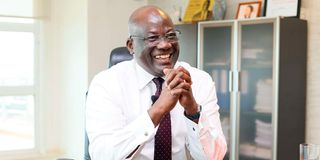
At his prime, Jubril Adeniji, the managing director at Guaranty Trust Bank (Kenya), was a soothsayer; he had guts and charisma—a man who always knew what to say. It was how he dodged trouble as a boy growing up in Nigeria, and how he convinced his mother to let him drive her at the age of 11.
Now, Jubril, who studied maths and finance, has other loves: Rotary club, singing, walking, and a siesta every Saturday from 12pm to 2.30pm, before he slips into the kitchen to flaunt his culinary flair with his chef's special: fish. His family—his wife and children—remain in Nigeria, so cooking became a necessity.
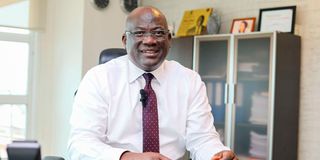
Tall, soft-spoken, and in a blinding white shirt, the father of three is every inch a type A personality: working bone-crunching hours, devoted to extracting every sliver of dividend from his hustle.
“May your road be rough,” he says. “That’s the blessing of my life.”
What’s something interesting that happened to you this week?
I’ve concluded my monthly review meetings very quickly. That excites me because the earlier you can start running your month, the greater the probability of achieving success in that month.
When I strip away the titles of banker and husband, what remains?
Philanthropist. I like to support the less privileged. I’m a Rotarian, and that’s where I spend my extra time.
What drew you to Rotary?
Childhood. Both my parents were presidents of Rotary clubs. I admire what they do. Leadership and touching lives. So, when I went to the university, and I joined Rotaract and became the president of my club.
Rotary requires a lot of time. So, when I went into banking, it was very difficult to find the time for Rotary. When I moved to East Africa, I believed that Rotary was the best place to connect with the right people. I came to East Africa nine years ago joining a club in Tanzania, and I have also joined one in Kenya.
Where did you grow up?
Nigeria. I grew up in Kainji. Kainji is where the first hydropower station in Nigeria is located. And I grew up within a research institute. My father is a researcher.
What did your younger self long for most in life?
To be more successful than my parents.
Mission accomplished?
To God’s glory, I’m still growing. My father has a doctorate, which I don’t have. But truly, am I looking for a doctorate today? No. I think I’m looking for ways to be more successful in other areas.
What kind of home did you want to build differently from the one you grew up in?
Different? Very close to the one I grew up in—a close-knit family. We work together, support each other, and challenge each other.
My parents were close, best friends until my mum passed away, and that’s the kind of home I am building.
You said your mother and father were very close. Do you have the same relationship with your wife?
We do. I’ve been away from her for 10 years. So, you can imagine the kind of relationship you have built that allows you to stay away from home for 10 years. It’s not been easy. I think we built a friendship and a personal relationship, and that has helped significantly to mould the family. I travel to Nigeria over a weekend once in a while.
We both started careers in banking, so she understands the demands of my job, and I understand the demands of her job; we’re able to manage each other effectively, and we respect each other.
What does your family know about you that you’ve kept hidden from the boardroom?
I’m the only son in a family of five. I have two older sisters and two younger sisters. I have a lot of women around me.
Yes, so that’s one thing that I grew up with. What else? Yes, when I’m tired, I sleep. And not too long, three hours are enough.
What kind of father are you?
A very caring one, but also a very disciplined one. Because my parents, my mum specifically, were disciplinarians. Even though I was an only son, she never allowed me to relax at all. But I think it paid off significantly.
Where does fatherhood test you the most?
I should have spent more time with my children. Like I said, I’ve been out here for 10 years. My eldest daughter is 22 now. So, as you can imagine, I’ve been away from home since she was just about 12. I’ve tried as much as possible to catch up when there are critical events and she needs support.
Jubril Adeniji, the managing director of Guaranty Trust Bank Kenya.
Photo credit: Bonface Bogita | Nation Media Group
What do you hope your children remember about you when they’re your age?
The values I’ve left them with. Yes, because I think that’s what I appreciate every day — it’s what my parents gave me. My values are important to me because, at the end of the day, life is short. You get into positions and you think that it’s the entire world. But it will leave one day. And one thing I do is I prepare my mind for the day it leaves.
Do you have any family rituals that you practise?
I’m a Muslim and I practise Islam. My children are stronger Muslims than I am. I’m happy about that. I try to go on the Umrah pilgrimage at least once a year to spend time with God and express my gratitude.
How do you show your self-love?
In Kenya, I’m a part of a group that walks in Karura Forest on Saturdays from 7 am to 10 am. We cover between 15 and 20 kilometres, then have breakfast. I also joined a walking group from Tanzania and it has also helped me to expand my network.
In East Africa, you need friends. You need a few people who trust you and can make other people trust you.
Do you have any hidden talents?
Hidden talents? Well, I like to sing once in a while. Even gospel songs. People ask me, ‘How do you know gospel songs?’ My parents were very open-minded. They allowed us to stay with family and friends who were Christians when we were young. And when we were there, we’d go to church with them.
I have uncles and cousins who are Christians, and during Christmas, we all celebrate together. When it’s Eid, we celebrate together.
Jubril, what is life’s simplest pleasure?
If I have a good life, that’s it. If I can wake up, I can move around. For me, money is not very important, really. I keep telling people that what is important is being able to meet basic responsibilities.
The question is, how much money do you need to live a good life? When money gets too much, I think it creates a lot of other issues that you never planned for. So, I would just like good health and to live to a very old age. My father is 88 now. I would like to be as old as him and be able to support my children and grandchildren.
What do you like to spend your money on?
A nice car. Yes. I like driving. I started driving at 11. My mum ran a distribution business and I used to go out with the driver a lot, so he taught me. By the time my parents found out, my father said, “Don’t let me see your hand on my car.” But my mum was excited.
Once in a while, when my dad was not around, I was like, “Mummy, let me take you to the market.” She’d agree and I drove her. That gave me a lot of excitement and self-sustenance.
Were you a mother’s boy?
I’m her only son. We fight sometimes. She deals with me. Can you see there is a mark here? [points to temple].
I had a small argument with her one night. When I woke up the next morning I came out of my room, she came out of hers, and I passed her without greeting her. She came after me and, unfortunately, as I was trying to dodge her, I hit a broken slab of the toilet top on the window. The rest is history. May her soul rest in peace. She was my most revered icon.
What is the funniest advice your mother ever gave you?
I can see you going around with some girls. Be careful, haha!
What’s a superpower you’d like to possess?
My Group CEO can see the future. He’s making some decisions based on what might happen two years, five years from now. I would like to have that ability too, that instinctive skill to be able to look around and say, ‘See, let’s take a bet on that’. And in five years, it will be a perfect decision.
What’s your most Kenyan behaviour?
I think I ask a lot of questions, which I think Kenyans do. We don’t just get convinced about something easily.
What would you teach the world that you think it should know?
How to be resilient in life. How to see challenges as springboards for success. Life is not easy. May your road be rough; it’s a good prayer because it’s just preparing you for some other responsibilities ahead.
Two roads diverged in the woods. Did you pick the harder one?
I don’t think I’ve ever had it easy. Everything I’ve had in my professional career, I’ve had to work very hard to get it. So, I speak with colleagues and friends, and I tell them that hard work, I believe, is a very critical virtue to success. Yes, divine blessings, very critical. But success is not cheap. You must pay the price for success.
I’m ready to give before I receive. And I believe in the principle of delayed gratification. I don’t consider what I’ll get in return before I do something. No. You told me that’s what you want me to do, so I will give it my best and I hope that something else will come of it. That’s one piece of advice I would give to young people today. Commit. In the course of committing, what you expect will come.
Who do you know that I should know?
I don’t know if you know Eric Kimani of Palmhouse Foundation. He’s a Rotarian. He’s in his 70s. But when you see him, you’d think he’s in his 60s. I went up Mt Longonot with him and his wife, and they got down to the foot of the mountain before me. He’s my Rotarian idol.