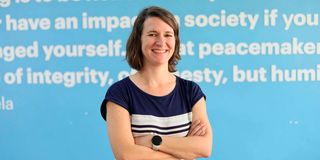
If you want to feel bad about your ear, spend some time with Lindsay Stradley. She is perhaps one of the very few people who can actively control it, or, at least wiggle, her ear up and down, a hidden talent which she reveals and attributes to nature rather than suture.
Lindsay’s ear may turn out to not be the most famous in history—at least not to the level of Van Gogh’s or the high priest’s servant’s ear that was severed and then regrown by Jesus. But that’s just one way to achieve fame; the other one, perhaps, is to move to Kenya and build a sanitation network to transform the lives of residents in low-income areas. The organisation, of course, is Fresh Life. It is here that she is particularly meticulous—or painstaking—you choose, in ensuring the pieces revolve with perfect synchronicity. If God is in the details, Lindsay is a devout believer.
With a professionally friendly voice, she namechecks her love for yoga and running, where her mind drifts and docks on nothing in particular, and any calls made to her during her sessions go unanswered, or, potentially, unheard.
What’s it like to walk in your shoes? I feel lucky to lead an organisation that focuses so fully on core quality of life issues for all urban residents and particularly has such a positive impact on low-income residents who too often have such poor access to sanitation in particular. I feel lucky to be here in Kenya, in such a beautiful country. And even in August, has the best weather in the world.
You moved to Kenya 14 years ago, what's your most Kenyan behaviour? Haha! I think the part of why it immediately felt like such a good fit is that some of my existing behaviours are so aligned with the Kenyan hustle. I feel like I'm always hustling to improve and grow. And so that, I guess that's like part of who I am. And so it feels very Kenyan, even if I brought it with me [chuckles]
What is your best characteristic and biggest flaw? My best characteristic, I think is, I'd say the balance of that energy and hustle and persistence with people. I care really deeply about people and relationships and I would describe myself as pretty empathetic. And so I think it's that balance of like pushing with always a sense of a deep sense of empathy and respect for people that I'm working with, people that we serve. And that balance, I think it's been really effective. My flaw? I'm terribly impatient haha!
What’s your most unCEO behaviour? I think I'm getting better, but can definitely sometimes find myself in the weeds, especially as a startup, as a CEO and co-founder, it means that at one point, there were just a few of us and we all did everything. And so it's hard over time to kind of stop doing some of those small, small things that you do at the beginning like fixing the formatting on documents, because particularly, I'll find myself doing and think this is not a good use of time. Just yesterday I was reviewing our new HR policies, which at a high level are super important and I should review, but when I review things, I can't help but also review the punctuation [chuckles].
As a perfectionist, what area of your life don't you have a handle on? Mmmh. I guess my children, you can never really have a full handle on your children. I had two kids, 10 and 11, both born here. They're unpredictable and, you know, very much their own people.
What's an underrated joy of motherhood? I don't know if it's underrated. So some joys that come to mind are some of the simple things like hugs, which sound like fun. For some, perhaps those are highly rated, but I think too often we think of their accomplishments and, you know, we're going to see them at a performance or a recital and we think, oh, look at my very accomplished child. But I think some of the best are hugs. When we leave for work or they leave for school in the morning, my daughter, who's 10, still lets me walk her into her classroom, holding her hand. And so I keep saying I have to keep doing that until she won't let me do that anymore.
That sounds nice. What have you had to learn about motherhood from how you saw your mother raising you? My mother was also a business executive and worked a lot, and I guess as I do too. One thing that my mother did really well at the time, I didn't understand why she did it, and I don't do it, but I probably should. Every day she would write down the three things she was going to accomplish that day. I have this just continuous to do list, and eventually I'll do them, but it's so long and I lose track. And so I think one thing that my mom did that was really effective was prioritising, and that means choosing the things you're not going to do as well. And I think I'm not so good at that. I just try to do all the things.
What has your child taught you that this boardroom hasn't? Mmmmh. My daughter is very good at listening. She actually just won her class's Nelson Mandela Award for the end of school, where all of the kids in the class vote on one person who's the most empathetic, respectful, and leader. I think part of what her classmates saw is that she's very empathetic, which I think I have, but she is more patient, and she listens like deeply. She wants to listen, to understand, and be present. And often that's actually one of the most important things you can do as a leader with your, and for your colleagues, and for your team.
What do you hope when your child is your age, she remembers most about you? It's funny that I do all these things, and they're like, Oops, I have a great childhood, and they won't remember any of them haha! I hope that she remembers that I prioritised them and doesn't look back and think mummy was always so busy and never had time for me.
What's your self-care routine with all this busyness that you have? Um, I love to run, so, most mornings I run, and I also love yoga. So once or twice a week I do yoga.
What's a tangible benefit you've gotten from either? I run every morning for the endorphins, the energy, get blood flowing, wake up. Yoga is quite physical especially the stretching of it, the athletic benefits, but even more, the mindfulness, there's an intentionality. I like when we have a yoga instructor and they are telling me what to do, and I just flow, do those things, without thinking, and just get to be a little bit outside of my own head.
Where does your mind drift to during yoga? It doesn't really. You are not thinking cerebrally, but it's the only thing in your mind is like those body motions, and so it's a chance to actually be out of your head, and not thinking about all the things that are otherwise in my head.
Where does control weigh more on you—motherhood or leadership? I am comfortable relinquishing control in both when I know someone else I trust has a clear plan and they are going to run with it. I don’t even need to know the plan, just that there is someone to charge. I'm actually very happy when someone else can effectively take control, and I don't need to. So even in my work, I tell all my team members who report to me, that really, they should be in charge of all of their areas. My leadership style is ‘ask forgiveness, not permission’. You should be the expert in each of your areas. You should be making decisions.
If I were to ask your children what mum does for work, what would they say? They would say that I provide great sanitation, particularly in the urban informal settlements. Lakini, they would also say, I used to think that mummy built the toilets, and they were – maybe not disappointed but sort of – confused when they came to learn that my job wasn't physically like building the toilets, and we kind of didn't understand, like, well, what else is there to do? [chuckles] I think the specific part of what I do each day, I guess they would describe as, I go to meetings and I write emails. The boring stuff.
What do you think most people misunderstand about waste? I think mostly people just don't think about it, and that's the biggest issue. A lack of awareness. You know, for those of us who are fortunate enough to have toilets in our homes, we use them and that’s a luxury because we don't need to spend time thinking about dealing with our waste as someone else will do that for us. And for half the world's population, no one's doing that for them.
What did you want from life, initially, that looking back now, you're glad it never happened? Well, in some ways, what I wanted was to work on issues around urban poverty, like ever since I was a little kid. I grew up in Atlanta, the southern part of the US, and just growing up in a city, you see the contrast of the high income and low income more obviously. I always did want to do something that really impacted people's lives—the quality of life—and at the same time, strengthened the economy of urban communities.
What do you want to know that you can’t have yet? When we first started as Fresh Life, I had gone to business school and I assumed that we could solve all the world's problems through business [chuckles]. I have come to realise that most of the things that matter, for them to last, to be done effectively, at scale, long-term sustainably, they have to be done with and through public systems, with government. I still believe that business has a lot of the answers, but they have to be in partnership. For example, here in Kenya, we don't have enough public budget to procure the sanitation services that we need to serve 100 percent of Kenyans.
What cheers you up the most? Seeing people succeed. And while sometimes that's our customers, especially the ones that I met 14 years ago: when I see them now, see where they are. The easiest sort source of energy for me, I guess, is our team. I know there are a lot of members of the Fresh Life staff that have been with us for years, like 14 years since we started, many of whom began as fresh grads and worked their way up both personally completing schooling and professionally. We've invested a lot in them and they've invested a lot in themselves. You can easily see community-level transformation in individual people.
What have you learned the hard way? Partly it is learning that business can't solve all problems and that management are important in making them really well run. Ultimately, you need public support, so not only government, but also that community-level support.
What’s your superpower? Finding energy when it should have run out. And perseverance. And transferring that energy to other people to be with us in this journey; that is what has built this company to where it is.
What will surprise people about how you spend your weekends? I love games and puzzles, especially the 1,000-piece puzzles. We have some wooden ones that are really hard, and each shape is laser cut. I can spend hours doing it with my daughter, and it is partly spending time with her, but also my brain suspends all other thoughts.
What’s your guilty pleasure? Every night before I go to bed, I play Wordle on the New York Times and other crossword puzzles, often with my family but sometimes alone.
Do you have any hidden talents? I am not very good at hiding things haha! And I probably always say more than I should. But I can move my ear [moves ear and chuckles].
Which is the one part of yourself you’ve worked hardest to understand? Letting some things go. Sometimes I keep working at something when it is no longer useful or it is time to go to bed. I have this compulsion to keep going.
What’s the best compliment you’ve received? My son’s friend once told him, ‘I don’t think you have any idea how smart your mother is’. This was out of nowhere, and for him to point it out, about how much I care about other people, that really makes me happy. To be seen.
What quote best describes how you see the world? I love Dr Seuss' book, The Lorax.I can recite the entirety of The Lorax [proceeds to recite the book].
What is the one question people rarely ask you but you wish they would? What I want to be when I grow up [chuckles]. I am fortunate to be doing what I am doing, but it’s quite hard to be seen without what I am doing, so what else would I want beyond the impact we are driving here? But I don’t have the answer, so don’t ask me haha!