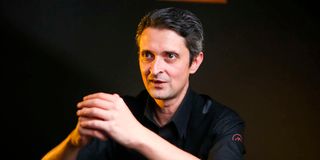
There is a certain gravitas to the way Anup Devani does his thing. An arbiter of taste, a symbol of epicureanism, when he enters a place, people look, not least because of his hedonism, his decency, and his unpretentious use of a waistcoat.
The name of the place is Revolver, a boudoir with a 1920s gangland, bootlegger aesthetic. A place where men spend money for a living, and a tchotchke of mercy-thin knives line the wall, just in case you—never mind. The only sign outside is an insider’s glyph, as cryptic as a page from the Voynich manuscript. If you don’t know what it is, you don’t know what it is. Here, Anup is part wiseguy, part confessor: he pours you a drink, and you pour out your heart. People come here not to get drunk, but to sip the good stuff, to lay it bare on the tongue, layer by layer.
“I was a quiet, awkward child. Now I'm a loud, awkward adult.” That’s not the coda to his success, just part of the Devani magic dust. A clinical geneticist, Anup’s savviness pincers you with its long arms, each word weighted, a paragraph in every sentence.
“I think about closing this bar every week,” he says, “I’ll probably still want to close it next week.”
Then he bums his cigarette. It’s like sitting on the porch of a shack in the middle of nowhere, listening to the saddest old man tell misremembered stories of his youth.
How does it feel to be living your dream? I am adventurous within my bounds. I like doing things that I think I might be good at. Give yourself the step up before you even get to it. I used to play a lot of squash. Now, I started playing padel because I felt like, yeah, I can perform. I’ll try that and see how I can perform.
If I’m being honest, you look like an English actor, Thomas Shelby-esque… That’s sweet, but I emote too much or not enough. Going to drama school was never a thing for me. I was always much more of a scientist in my head.
What are the pros and cons of being you? Pros are that I get to meet some of the most fantastic people that I've had the pleasure of meeting in my life. And I get to have a drink with them. And I get to tell them what to drink, which is great fun for me. Cons are long hours, painstaking thought processes. It's the standard negatives that people have in their lives. Sometimes you deal with people that you don't want to deal with. Sometimes you'd rather sleep in for an extra hour when you've got a day's worth of work already ahead of you. Or a day's worth of thought, or a day's worth of something. Honestly, I do feel like I've lived quite a charmed life so far. I'm starting to feel like the charm might be wearing off. Maybe it’s just a rough patch.
How does someone know it's time to ditch medicine for hospitality? When they have a mental breakdown, maybe. When they think that masochism is the way forward. When you know, making too much money is terrible, and you want to work long hours for far less money. That's when you ditch medicine for hospitality [chuckles].
What makes for a good bar owner? Care. Not worrying exclusively about your bottom line. Worrying about the quality of what happens when you're not here. And just making sure that your staff are trained to your standards and trusting them to do the right thing.
You were an employee; now you are the Big Kahuna. What does it feel like to be a boss? I mean, it's definitely a hard one. There's a sense of responsibility that automatically comes from employing someone. Everything that this person makes, lives and dies with me. So my sense of responsibility is always going to be like, I've got to pay my rent and I've got to pay my salaries. That's the end of it. And doing whatever I can for them in the interim, which feeds into the bigger picture of turning into an honest-to-God adult. Nobody feels like an adult until the day you're paying salaries when you know that you can't pay yourself. I'll figure my way through the world, but they rely on me to make their money, and they should be the first people to make their money.
What does the bill from success look like? Honestly, I've sacrificed free time and doing things that I enjoy. But I'm very lucky that by sacrificing a lot of things that I enjoy, I found something new that I enjoy. I learned how to bartend behind this bar. So I built the bar first and learned how to make the drinks after. But nothing gives you quite as much of a high as a busy night in hospitality; there’s something very visceral about it, a high that just makes you want to come back and do it again.
A high… no pun intended? Haha! I see you there.
What have you learned the hard way? Most things. Financial management definitely. How to not get ahead of yourself when the money's coming in. How to plan longer into the future because volatility isn't something that you'll see day to day, but you'll see it week to week, month to month. It can get pretty difficult. So just making sure that there's enough cash in the bank to get what you need done first, and then all the bells, whistles, and thrills can come later.
Outside looking in, we see a man living his dream. How are you defining ambition now? Ambition is doing well enough to be able to sleep in. Ambition is going out with my wife and friends on a Friday night. I can rarely do these things. I'm living a variant of my dream. I always found being on the other side of a very large table in genetics to be a barrier to legitimately connecting with someone. Even though it's a very big table in its own right, connecting with people across a bar is far simpler. You're never in a position to give them bad news or make their life more difficult for one reason or another. You are here to see them on their way to having a good time.
What is a similarity between science and bartending? Food and drink are biochemistry. Understanding how things work on a chemical basis means that I can derive more flavour than most would be able to, purely by thinking it through in a scientific sense. But then there's also balancing a cocktail. My thought process is much more layered but much more intentional—never losing the soul of the spirit that we're playing with, only adding to it.
Speaking of, which is the one drink that tells the story of your life? Whisky. Scotch whisky, to be precise. I had my first dram of Scotch whisky when I was 24 years old. So I've come through my drinking to get drunk phase, drinking to have fun phase, teenage, whatever, as you go along. But I feel both like I've missed out by having my first whisky so late, but also that it was the exact time for me to understand and appreciate it. It wasn't something that I was drinking to an end. I've been to Scotch distilleries, and I've got to try some of the best whiskies the world has to offer. And every single whisky, every single time I try one, just surprises me in a brand-new way. It's like a mystery even behind a door that I know.
Was this part of your dreams growing up? It's a funny one [chuckles]. I was very much in the shadow of my older brother, who had a lot of dreams, and they changed day on day. And I kind of never bothered with dreams, to be honest. I always thought my brother was smarter than me, so it doesn't matter what dream I have; he's always going to supersede me. Turns out I was wrong [chuckles]. I followed things I liked and understood, like Science, and I ended up being a geneticist. The first thing I do when I wake up every morning is to read a couple of scientific papers that have been lingering in my inbox. I guess in its way, instead of dreaming about something, the dream found me.
What do you miss most about your childhood? Actually, Nairobi in the 90s was awesome. It was so green and chill. I still remember the first time I was allowed to drive a car when I was 16 years old, in 2001. There wasn't the same kind of traffic that you get in Nairobi now. You could basically say, wherever I am, to wherever I'm going, it's going to be 15 minutes. I had an uncle who lived in Karen at the time, and we'd be due at their place at 8 o'clock for dinner. We'd leave Kileleshwa at 7.45pm and it would not even be a problem. Even though we knew it was a city, it still felt like a village back then. You kind of knew everybody that you would come into contact with daily.
What has remained the same for and in you? Everything has changed. I was a quiet, awkward child. Now I'm a loud, awkward adult. Maybe the awkwardness hasn't changed, but I feel like I've kind of gotten past that a little bit.
What did you believe about yourself when you were young that has guided you to here? That I can always pick on my strengths when things aren't going my way. And, it's okay to rely on people. I like doing things myself, but sometimes it's okay to rely on people. And it's okay to ask for help. I was taught that when I was young, I forgot during my adolescence, and I've recovered and understood much better than I know now that I'm getting older.
What does your brother think about you now? In all honesty, I know that he weirdly had this idea of opening a bar at some point [chuckles]. So I think there's probably a little bit of a turnaround from our youth, where if he opens a bar now, he’ll just be copying me. But in general, I think that he thinks well of me.
How are you going against the grain? The drinking culture in Kenya is, unfortunately, a matter of volume and alcohol being a means to an end. I am trying to create an experience for people where they can come and enjoy a drink, and they can enjoy two. Outliers can enjoy three. But we do actively go out of our way to make sure that people aren't here to get drunk. We use better pouring spirits, which means that our price point is higher. And obviously, we're in a fairly high-end part of Nairobi as well. So all these factors do kind of feed into the bigger picture. But the principle is that from a chemical perspective, alcohol is very, very impressive at picking up flavour. The fact that it also makes you drunk is kind of not my problem. Or I don't want it to be my problem.
Opportunity costs? Yeah, but I don't want people getting drunk to be the reason why they're here. I want them to be able to sit back and sip on something and think to themselves, Okay, this is a fantastic drink. And to indulge in it and to appreciate it, and to spend time with it. I actively tax people who want to do shots in this bar. And I've had a lot of pushback for it. And people tell me, Oh, you know, this costs far less at this other bar. I'm like, go to the other bar. By coming here and ordering a shot, you're turning your nose up at my imagination.
What does a bartender like you look at when a customer first walks into your bar? Their mood, actually. Because if they're happy, I want to keep them that way. If they're sad, I want to change that. If they're introspective, I want to talk about their introspection to the end. Being a bartender, and this is a Hollywood cliché for sure, but we do end up being people psychologists—whatever is distressing you, whatever hurts, whatever is happening, you want to let it out.
Are you in your head a lot? Very much, almost constantly.
How do you get out? Sports. It's always nice to hit a ball as hard as you can and back-hit somebody else. It kind of gets you out of the zone. I actually find a lot of joy, or a lot of departure from inside my head, with a lot of stuff that I do. I take care of all the design menus, websites, and all that kind of stuff. And it just gives me an outlet where all I need to worry about is aesthetics without getting cerebral about it.
What's something about your journey that you've never revealed until today? I thought about closing this bar every week since the day it opened.
What stopped you? As it turns out, it's like intimately correlated with my bigger picture. But I still probably want to close it next week.
Where do you still dream of going? I would like for this bar to get recognition, even greater recognition than the standard bar, which seems trite. But, having an African bar legitimately listed in the Top 50 bars in the world, that’s not there because of its marketing power or PR power, but because it deserves it in its own right, and nobody needs to shout about it; it just needs to be whispered in the right people's mouths. I'm not one for personal glory at all. I'll take it when it comes, but I'm not actively seeking it out. I like to know that my hard work pays off.
Was there a single thing that was in your mind when you were designing this? Two of my favourite bars in the world, one in London, one in New York. The one thing that they share is, well, there are two things they share: beautiful aesthetics and low light. Low light is easy to handle. The aesthetics, I wanted to make my own. I spent a lot of time making sure that the symmetry of everything was absolutely important. And that I executed on it as well. Like getting copper-coloured cocktail shakers where silver and gold are easy to come by.
What do you want me to feel when I walk into your bar? Welcome? A little overawed. We know what we're talking about, so you don't need to worry about it. But, mainly welcome. I want the music to remind you of something, but not to take you away from the moment that you're in. If you walk in with somebody, I want you to have a conversation with them. I want you to have a conversation with me. I want you to have a conversation with anybody you come across in this bar.
What's the cost of your ambition? Lack of sleep. Sometimes lack of money. Sometimes, spending too long worrying about things that actually shouldn't matter as much as they do. Really, when it comes down to it, I wish I could spend more time with my dogs. Not necessarily in that order.
When you look in the mirror, what do you hope to see? Somebody better looking than I actually am [chuckles]. I hope that there's always more wisdom behind my eyes than the previous day. I hope that I've learned how to be better myself and to be able to pass that along to other people. And I also hope that today's not the day that my imagination kills me and I can't invent a new cocktail.
What do you know that I should know? Fun fact [chuckles]. There is a bottle of whiskey on my shelf, and there were only 140 bottles of those made, of which only six were allocated to Africa, of which only two remain unopened in the world, and both of them live in Nairobi…and one is here.
What will it take to open that one? Two things: the bottle is appreciating as time goes by, unopened. If I open it, that goes away. But if somebody decides to make me an offer I can’t refuse and decides this bar is all they ever wanted in the world, and they are willing to shell out a shocking amount of money for it, that would be the celebration. And you would be invited [chuckled].