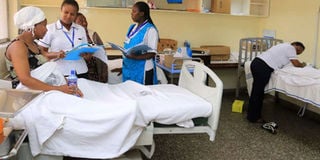
But for this promise to be meaningful, it must reach every woman and child, everywhere in Kenya.
While Kenya has made gradual gains in maternal, newborn and child health with improved vaccination and increased antenatal care, progress in maternal survival has been painfully slow.
Between 2014 and 2019, the maternal mortality rate dropped by less than 2 percent, even as investment increased.
The United Nation's data shows that Kenya’s maternal mortality ratio remains one of the highest in East Africa, exceeding those of Ethiopia, Uganda, and Tanzania.
Newborn and child deaths have also declined slightly and are severely constrained by inequities.
For example, children born to mothers with only primary education face far higher mortality than those whose mothers have secondary education and beyond.
Persistent inequalities continue to deny children a healthy start in life.
Kenya’s maternal, newborn and child (MNCH) services have suffered from fragmented policies, inconsistent county financing, and short-term funding.
Devolution has blurred responsibilities between national and county governments, leading to gaps in planning, poor reporting, and weak accountability.
The Maternal, Newborn and Child Health Bill 2023, proposed by Senator Beatrice Akinyi Ogolla, presents a vital opportunity to change this trajectory.
The Bill seeks to establish a clear legal framework guaranteeing the right to maternal, newborn, and child health services.
It obliges national and county governments to respect, protect, and fulfil these rights through enforceable mechanisms.
Service delivery
At its core, the Bill affirms that every woman and child in Kenya, regardless of location or economic status, deserves timely, affordable, respectful and high-quality care.
It embeds service delivery in the principles of universal access, equity, dignity, availability of essential services, and continuous quality improvement.
The Bill guarantees the right to the highest attainable health for all mothers and children, ensures access to the full continuum of care, including before pregnancy and through childhood and protects marginalised and hard-to-reach communities, such as people living with disabilities or those unable to pay for health services.
It also guarantees respectful, dignified and non-discriminatory care, irrespective of identity, such as age, marital status or social background and strengthens health financing at the county level through mandated country budget allocation for MNCH, among other benefits.
The Bill is more than a piece of legislation; it is a lifeline and a turning point for millions of Kenyan families.
By making essential services enforceable rights, strengthening accountability, and securing sustainable domestic financing, the Bill lays the foundation for people-centred Universal Health Coverage.
Political leadership is aligning behind reforms for women and children.
President William Ruto’s involvement with the Global Leaders Network for Women’s, Children’s and Adolescents’ Health and his directive for real-time reporting of maternal and child deaths signal a strong executive commitment.
Health Cabinet Secretary Aden Duale’s focus on realising the Social Health Authority and robust county leadership further demonstrates that Kenya is mobilising on all fronts.
With government officials, communities, civil society, and health workers rallying together, Kenya stands ready to turn these commitments into action.
As the Bill reaches its final committee stages, now is a critical moment for public involvement.
Citizens are encouraged to contact their MPs to express support for the Bill.
Advocates, experts, donors, and community members must unite and implement strategies to accelerate the reduction of maternal, newborn, and child mortality.
The passage of the Bill will show that “health for all” is no longer just a slogan, but a binding national pledge.
Dr James Nyikal is the National Assembly Health Committee Chairperson, Dr Margaret Lubaale- Executive Director of Health NGO Network and Prof Anne-Beatrice Kihara- immediate former President of International Federation of Gynaecology and Obstetrics