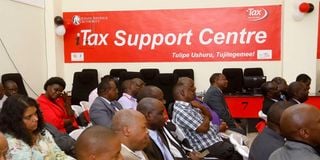
A section of social media platforms has recently witnessed intense public debate about the newly created Small Taxpayers Department of the Kenya Revenue Authority.
A lot of discussions have revolved around a wide range of allegations, including intimidation and unofficial revenue “quotas” by the taxman.
These claims are undeniably serious and deserve scrutiny. Yet they also raise an important question: why would a member of staff take issue with performance targets set to support budgetary needs?
Public officers, especially those working in critical institutions such as the KRA, are well aware that working under pressure is part of the job description.
With a national budget of Sh4.29 trillion and the taxman expected to raise approximately Sh3 trillion, staff must rise to the occasion.
Missing revenue targets is no longer a matter of inconvenience; it places the country at risk of heightened borrowing.
Kenya’s public debt has already surpassed Sh12 trillion, reaching about Sh12.06 trillion by September 2025, equivalent to 67.3 percent of gross domestic product.
This worrying position has been driven by a growing reliance on domestic borrowing alongside maturing external obligations. In such an environment, tax administration is not a casual undertaking; it is a national duty tied directly to economic stability.
Integrity is an inseparable pillar of any tax administration. The Bribery Act 2016 criminalises offering and receiving bribes, placing equal responsibility on all participants in corrupt activities.
If any KRA staff member engages in collecting unofficial revenue from taxpayers, that individual should not only be dismissed but also face the full force of the law. Fortunately, there are systems meant to prevent, detect, and punish such behaviour.
One of its most successful tools is the iWhistle platform, a secure, anonymous reporting system that has strengthened anti-corruption efforts.
Last financial year alone, iWhistle enabled the recovery of Sh6.8 billion from 821 verified cases.
The KRA has consistently collaborated with investigative agencies to prosecute wrongdoers and take action against internal staff implicated in corruption. Only last month, 24 employees were released from duty after corruption-related investigations confirmed misconduct.
Complementing iWhistle are lifestyle audits, the Informer Reward Scheme, which grants whistle-blowers up to Sh5 million, and an Integrity Award Framework that recognises exemplary officers.
These mechanisms raise an important question: why would any staff member choose to engage in collecting unauthorised revenue instead of using the anonymous systems available to protect both themselves and the economy? With these structures in place, many of the online claims circulating appear not only suspicious but inherently unreliable.
Such narratives are far from harmless. If left unchallenged, they can undermine the integrity and independence of Kenya’s tax enforcement processes. Kenyans deserve an effective and efficient tax system that is capable of safeguarding economic progress.
Several reforms are currently underway, targeting the modernisation of technology, sealing revenue leakages, and creating a predictable environment for businesses.
This is bound to rattle some parties who have for years thrived on loopholes for personal gain.
Okoth Agonda is a Tax Communication Expert and Adviser