Time flies with great content! Renew in to keep enjoying all our premium content.
Prime
UN Nairobi summit a moment for environmental action, not pledges
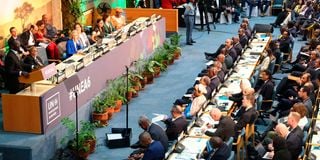
President William Ruto delivering his remarks at Unep headquaters in Nairobi on February 29, 2024 during the sixth session of the United Nations Environment Assembly (UNEA-6).
As global leaders gather in Nairobi this week for the seventh session of the United Nations Environment Assembly (UNEA 7), the spotlight once again falls on Kenya, the host of the United Nations Environment Programme and a central voice in global environmental dialogue.
The summit comes at a time when climate shocks, pollution and biodiversity loss are colliding faster than countries can respond. The theme ‘Advancing sustainable solutions for a resilient planet’ calls for one thing above all: implementation, not rhetoric.
Kenya enters this assembly with renewed purpose, sponsoring three resolutions that address emerging threats and overlooked opportunities.
The first is on the environmental dimensions of antimicrobial resistance. With medicines and antibiotics often improperly disposed of in rivers, dumpsites and public facilities, antimicrobial resistance is becoming a silent ecological crisis.
Agencies such as the National Environment Management Authority, the Health ministry and water authorities can use this resolution to strengthen waste management standards, enforce producer responsibility and upgrade disposal systems in health centres and counties.
The second resolution is on the environmental sustainability of artificial intelligence (AI). As Kenya pushes its digital economy agenda, AI systems are expanding through data centres, cloud services and tech hubs.
These systems require massive energy, minerals, water and hardware. Kenya’s proposal calls for global guidelines that promote renewable-powered data centres, energy-efficient algorithms and circular systems for electronic waste.
With Konza Technopolis and the ICT Authority championing digital innovation, Kenya is well-positioned to lead the conversation on green AI in Africa.
The third resolution taps into one of Kenya’s greatest assets: sport. As a country known worldwide for its athletics, marathons and rugby culture, Kenya understands the power of sport to shape behaviour.
Through the Sports ministry and national federations, this resolution can link environmental education to sports, turning stadiums, training camps and competitions into platforms for climate awareness, waste reduction and cleanups. If taken seriously, the sports ecosystem can drive environmental action in ways policy alone cannot.
Beyond these resolutions, UNEA 7 must elevate nature-based solutions to core investments. From mangrove restoration in Lamu to dryland regeneration in Baringo and rangeland restoration in the north, communities are proving that locally led work delivers real resilience. These efforts need sustained funding, not pilot-level support.
Environmental markets also require clearer rules. Carbon credits, biodiversity offsets and ecosystem service payments hold promise but often fail to benefit communities.
This Assembly is a chance for member states to demand transparency, equity and safeguards through the Ministry of Environment and national regulators.
For Kenya and East Africa, this Assembly is more than an event. It is a platform to influence global priorities, attract investment and highlight the region’s leadership in restoration, clean energy and community-driven climate action. UNEA 7 should mark a turning point from environmental aspiration to tangible and measurable transformation.
The writer is a climate action enthusiast and a communications specialist at Windward Communications Consultancy.
Unlock a world of exclusive content today!Unlock a world of exclusive content today!