Time flies with great content! Renew in to keep enjoying all our premium content.
Prime
Lessons from Brazil’s Atlantic Forest
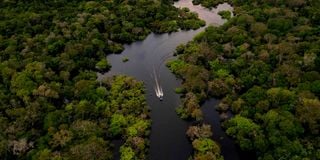
Aerial view showing a boat speeding on the Jurura river in the municipality of Carauari, in the heart of the Brazilian Amazon Forest, on March 15, 2020.
On October 19, 2025, together with other participants in the Yale University Environmental Leadership and Training Initiative, I arrived in Porto Seguro, Bahia, Brazil. It was here that the Portuguese first set foot centuries ago, forever changing the destiny of this land and its people.
My journey here and my participation in the programme were among the most significant in my career. It brought class knowledge and theory to life, showing how history reshaped nature and how we can help it heal. The experience also deepened my conviction as a storyteller and climate action advocate.
For one week, we travelled across southern Bahia, a region where the Atlantic Forest, once vast and continuous, now survives in scattered fragments. Yet within those remnants lies a powerful story of recovery, where science, culture, and community are knitting back life into the land.
The Veracel Ecological Station shows how degraded forestlands can heal through natural regeneration supported by research and local commitment. Here, every seedling is tracked and every tree restored with purpose. It is the kind of long-term vision Kenya’s 15 billion trees initiative can draw from, combining the Kenya Forestry Research Institute’s research services with community-based monitoring.
Pau-Brasil National Park, one of the last strongholds of the ancient Atlantic Forest, will teach you the importance of protecting what still stands while restoring what has been lost. The park thrives because surrounding communities see conservation not as exclusion but as a partnership.
It reminds us that Kenya’s protected landscapes, from Mau to Kakamega, can only endure if local people remain part of their story.
Pau-Brasil Rural Settlement, where families who were once landless grow cocoa beneath native trees under the cabruca system, keeps the forest canopy intact while producing food, showing that land reform and ecological restoration can work hand in hand. The shamba system could evolve in a similar direction with stronger ecological safeguards and farmer training.
In Teixeira de Freitas, the Arboretum Programme stands tall in its work on forest diversity through seed collection, nursery management, and research.
It unites institutions, scientists, and communities under one coordinated restoration effort, a model Kenya could emulate to secure native species for its 15 billion trees campaign.
The Egídio Brunetto School of Agroecology trains small-scale farmers through a hands-on model that blends classroom learning with practical fieldwork. It proves that restoration and food sovereignty can grow together, a lesson Kenya’s agricultural training institutions can adapt.
At the Jaqueira Indigenous Reserve, the Pataxó people demonstrated how culture and conservation coexist.
Their indigenous-led tourism preserves both biodiversity and identity, echoing the struggles and resilience of Kenya’s communities, such as the Ogiek and Sengwer.
Kenya should learn from Brazil, rooting every tree in research, community, and culture. This will not just restore forests; it will restore hope, because every forest tells a story, and Kenya’s is still being written.
The writer is a climate action enthusiast and a communications specialist at Windward Communications Consultancy.
Unlock a world of exclusive content today!Unlock a world of exclusive content today!