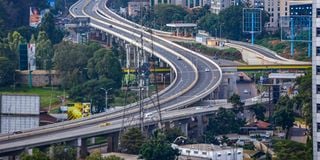
The Treasury has revealed a Sh103.76 billion termination or break fee that Kenya will pay to the owners of the Nairobi Expressway should the 27-year public-private deal be terminated prematurely.
The disclosures show termination of the Chinese-backed expressway dwarfs all other public-private partnership (PPP) break fees, underscoring the extent to which its owners sought to protect themselves from regime transitions in a country where new administrations have cancelled or revised mega projects.
Locally incorporated Moja Expressway, a subsidiary of China Road and Bridge Construction (CRBC), built and funded the construction of the 27.1-kilometre super highway and will recoup its investments from tolling over 27 years.
It was constructed under the previous administration of Uhuru Kenyatta under the PPPs to finance the construction of highways and other infrastructure after public debt ballooned.
Termination fees of Nairobi's expressway account for more than half of the Sh203 billion in PPP break fees for 11 infrastructure projects.
The potential payout to Moja Expressway in the event of termination of the deal set to run to 2049 is equivalent to 29.03 percent of the projected revenue of $2.765 billion (about Sh357.35 billion) over the 27 years.
It is also about 82.17 percent of $977 million (Sh126.27 billion) the firm will earn in the form of dividends and equity release (recoup of capital and returns therein) during the concession period.
The Treasury's disclosures show that while PPPs such as the Nairobi Expressway are structured to shift financing and operational risks to the private investor, they expose taxpayers to hefty fees in the event of the collapse of the deals or State breach.
"Assuming the worst-case scenario of termination of PPP projects due to contracting authority default, the maximum termination sums as at financial close for executed projects have been reported as the contingent liability," the Treasury writes in the Annual Public Debt Report for the financial year 2024-25.
"As of the end of June 2025… total estimated exposure related to termination sum payments amounts to Sh203 billion. Assuming 5.0 percent probability of termination by the contracting authorities, contingent liability associated with PPP projects arising from project termination payments is Sh10.19 billion as of end June 2025."
Under the PPP structure, private investors recover their investments by charging user fees over a defined concession period.
The regime of former President Mwai Kibaki enforced the PPP Act in January 2013, banking on private capital to deliver large infrastructure projects without tapping taxpayers' cash or piling on new loans, and further ballooning the public debt.
The model has so far delivered 11 projects, with the Nairobi Expressway being the largest and most commercially significant. Moja Expressway collects tolls of between Sh170 and Sh500 from motorists in a 27-year operating agreement after the road opened in May 2022.
The road, which cost Sh70.78 billion to build, runs from Mlolongo in Machakos County to Westlands in Nairobi.
However, despite the high traffic volumes on the PPP flagship infrastructure project, the concession is currently operating at a loss.
Motorists, for instance, paid Sh7.16 billion in toll fees in the six months to December 2024, falling short of the Sh9 billion required to cover loan repayments, operations and maintenance, according to the Treasury.
Over those six months, about 12.5 million vehicles passed through the road.
Its net loss widened to Sh1.84 billion in the six months to December compared to a Sh1.2 billion loss in the year to June last year.
The Chinese operator would have absorbed deeper losses had it heeded regulatory calls to cut its toll charges following a drop in inflation and strengthening of the shilling against the dollar.
Kenya National Highways Authority (KeNHA), which regulates the expressway, says that the strengthening of the shilling and lower inflation should trigger a drop in toll charges, which were reviewed upwards on January 1, 2024.
A collapse of the concession—whether triggered by government action, financial underperformance, or legal disputes—would convert the expressway's significant contingent liability into a cash payout, straining the already tight Exchequer.
However, Treasury officials caution that termination payouts are unpredictable and can only be calculated according to contract-specific formulas, which usually involve compensation for construction costs, financing obligations and projected future revenues.
"It should be noted that the likelihood of occurrence, value, and timing of such termination payments cannot be determined with certainty in advance," the Treasury writes in the report.
"Furthermore, it is unlikely that all projects will be terminated simultaneously, resulting in the aggregate termination sum of Sh203 billion becoming due at once."
While the expressway dominates the exposure list, the Treasury report also reveals liabilities across 10 other PPP projects.
These include the roads annuity programme (Lots 13, 15 and 18), with a combined Sh23 billion termination fee, while energy projects for solar, wind and geothermal PPPs collectively account for more than Sh73 billion.
The Lot 15 Roads Annuity project — which covers urban roads in six central counties of Nyeri, Kirinyaga, Murang'a, Embu, Tharaka Nithi and Laikipia — carries a break fee of Sh8.49 billion.
On the other hand, the exposure for Lot 13 (upgrade of various rural roads across the country) and Lot 18 (urban roads in western counties of Kakamega, Bungoma, Busia and Vihiga) was put at Sh7.29 billion and KSh7.20 billion, respectively, as of June 2025.
In the energy sector, the 40-megawatt Malindi Solar Plant has a termination liability of Sh12.26 billion, while the 40-megawatt Cedate Solar and 40-megawatt Selenkei Solar projects (both near Eldoret) expose the Government to potential payouts of Sh9.95 billion and Sh10.37 billion, respectively.
The 50-megawatt Chania Green Wind Power Project in Kajiado county has a liability of Sh14.71 billion, the 35-megawatt Sosian Menengai Plant in Nakuru (Sh11.52 billion liability) and the 35-megawatt Quantum Menengai Plant, which is also in Nakuru (Sh14.79 billion).
Kenya's PPP programme has mobilised about Sh164.39 billion in private capital as of the end of June 2025, spread across the 11 projects.
However, the Treasury says the PPP model still faces bottlenecks that have led to the cancellation of deals.
"The programme continues to face challenges, including lengthy project preparation timelines and limited technical capacity at some of the contracting authorities," the PPP Unit says.
In 2021, Kenya amended the PPP Act of 2013 to streamline onboarding private investors by reducing the bureaucracy involved in finalising deals.
The PPP (Amendment) Act 2021 repealed the previous Act of 2013, allowing public entities in PPP deals to single-source work in an effort to accelerate projects.
Kenya had previously struggled to attract private investors to PPPs, prompting the legal changes that were signed into law by former President Uhuru Kenyatta.
The subsidiary legislation on the PPP Act 2021 also introduced a raft of other sweeteners, including doubling the limit of fees payable to transaction advisors behind successful PPP projects.
In the changes, the Treasury set the success fee at one percent of the total cost of a PPP project—double the previous one.
A success fee is a conditional agreement whereby a consultant or adviser is paid a set rate if a PPP project's outcome is positive. If the outcome is not positive, there is no obligation to pay the fee. It serves as motivation to the consultants or advisers to do their best and earn the maximum.