When most people picture a holiday, they imagine big resorts, wide beaches, sprawling views, and endless buffet tables.
But there is a new trend taking shape across the country which shrinks the holiday experience into pocket-sized cabins whose biggest plans involve enjoying a nice cup of something steamy on a tiny veranda, as the birds do all the talking. This trend is all about charm and coziness rather than grandeur.
“People always need a certain closeness and intimacy. Because of this, people lived in smaller spaces back in the day, but someone came and sold us the idea that success means building bigger houses even though they make us grow apart. Your children can come home from school and disappear into a bedroom on the third floor while you’re on the second, and you might not even realise they’re home. With a tiny, cosy space you have no choice but to meet, talk and live together, and that naturally strengthens the bond,” says Lina Odero, who not only lives in a tiny house, she also owns four others which operate as Airbnb's.
One of these is a 41-square-meter A-frame cabin, tucked away in the leafy Nairobi suburb of Karen. Though compact in size, the A-frame claims centre stage in its own small compound and distributes its weight across several concrete stilts. Rising in a distinctive architectural design, it commands your attention with little to no fuss.
At first glance, an outdoor dining area and accompanying fire pit greets you to one side of the house while a solitary hammock waves at you from the other side.
Taking the honours, a cushioned bench ushers you up a couple of steps onto a wooden deck that receives you just before you enter the cabin. This landing deck, the host assures, can also double up as another seating area.
“The idea here was to maximise on the outdoors because with tiny houses, you’re not going to spend all your time indoors,” explains Ms Odero. “So, you can sunbathe on the cushioned bench with your morning cup of coffee, have your lunch in the shaded dining area over there, and then when the sun goes down, you can lie in the hammock, then make your barbecue over the fire pit for dinner. And if you want to entertain guests you can host even up to 30 or 50 people outside, the children can run, and no one will feel restricted.”
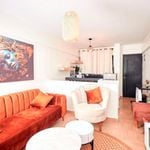
Interior view of a cozy Airbnb at Cozy Retreats, Karen, Nairobi, photographed on November 28, 2025.
Photo credit: Billy Ogada | Nation Media Group
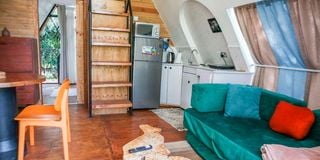
The cabin, which is mostly made of wood and obsessively large windows, embraces an open-plan arrangement for its living space. Employing clever design tricks like retractable surfaces and multipurpose furniture keep the space from feeling cramped even as it boasts of all the essentials: a fully functional kitchen; a sofa that can be pulled out to create extra bedding; an entertainment nook with a bookshelf, TV screen, and games; a tiny dining area; and a workstation that can appear or disappear as needed.
“For tiny spaces, you make them work by using furniture that is multi-functional. I have a piece that can be used as a desk, a storage cabinet, or a side table.”
A sliding door (yet another trick for the limited space) reveals a comfortable bedroom and yet another private veranda outside it where a couple can privately enjoy some quiet time. But this is not the only bedroom the cabin offers; there’s a second smaller, triangular one neatly tucked into the roof, right above the main sleeping area.
“I hadn’t thought of that loft initially. That space was just going to be the roof for the main bedroom, but I was sitting there one day and I thought, this roof is a bit too high, am I really going to waste it all on the bedroom?”
Thanks to her quick-thinking, the cosy A-frame can now comfortably accommodate a group of four people.
“I receive all kinds of guests, from solo travellers to small groups and families of like mom, dad, and two children, but the cabin is extremely comfortable for couples who are the majority of my guests.”
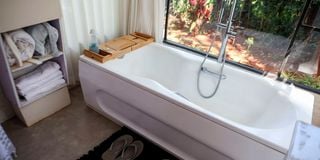
The final feature of the cabin, which both Ms Odero and her guests unanimously agree is the best part, is the bathroom. With a bathtub, a standing shower, heated water, and surrounding floor-length windows, this charming bathroom ramps up the cabin’s luxuriousness, lending heavily to the idea of relaxation and letting go.
“I always say to make a tiny house special, one should do one grand and luxurious thing. For this house, it’s the bathroom,” she discloses. “It’s nice and spacious and has a garden right outside so you can soak in the tub with a drink and enjoy the view.”
Touch of sustainability
As far as sustainability goes, Ms Odero believes the size of the house already makes it so, because you use less of everything – money, materials, utilities.
“Then I added recycling on top. The wood was from pallets that had been used for something else, there’s second-hand furniture and a door that I got from the flea market, and the dining table used to be a roadside culvert that I rescued and glued a tabletop on one end. There’s also a log table that I bought from my neighbour who had chopped down a tree and was selling it as firewood.”
Interior view of a cozy Airbnb at Cozy Retreats, Karen, Nairobi, photographed on November 28, 2025.
Photo credit: Billy Ogada | Nation Media Group
This approach, coupled with the fact that rather than hiring a contractor for the one-year-long project, she choose to do it herself, summed up the construction cost to Sh1.5 million.
The location also adds to the appeal, with the options of malls, water sports, nature trails, a museum, animal sanctuaries, and even a spa just minutes away. Unsurprisingly, the cabin has won over a handful of loyal regulars whose preferences: favoured robes, preferred temperatures, whisky glasses, and wine openers, are now etched into her memory.
Her usual rates are Sh10,000 per night, but they rise to Sh12,000 during the festive (high peak) seasons.
Happiness sanctuary
Another tiny house making big waves is the Citronella Mountain Cottage in Nanyuki. Born from an old 10,000-litre water tank split in half, the cottage is half metallic tank and half timber structure and occupies a total square footage of 18ft by 18ft.
A self-proclaimed lover of tiny houses, Obadiah Mwaki Mwirigi had already spent considerable hours following the European tiny living movement, but it was a trip to the Northern part of Kenya that successfully inspired him to build one of his own.
“During this trip, I saw how the Samburu people live. Most of them have small manyattas, but they are very happy people,” he notes. “After experiencing a wonderful three-day stay in a manyatta myself, I realised that happiness doesn’t come from having a lot – it's simply about appreciating the little that you have.”
Fired up and armed with Sh100,000 and the intention to complete construction in three months, he flagged off the project soon after his return home. But things didn’t go according to plan. Construction ended up taking a whole year, and his initial capital was long gone by the time he was done with just the flooring of the house.
Still, the result is a fully furnished, self-contained cottage built for two.
“There is a market for this kind of concept, and it’s very diverse. We see a lot of international travellers, but there are also some Kenyans who enjoy the experience,” Mr Mwirigi says.
Though compact, Citronella Cottage is surprisingly spacious. A double door makes it easy to move furniture in, while a veranda and outdoor seating area extend the living space. Inside, there’s a foldable wall-mounted table, a snug couch, a 5x6 bed, microwave, fridge, TV, and wooden floors finished to a high standard.
But the feature that his guests rave about the most is the unique, outdoor bathroom. The shower and toilet sit in a semi-open space filled with live plants and flowers, including a small tree that grew during construction.
“The bathroom is attached to the house but once you open the door that leads into it, you feel like you’ve stepped outside, even though you’re still inside,” he explains. “It gives you a sense of freedom.”
Incorporating a lot of natural light to reduce energy consumption, Citronella cottage further brags of an eco-friendly status with her drainage and septic system which is made of recycled materials including buckets and tyres. A natural seepage from the system also serves in keeping the compound lush all year round.
Though many assume that tiny homes are cheap to build, Mr Mwirigi states that this is a misconception.
“I was guilty of this as well, but quality finishing is never cheap. The beauty is that people appreciate something that has been done well, and this makes the return on investment solid,” he says. “It’s not something you regret.”
Commenting on lessons learnt about creating memorable experiences with limited space, Citronella’s host champions great customer relations.
“Even with a big mansion, if you lack customer service, no one is coming your way. People want the human touch, and that’s not something you can automate even in this digital world.”
To shore up this belief, he decorates the cottage over the Christmas season in a bid to spread the cheer to his guests. And between his efforts and the location, which offers a variety of optional activities including game drives, trips to Mount Kenya, and other local excursions, something is clearly working because, “during Christmas, we don’t even talk about an increase in bookings: it’s an overflow,” Mr Mwirigi says.
Obadiah Mwaki Mwirigi, owner of Citronella Mountain Cottage in Nanyuki, says many large homeowners would realise how much space goes unused if they traced their steps.
Photo credit: Pool
The cottage’s normal rates are Sh7,500 per night, but they shoot up to Sh12,000 during the high peak season.
“If you are looking for an intimate space, somewhere to reconnect and have a great time with your partner, then a tiny home is definitely the answer because it doesn’t allow anyone to run off to another corner. You have to be present with one another.”
Stashed away in Nyeri, is the Forelsket cottage - or as the owner, Wachira Ngatia likes to call it, Forelskie. The name, which is Danish for “House of love”, is a quiet tribute to the construction journey that turned into an unexpected love story.
“I fell in love with the entire process of seeing what I had in mind coming to fruition, and I wanted a name that could accurately capture that feeling,” states Mr Ngatia. “With a Jacaranda tree in the compound, I briefly considered naming it Jacaranda house, but there are so many jacaranda places, so I dropped it.”
The idea of minimalism, backed by the (wrongful) assumption that a tiny home would be cheaper to build, were some of the key drivers of his decision to build a miniature structure, but it goes deeper than that.
“I was afraid that a big project would deplete my finances before I could realise the dream, so I opted for an option in which I could comfortably pour my heart and soul into,” he says. “And I also wanted something intimate where people couldn’t escape one another.”
Having obsessively consumed tiny living content, he began construction of the 52-square-meter build in April 2023.
“I completed the entire shell of the house in three months, but the finishings and landscaping took a bit longer and I ended up listing the house in December of that year.”
The shell alone cost him about Sh1.7 million, an amount that rose significantly once he added the finishing touches that give Forelsket her personality.
Though it was a challenge designing the house and its fittings, the result is a homely space where all the basics are covered: cooking, sleeping, and shelter, and each feature is intentional.
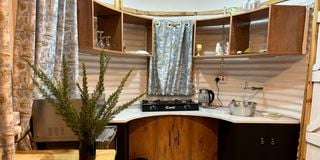
The open plan kitchen, which is one of his favourite spaces in the house, comes fitted with modern, luxurious amenities, including custom-made cabinetry and counters.
Then there is the retractable TV console table, a sofa which can turn into a bed, and a pergola which allows guests to enjoy fresh air, shade from the elements, and a nice blend of both the indoors and outdoors.
“When you receive guests in a tiny house, they don’t have to go into the house. So, this pergola acts as an extension of the house while allowing you to decorate and add plants there. Simply put, it offers the best of both worlds.”
The landscaping, in which he pulled no punches and oversaw every step himself, is one of the things his guests appreciate the most about the house and is perhaps his proudest achievement.
Another thing that is a hit with guests is the ambience and the lighting features.
“There are lights all around the place and they come alive at night. And then inside the house, there is a variety of lights to choose from depending on one’s mood.
Guests at the Nyeri-based house typically range from solitary people looking for serenity, grounding, and calmness, to couples and groups of friends that just want to get away from the usual hustle and bustle of their lives. And though it’s listed for three people, the cottage comes with a spill-over wooden cabin which can accommodate a couple of people.
The backbone of Forelsket’s bookings, Mr Ngatia says, is formed by return guests and referrals.
“They are the ones who keep the lights on,” he says with a smile. “Some of them even keep the place a secret out of fear that it will become too popular and hamper their access.”
Among his regulars is one whose first visit is still fresh in Mr Ngatia’s mind.
“He was going to Nyeri for work and simply needed an area with a workspace for about three days. He was a bit skeptical at first, but when he came, he fell in love with the place and ended up staying three weeks! Now he comes often.”
Bathroom area inside a Cozy Retreats Karen Airbnb, photographed on November 28, 2025, in Karen, Nairobi.
Photo credit: Billy Ogada | Nation Media Group
Preferring to customise his recommendations based on the type of traveller, Mr Ngatia is so honest with his guests that if someone wants a ‘town vibe', he politely warns them that Forelsket may not be the place for them.
“But if they want nature, quiet, grounding, then it’s perfect.”
As such, most of the nearby activities center around that concept and include a waterfall and nature trails about 20 minutes away, bonfire evenings under clear rural skies, and visits to Chaka Ranch for those seeking more activity.
Guests are also free to pick fresh vegetables from the small kitchen garden in the compound, which adds a charming, yet sustainable detail to the compact home.
The biggest challenge so far has been maintenance.
“You have to keep a tiny house very clean. Any mess is immediately visible, so you have to be quick with the rectifications. This also applies to the landscape outside. You have to keep pruning the flowers and cutting the grass. The upside is that it’s a small area so it’s quick to clean.”
Depending on the season, the cottage rates range from sh5,000 to sh8,000 per night. And every December, the House of Love gets a soft festive touch, nothing too loud or shouting, just some subtle decor that reveals itself when you pay attention.
For Mr Ngatia, the whole experience has been “crazy, to say the least.” Forced to learn things quickly, his biggest lessons have been to start with the end in mind, curate every corner of the space beforehand, and be open to constructive feedback. Seeing the journey as one of continuous improvements, he is certain the house will look slightly different in the next year.
“I’m still in the process of making it better. Who knows, I might decide to add some flowers or a new feature like a jacuzzi.”