Time flies with great content! Renew in to keep enjoying all our premium content.
Prime
The Sh45,000 kiondo brings grandma’s craft back to life, supports women weavers
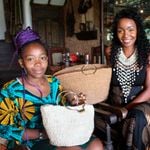
Vicky Ngari displays a sisal-woven bag, or “Kiondo,” at the Cosmology of the Kiondo event held at Hemingways Eden Residence in Nairobi on November 14, 2025.
While abroad, Vicky Ngari saw versions of the kiondo that were “very manufactured and inauthentic.”
“They looked good, but they were not done the right way or with the original sisal material, yet they were being sold for around Sh259,300 to Sh388,950 ($2,000 to $3,000),” she says.
She was working as an assistant stylist in London, UK and got exposed to many global opportunities.
“But I didn’t see African fashion in the way that I envisioned it or in a way that felt authentic, even after it became the in-thing in the global fashion industry,” says the former Miss Kenya and Miss East Africa UK.
Ms Ngari came to the conclusion that perhaps the solution was not in creating something new, but in involving the people who have the knowledge of the original kiondo craftsmanship before it dies away.
But hers was slightly different; she aimed for a luxurious kiondo, but still made the traditional way but with a tinge of modernity.
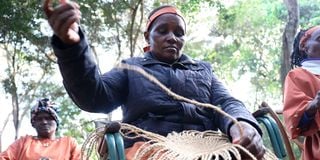
Peninah Nduku weaves a sisal “Kiondo” bag at the Cosmology of the Kiondo event held at Hemingways Eden Residence in Nairobi on November 14, 2025.
Photo credit: Bonface Bogita | Nation Media Group
She started her handwoven kiondo brand called ‘Vicky Ngari’, stocked in boutiques in London, in the Billionaire’s Resort in Malindi, and in the Artisanal Gallery at Hemingways Eden in Nairobi’s Karen. Ms Ngari is also planning a pop-up in Lamu in the near future.
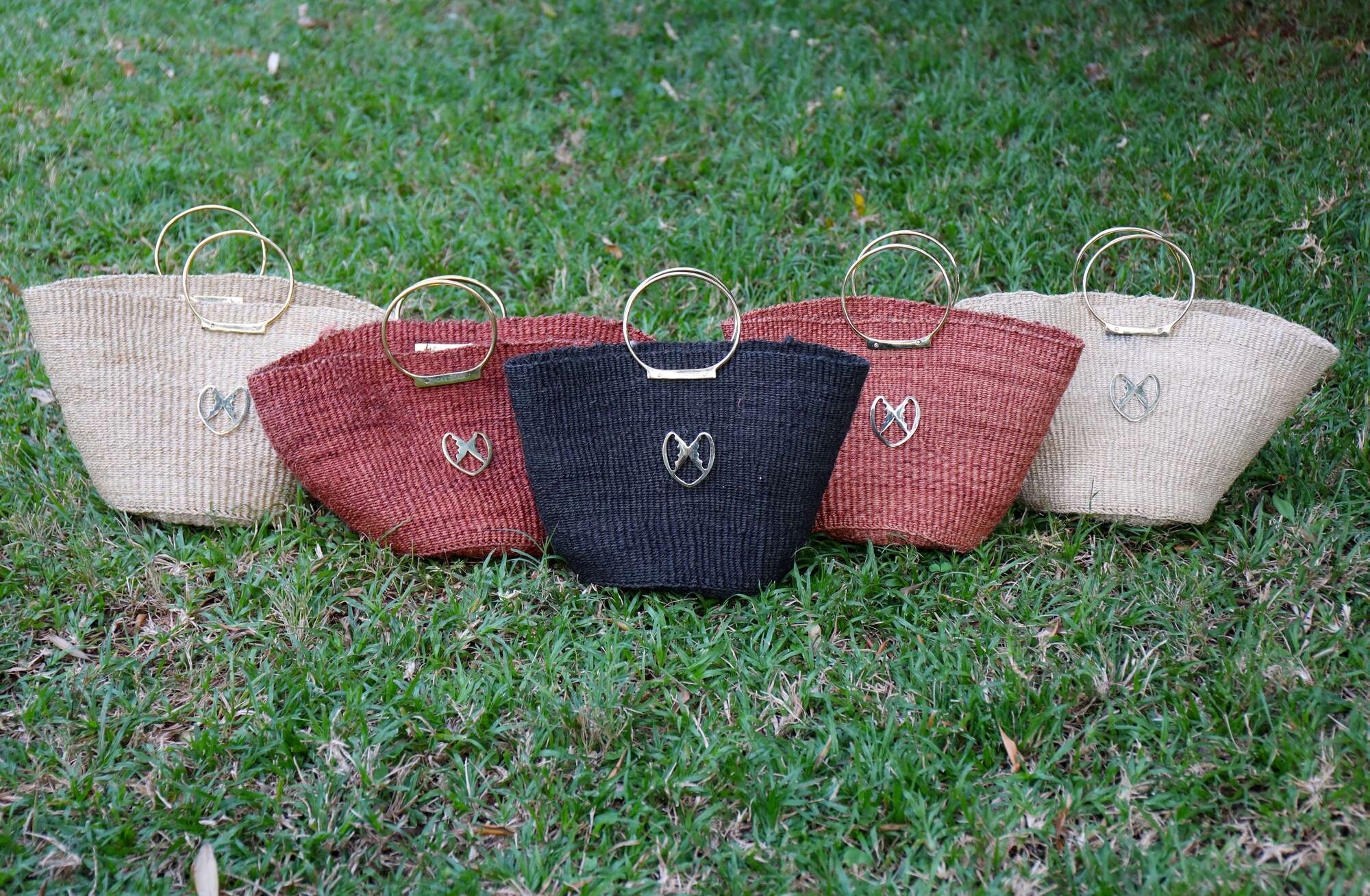
She says hers are different. They are made with natural sisal, brass (logo and handles), and tree bark dye, and are produced in batches of 10. This is reminiscent of the daughters of the Gikuyu clan, including the unmarried one who is often overlooked. Each kiondo comes with a certificate of authenticity, just like luxury goods like Chanel or Louis Vuitton.
The prices range from Sh10,000 to Sh45,000, depending on size.
Agikuyu culture
To make the kiondo as grandmothers made it, she got in touch with Prof Joseph ‘Mukuyu’ Kamenju, a lecturer on architectural history and theory. His guidance helped open Ms Ngari’s eyes to the world of weaving, as seen through the lens of the Gikuyu people.
A sisal-woven “Kiondo” bag on display at the Cosmology of the Kiondo event held at Hemingways Eden Residence in Nairobi on November 14, 2025.
Photo credit: Bonface Bogita | Nation Media Group
“The Gikuyu never crafted anything without a purpose. They encoded so much into their artefacts,” she says. “Like the way the kiondo is woven in a spiral cone shape, with the centre starting at the bottom. This is the same way the Gikuyu people came together to dance around a tree whenever they were celebrating. The wefts and warps mimic how the men and women wove their hands together as they danced, with the men placing their arms on the women’s shoulders, and the women weaving theirs around the men’s waists.”
The same weaving technique was also used as the Kikuyu people of old built their houses.
Speaking at the official launch of ‘Vicky Ngari’ bag collection at Hemingways Eden in Nairobi a few weeks ago, Prof Kamenju added some insights.
“According to Kikuyu culture, everything started when Gikuyu met Mumbi, but it’s important to note that the woman pre-dates the man in that story and was seated somewhere just waiting for him. She is the essential life form, and this is why the Kikuyu are matriarchal in nature,” he said.
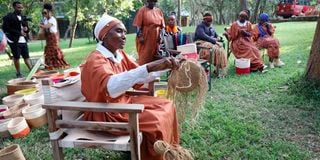
Messry Lung'atso (left) and Felister Chepchumba at the Cosmology of the Kiondo event held at Hemingways Eden Residence in Nairobi on November 14, 2025.
Photo credit: Bonface Bogita | Nation Media Group
“Now, when the kiondo is being woven, it starts at the centre (the navel) with four strands. These are symbolic of the woman before the man comes in. The man comes in when the two strings are added to hold the four together, and then it begins to go round and round in an ever-winding circle.”
If you go on to decode the kiondo, the professor said, it shows the stages from conception to baby, baby to child, to young man, married man, old man, and then death.
“In the old tradition, they would even put in the initiation ceremonies that are evoked from one stage to the next,” he said. “This is why it is said that when the woman is weaving, she is actually encoding the memory of the entire tribe.” But with the erosion of African culture, some of these ideals have been lost, and these are precisely the ideals Ms Ngari hopes to restore with her kiondos, even as she continues to learn.
“My bags now are completely plain and in one colour, but I am committed to doing many different versions with different messaging as we develop. But as simple as it is now, Prof Kamenju assures me that it suits the times perfectly, with how far we’ve strayed from tradition.”
Anastasia Mwikali (left) weaving a sisal-woven bag, also known as a “Kiondo,” at the Cosmology of the Kiondo event held at Hemingways Eden Residence in Nairobi on November 14, 2025.
Photo credit: Bonface Bogita | Nation Media Group
Beyond fashion and culture, however, Ms Ngari is also using her kiondos to empower women.
Her regular group of weavers come all the way from Naivasha and Matuu.
Peninah Nduku, a mother of three, is one of them. She was taught to weave as a young girl by her grandmother. She also learnt the technique in primary school while studying art and craft. Now, this is her source of livelihood.
“I dropped out of school after Class Eight and got married soon after. This is what supports my family and puts food on my table. It has also taken all my children to school,” she says.
Other beneficiaries
The other beneficiary is Beyond Fistula, an NGO that supports women with fistula. Ms Nduku counts the experience of teaching them how to make kiondos as one of the golden opportunities that her craft has offered her.
“We taught them to make finished products, sell them, and earn money. We’ve stayed in touch with some of them, and they say they’re doing well. It brings me a lot of joy to know that I touched someone’s life in a positive way.”
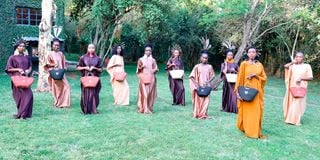
Female models displaying sisal-woven bags, also known as “Kiondo,” at the Cosmology of the Kiondo event held at Hemingways Eden Residence in Nairobi on November 14, 2025.
Photo credit: Bonface Bogita | Nation Media Group
Her challenge, however, has been in finding the time to weave.
“I still have to do my household duties, so sometimes I’m too busy with the day-to-day responsibilities to find time to weave. In such instances, I’m forced to either sleep very late or wake up very early to make up for that time.”
For Janet Mwende Kioko, 49, weaving offered her a helping hand when she was at her lowest.
“My husband passed away in 2018, leaving me alone with our four children. To provide for them, I learned from the older women how to weave kiondos, and that is what has fed us, kept a good roof over our heads, and educated all my children. I owe everything to this work.”
She also credits it for her wellbeing and overall positive outlook in life. “When you weave, it’s difficult for your mind to be idle or get into a depressive state. It keeps you busy all through since you can even do it as you walk.”
For Anastasia Mwikali, 54, her weaving journey began back in 1999 when she had only two children.
“In our village, there is no other work for us to do, so this was the only way for me to support myself,” she says. “I used to help my mother make the sisal strings as a young girl, so I knew that from an early age, but the actual weaving I learned later in life after I was married and had children, and life became extremely difficult.”
Ms Mwikali says her husband’s income is really meagre and inconsistent and can barely support them and their six children. The income she gets from selling her kiondos really boosts their upkeep.
Having passed on the craft to her children as well, she believes the practice of making a kiondo has helped them not only bond as a family, but it has also given them a foundation on which they can build a financial future for themselves.
“We really have a great relationship with my children, and I like that whenever they need some money for something, they are able to make some sisal ropes or kiondos, sell them, and get their money.”