Privilege. This word is ingrained in Isaiah I.C. Wakindiki’s very being, shaping his identity. He does not play down his skills or blessings, but presents them as fully earned, while also identifying with the streets he grew up on in Irundini village, Mukothima, Tharaka Nithi.
He plays the greatest hits from that album. Growing up Methodist. There were lorries that would screen movies in the village square. “Every two weeks,” he says, “We would have mobile library services and use our library cards to borrow books.” Little wonder then, to reach for a trite metaphor, that his family is full of professors, he is the Vice Chancellor of KCA University himself.
Yet his younger brother is now the Deputy President of Kenya, and seeing that he, too, fiddled with politics, does he ever get jealous of him? After all, envy is the most prevalent human emotion. “No,” he says, “How can I be jealous of God’s favour? It’s a privilege.”
For Prof Wakindiki, more than just a bean-counting vice-chancellor, life’s joy is walking around and people calling him, “Mwalimu.” Teacher. You can tell because for every answer, he cites an example.
Prof, tell me something cool about yourself.
When I was young, I had measles. My mum took me to a hospital about 20km away, and by the time we got there, I was reeking. I was covered in flies, the nurse said, ‘This child is dead. Go and bury him.’ I was not dead. And that was my first resurrection.
Do you think you’re a lucky person?
No, there’s no luck. But to sit here is a privilege. It’s not luck. My parents are alive, and that’s privilege, not luck.
What do you mean by ‘privilege’?
I’ve had privileges in life, not lucky. My family and my both my parents are still alive. Having gone to school and succeeded, I think that’s a privilege. So I see myself as a beneficiary of privileges.
On the subject of this office, what’s the least VC-like thing you’ve done lately?
I am not conventional, because, often, when we become too conventional, we miss the details. Currently, we are having student elections, and they keep calling me or getting my attention as VC, but I refuse to intervene because they have their own electoral body. Let them sort out their issues as students. My role is to facilitate.
What’s boring about being you?
Being forced to behave in certain ways, contrary to my beliefs. What did you ask me?
The boring part about being you.
Oh, yes. I get bored because of things like the many governance organs we have in the university. I’m not the ultimate. And there’s nothing ultimate in this world. Even the President is answerable to the people, so it’s a cycle.
I am impatient with people who condone mediocrity. As I’m saying, this is a position of privilege, and as vice-chancellor, my decisions should improve people’s lives and livelihoods. Not me.
When we think about the world you occupy right now from the outside, we only see academic gowns and suits. Where do you go when you want to be just Isaiah?
I like spending time with my family. My biological family. I also belong to a religious group called the Methodist Church. I’m a lay preacher there. In my neighbourhood, we have a third layer of family, and we meet once in a while, like presently we are working on the water supply in the area.
That’s a very media-trained answer.
Haha!
What are you secretly good at?
I’m a very empathetic person, despite my privileges. Because if it were not for some interventions in my life, I could be a resident of Mathare Area 4. There’s nothing I could have done about it. If it were not for the privileges I had along the way, I could be in Kibera. I hope that is not media trained [chuckles].
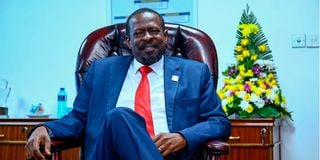
KCA University Vice Chancellor Professor Isaiah Wakindiki at his office in Nairobi, on October 15, 2025.
Photo credit: Wilfred Nyangaresi | Nation Media Group
What’s something you do that has nothing to do with science or academia or soil?
Reading, especially biographies. In my car, I carry a book all the time. I read one, I finish it, and get another. Because I have the privilege of having a driver, I’m busy reading a chapter.
Which one are you reading now? And why specifically biographies?
I like biographies of world leaders. Currently, I’m reading about [Vladimir] Putin, of Russia, and how he has managed right from where he was born, and his parents and his involvement in the KGB, all the way to the presidency. It’s very intriguing to see what privileges he had in life that put him there.
Is there a biography you’ve read that has resonated with you at a personal level?
Abraham Lincoln. This gentleman became a lawyer out of sheer privilege; he never went to any formal school. Eventually, he became a lawyer and one of the most successful American leaders. He is known for two things: ‘The buck stops here’, which is taking responsibility in his leadership. Secondly, after winning the election, he appointed members of his opposition to government positions. They call that a ‘Team of Rivals.’ In other words, I built my leadership among people who directly oppose me, it’s only that my position has no election, I would have appointed my rivals as DVCs (deputy VCs) [chuckles].
Prof, do the biographies you read shape your thinking or do they reinforce your existing beliefs?
They actually reinforce and modify what I personally believe in. I see myself as just part of the cosmos. Right? Only privilege has taken some of us out. I read somewhere that they refer to us as a family of professors. They say, you know, I sit here as the vice-chancellor. My brother is the deputy vice-chancellor at Chuka University. And I ask myself, what has made it possible? It’s not being lucky. If it’s a requirement of the vice-chancellor, I meet it, ditto my brother, who used a different path. My other brother is somewhere else in politics. It’s a privilege.
You’ve spoken about privilege quite a bit. Do you feel the weight of it in your interactions, if at all?
I’ve never hidden my talent. Firstly, because of my belief. I’m a Christian, and a strong one, and a practitioner. I don’t shy away from presenting myself in any forum. I’ve even contested to be a Member of Parliament, for example. I was not declared the winner.
That is different from not winning.
Haha! You heard me. I don’t believe I lost. You only believe you can win or lose in a fair system. Even the person who presided over the elections and declared the president, the late Samuel Kivuitu, said, “I don’t know who won.” [chuckles] I do, however, believe in losing, but I was not declared the winner. And I never took offence.
This is a tricky type of question, but do you ever feel jealous of your younger brother, who is now the Deputy President of Kenya?
We took different paths. My brother used a certain path and there were certain privileges along his way until he is where he is, and one of them was God’s favour. How can I be jealous of God’s favour?
I used my own path even when I was contesting, which did not yield results. It was not because of my brother; it was universal suffrage. I even voted for him when he ran for political office as a senator.
Now I have no interest in elective positions, just as a participant, and I have decided I will be participating at the highest level available in the land. I feel privileged that my brother is the deputy president.
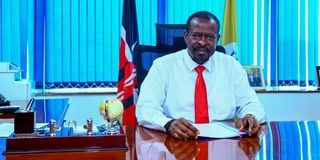
KCA University Vice Chancellor Professor Isaiah Wakindiki.
Photo credit: Wilfred Nyangaresi | Nation Media Group
What misconceptions do people have about you?
Some people expect me to behave like a typical VC. When I came to KCA, they (owners) were looking to sell because they were unable to run it. We had Sh8 million in the bank, with a payroll of Sh93 million. I closed the overdraft account, which was accruing interest at a rate of at 30 percent interest per month. Since then, our reserves have grown to around Sh1.78 billion. I paid off all the debts.
There is what we do, and there’s what I thought as a leader we should do. Stealing is not good. It goes against my faith. Don’t expect me to play the tune. They say, ‘We can take care of you.’ And I say, ‘I am well taken care of’ [chuckles].
What is the most personal item in here for you?
If they tell me to go right now, I’ll just carry my phone [chuckles].
If your life were a patch of soil, what would grow on it?
I would say that my soil would be so balanced that any crop that nourishes human beings would be able to flourish in that soil. Because soil is usually not selective about what grows on it. What determines survival is nutrition. The survival of any crop or plant depends on the nutrition that the soil provides.
What have you learnt the hard way?
I need to be patient. I am generally impatient, especially with slow decision-making and anything that can be done better. But that is not how the world is wired, especially where self-interest is involved. And I need others to run the cycle; they may be the slowest, but I need them.
What have you exchanged for success?
Sacrifice. As a young man, I chose to remain in school, while my contemporaries were involved in so many other things. I kept away. I sacrificed that. For example, I have also learned to say: “I don’t know”; “I don’t want”; “No.” [chuckles]
What are you looking forward to this weekend?
I have a few goats that I keep. Yes. I go and check on them to see how they are faring. I practise my agriculture as a goat and sheep keeper. We call them small ruminants.