Women cyclists choose to ride their bikes for various reasons—fitness, both mental and physical, hobby, networking, community building, or simply as an easy escape from life's stresses.
However, for some, it is an act of defiance, a protest against societal restrictions that often try to dictate that women must never cycle.
These two women have not only dispelled this myth but have done so glamorously, earning medals and accolades at a level where few believed in them.
At 37, the mother of two is among a small but growing number of Kenyan women cyclists pushing boundaries in a sport that is still largely male-dominated, underfunded, and misunderstood.
Alice’s journey began miles away from the well-paved roads of Kahawa West, where we meet her and her daily training circuit. She was born in Nyandarua, the fifth of several children, and lost her father when she was still in primary school.
Her mother fell ill soon after, leaving her and her siblings to navigate childhood amid economic struggle.
“When my mother got sick, I was still in school. No one was around to care for her, so my sisters took her in, and I had to leave home to live with one of them.”
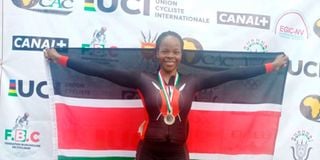
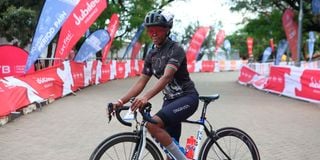
Julia Alice, a professional cyclist displaying a Kenyan flag after a win.
Photo credit: Pool I Nation Media Group
That move took her to Samburu, a place that would quietly spark a lifelong love for cycling.
In Samburu, bicycles were as they are now, not toys. They are essential lifelines. She watched schoolboys glide past on their bikes as dust rose behind them.
“I wasn’t good at it at first. Back in our village in Nyandarua, there weren’t many bicycles. But when I saw how the kids in Samburu used them, I wanted to learn.”
Her elder brother taught her to balance and pedal. She believes the lessons on those uneven, dusty roads made her the cyclist she is today.
Soon she was riding 6km to school every day, barefoot, using her sister’s child’s bike. “It wasn’t much about racing; it was survival, mobility, and curiosity.”
Even then, she was the girl who joined every game, every sport and every race.
Adult-hood slowed down that pace. She completed high school in 2010, joined KCA University for CPA classes, then got married and had her first child.
“By the time my daughter was two years old, I had stopped studying,” she says. “I started focusing on my family.”
Like many young Kenyan mothers, her dreams had to negotiate with household realities.
Then in 2019, she saw a friend post a sleek modern racing bike. Light, fast and nothing like the heavy ‘Black Mamba’ bikes she grew up seeing. Her curiosity came alive again.
“He told me the team was looking for riders and added me to their WhatsApp group,” she remembers. “That’s how I found RDX Cycling Club.”
Entry into the sport wasn’t cheap. She bought a 19kg bike for Sh30,000 — a mobile app loan she took, a risk, and a quiet gamble.
“But I told myself, God has a plan. You start small then purpose to grow.” She trained daily and saw he weight drop from 78kg to 58kg.
Julia Alice Miringu pictured on October 5, 2025 at Nyayo Stadium in Nairobi.
Photo credit: Billy Ogada I Nation Media Group[
Her commitment impressed fellow cyclists so much that within 11 days, they helped her buy a professional bike worth over Sh80,000.
That same year she entered the Tour du Burundi. Her first international race.
A gruelling five-day stage event. She finished in the top ten — a remarkable debut by any standards.
When the races slowed down during the pandemic, Alice did not. She trained whenever she could.
“There were many group rides. I’d leave my kids with their father or my sister, join the group on weekends, and ride to places like Machakos or Mai Mahiu.”
Those were chaotic years, she admits, balancing family love and personal ambition and passion especially, but they brought structure and confidence.
Since then, Julia has compiled a résumé most Kenyan cyclists — male or female — would envy: Kenya Cycling Federation races in Nairobi, Naivasha, Machakos, the African Championships in Egypt where she won three silver medals in paracycling, the Safari Classic Ride, Ride Karura Challenge, Tour de Machakos, and the Jubilee Live Free Ride in 2025, where she placed in both able-bodied and paracycling categories.
Her two children now cycle competitively. “I want them to start early,” she says.
“When you begin young, you learn to understand the bike like a friend.” Their father supports their routine. At home, cycling is part sport, part family language.
Kenyan endurance sports have always been tough for women — the cost, the safety concerns, the time demands. “You can have the talent,” Julia says, “but if you don’t have support, you can’t go far.”
Her journey to becoming a professional cyclist has seen her navigate motherhood, financial pressure, loss, and ambition.
“You can’t think only about medals. You think about what you are leaving behind. The example you’re setting.”
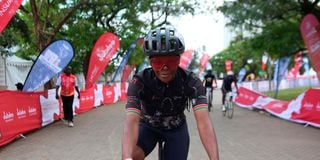
For three weeks every month, Valentine Onchari, 32, kits up, saddles her bicycle and heads out to work—she pushes into traffic for a 25-kilometre ride to the office. She does the same in the evening. 50km a day. Five days a week.
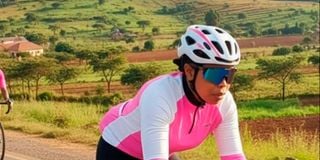
Valentine Onchari, 32, cycles along the Eldoret- Iten Road in August 2025.
Photo credit: Pool I Nation Media Group
“It sounds crazy, but cycling is the one thing that gives me order in a very busy life,” says the project consultant at Japan International Cooperation Agency.
Her love for cycling also began in high school. At Aga Khan High School in Mombasa, she took up swimming and cycling almost simultaneously.
“I was that sporty child. If you needed someone for a race, a swim or a ride, I was there. And I was lucky because my family and the school supported every bit of it.”
She entered her first triathlon as a teenager. She still remembers with great fondness her first cycling outreach, “I must have been around 15 or 16. The details are blurry, but I remember the feeling—just wanting to finish, wanting to prove to myself that I could do it.”
Adulthood rearranged things. She stopped swimming first, then gradually cycled less and less.
“Life happened. School, work, marriage, children—you know how it goes.” Nearly a decade passed without structured riding.
In early 2024, something tugged her back. “It wasn’t planned,” she adds. “Something in me just said: go back. So, I listened.”
The return was anything but glamorous. “My old bike was basically dead. I had no gear. Nothing. And cycling is not a cheap sport.”
She bought what she calls “a proper bike” and slowly rebuilt her kit. “Just the bike alone is a big cost. Then there’s the helmet, lights, bike computer, shoes, kits—before you know it, you’re deep into your savings.”
Her body wasn’t ready either. Years away from the road demanded repayment.
Valentine had full-time work, graduate school, a marriage and two children — no time for long training rides.
So, she built cycling into her commute. “Cycling forces you to plan your day. You can’t wake up late. You can’t procrastinate. With it, my time management got better.”
Her family adjusted to her new routine. “If it’s a weekend race or long ride, they know Mum is out there. And they support me. That is everything.”
Like Julia, she faces the unique dangers of being a woman on Nairobi’s roads.
“I wish I could say the danger is only about traffic, but being a woman on a bike—that’s a different story. You get comments, stares, people thinking you don’t belong on the road.”
She has turned back home on days when her instincts warned her. “Safety comes first.”
Months into her return, she joined a team—the Gravel Riders Club—and entered a race — just to finish, she told herself. She finished fourth.
“Some people have been training consistently for years. I had been back for one year. So yeah, it meant a lot.”
In 2025, she joined a six-member team for the Jubilee Live Free Grand Nairobi Race.
Valentine Onchari along the Eldoret- Iten Road in August 2025.
Photo credit: Pool I Nation Media Group
“Team races are different. You start together. You work together. You draft, you pace, you adjust as a group.” They won the team category. “It was beautiful. Truly. I felt proud of us.”
Cycling has changed her body, her mind, her lifestyle. “Physically, I’m the strongest I’ve ever been. Mentally, it clears my head. It’s free therapy.”
She watches what she eats. Hydrates better. Sleeps intentionally. “My body tells me what works and what doesn’t.”
Her message to women — especially mothers juggling many roles?
“Start where you are. Don’t wait for the perfect moment or perfect bike. And don’t feel guilty. Women are taught to apologise for taking time for themselves. Don’t. Cycling makes me a better mother, a better worker, a better person. You deserve something that fills you.”
Unlock a world of exclusive content today!Unlock a world of exclusive content today!