Some men grow old and slow down, while others speed up. Macharia Njeru is one of the latter. Now aged 57, he's stronger, sharper, and more energetic than he was at 30.
Macharia is on a lifelong journey to stay fit. To do this, he has been shaping his body to support the mind that keeps him at the top of his game by strictly adhering to discipline.
To run a legal practice that has lasted over three decades, Macharia argues, one must keep a mind as sharp as a tack.
If the law—his playing field—is his yin, then the gym has been his yang for nearly the last twenty years. Exercise has provided his balance.
Besides managing his law firm—Macharia-Mwangi & Njeru Advocates—Macharia has served on the board of Kenya Airports Authority and been part of the National Task Force for Police Reforms. He was the first chairman of the Independent Policing Oversight Authority and later worked at the Judicial Service Commission as the Law Society of Kenya’s representative and as the commission’s vice chair.
He has also chaired boards for banks in Rwanda and Uganda. With such a busy life, it’s easy for one’s body and mind to deteriorate. But not for him. He checks in at the eighth-floor gym of the Dusit Princess Hotel in Westlands on a Monday morning for this interview.
His workout begins at around 6.30 am. For an hour, he trains vigorously and without subtlety. Elvis, his personal trainer, tells me he trains intensely every three or four days without fail.
The results? Remarkably flexible and agile (for a man his age) and has an upright gait. “If you saw me walking from behind, you would think it’s a young man,” Macharia says.
The discipline manifests in two ways: he never skips a gym session, regardless of where in the world he is (his duty calls him across the pond many times), and he has followed the same diet for the last 17 years.
Macharia’s way of life runs so deep that when we settle in for the first part of our interview at the Hotel Olive Restaurant, he does not order anything.
“I only take two meals a day. My meals are timed, and since it hasn’t been sixteen hours since the last one, I will let it pass.”
He sticks to a glass of water and a cup of black, sugar-free coffee and reveals that he has practised intermittent fasting for as long as he has been working out.
“You cannot defeat the wrong diet with exercise. Diet has an important place in the overall results.”
Macharia Njeru says exercise has provided his balance.
Photo credit: Pool
He adopted this lifestyle after a wake-up call that many years ago. “I’ve never known my mother without diabetes. She was diagnosed in her early thirties, and today she is past 80, still walking, still sharp. She has survived because of discipline. Watching her taught me that health is not luck, it is choices.”
The second wake-up call came from a friend. “This guy used to come to my office back in the day, when I had just started my law firm. Then suddenly, he disappeared. Months later, he returned—on crutches. Diabetes had taken his leg. That scared me. It dawned on me that this thing was not abstract. It could be me.”
With all the responsibilities that came with his soaring career, the pressure was enormous. “But I discovered something powerful. Forty-five minutes in the gym could melt away the stress of a hundred emails. A morning workout gave me more energy for meetings than any cup of coffee. That’s why I tell people that exercise is not a luxury. It is therapy.”
Embracing yoga
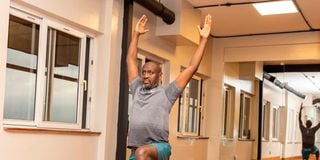
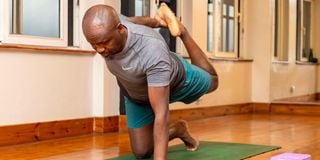
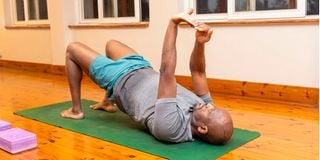
Strength training builds his muscles and cardio strengthens his heart, but he says that yoga gives him something deeper.
“Yoga is my fourth day. I always tell people not to ignore it. It helps with flexibility and balance. There are parts of your body that stiffen as you age — the glutes, the pelvic region — and yoga unlocks them.
“At first, I thought yoga was for soft people. But let me tell you, when you start doing it, you realise it demands strength, patience and humility. It’s not about sweating; it’s about control.”
He has reaped its benefits with time. “With yoga, I feel lighter. My balance is sharper. Even in leadership, balance is everything. If your body can balance, your mind can too.”
A younger Macharia used to run as part of the fitness ensemble he observed. “With time, even at my level of fitness, your body asks you to tone down. Pushing oneself is okay, but there is a limit to what the body can take. The goal is to keep fit. If exercise brings along the potential to injure either a part of or the whole body, look for ways of remaining active without putting yourself in danger.”
He has replaced running with walking whenever he can.
The successes he gets in boardrooms and courtrooms blend naturally with the commitment he brings to his fitness journey.
“For you to work out regularly, it takes high intensity of discipline,” he says. “Only the very disciplined can maintain that continuous working out. The person who can drag himself out of bed at 4.30 am to lift weights is the same one who will show up in the boardroom prepared, focused and consistent.”
The gym has taught him lessons that no textbook ever could. “Once I take on something, I put my all into it with intensity, and I don’t waver,” he explains. “That discipline is the same I apply in my style of leadership.”
But discipline is just one half of the equation; the other is clarity. “The clarity that exercising gives somebody is at another level. Problems that look impossible in the office shrink when you’re on the treadmill. Decisions that seem foggy become sharp after a workout. It’s like your brain breathes better.”
Macharia Njeru never skips a gym session.
Photo credit: Pool
Fitness evangelist
To him, exercise and leadership are inseparable; exercise is the training ground for leadership. Every dumbbell rep is a rehearsal in persistence. Every yoga pose is a practice in balance. Every 16-hour fast is a lesson in self-control.
On the question of the delicate balance between duty and personal wellness, Macharia knows nothing more than this blunt, but very practical maxim: “If you can’t take care of yourself, how are you going to take care of an institution? How will people trust you with their affairs? It is Bruce Lee who once said, ‘I fear not the man who has practised 10,000 kicks once, but I fear the man who has practised one kick 10,000 times.’”
Fitness, for him, is gospel, and he is its most coveted evangelist. His first congregation was his family. “My son is 28 now. That guy really works out. He has taken over from me properly. My other children, too — everybody in my family exercises.”
It doesn’t stop at home. He carries this message to boardrooms, offices, and even the pews of his church. “Everywhere I’ve worked — IPOA, JSC, my law firm — people know me as the man who will talk about fitness. But I don’t just tell people. I live it. They see me doing it. They see the results.”
That, he believes, is the most powerful influence, visible consistency. “One of the best ways of sending a message is when people see you doing it,” he says. “When they see the benefits in you, they want it for themselves.”
He has seen colleagues switch from extended weekend sleep-ins to early-morning walks, friends sign up at gyms after watching his discipline, and even casual acquaintances inspired to eat cleaner after listening to his story.
“Everybody knows me as that guy who is always talking about fitness,” he adds. “And I don’t mind. If I can change even one life, that is worth it.”
Is there such a thing as taking a break from this lifestyle for Macharia? “That’s the thing, this is not a timetable that I follow, this is my life. So, for as long as I am alive and able to do it, there is no stopping.”