Time flies with great content! Renew in to keep enjoying all our premium content.
Prime
How in-laws turned a simple idea into thriving honey-testing business
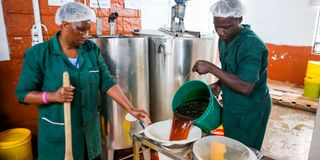
Kijani Honey production manager Miriam Wamboi (left) and assistant producer Nelson Bahati sieve honey to remove impurities at the company’s facility in Jamhuri Park Showground, Nairobi, on November 3, 2025.
Four years ago, Anthony Mwangi visited his now-business partner, Henry Guchu, and a container of honey in his office generated an investment idea that the two now boast of.
“When I visited Guchu, my brother-in-law, he told me what I was seeing on his table was gold,” Mr Mwangi says.
Mr Guchu, a lawyer, told him that local honey production only meets a fraction of its total demand. They saw an opportunity, which gave birth to Kijani Honey. They started a business of testing and selling honey.
“We realised the major problem facing the industry is adulterated honey. Suppliers of quality honey also rarely meet the demand volumes,” Mr Guchu says.
They first started conducting market research to understand the scope of production and quality.
“We toured honey-producing regions, Ukambani, Baringo, West Pokot, Tanzania, among others,” Mr Mwangi says.
During their visits, they never left the refractometer, a honey quality testing equipment, behind.
“We got so many complaints and concerns about adulterated honey from consumers,” he says.
Kijani Honey director Anthony Mwangi (left) and co-founder Henry Guchu during an interview at their facility in Jamhuri Park Showground, Nairobi, on November 3, 2025.
Photo credit: Billy Ogada | Nation Media Group
They travelled to Tabora in Tanzania, where they drew key lessons on beekeeping, because most keepers there are large-scale and operate in public forests.
Armed with knowledge and skills, their journey in establishing Kijani Honey started.
“We started with a 30-tonne consignment from Tanzania,” Mr Guchu says, injecting Sh14 million as seed capital, money that was also used to set up a facility in Nairobi. “We got the funds from our savings.”
However, the journey was not easy. Understanding the import duties, taxes, and clearance procedures at the Kenya-Tanzania border, Mr Guchu says, was difficult.
Also, the stock run out after just one and a half years. That taught them a lesson.
Mr Mwangi says testing honey quality and ensuring customers have an all-year-round supply is key. Besides, Kenyan honey being produced in low volumes, with most of it adulterated, he also says it is pricey.
Quit employment
With continuous research and upscaling, they mastered how to maneuver in the honey industry. Now they have a facility at Jamhuri Show Grounds, Nairobi, for testing and processing.
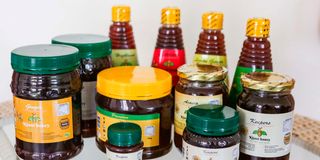
Some of the assorted products of Kijani honey pictured at the facility in Jamhuri Park Show ground in Nairobi on November 3, 2025.
Photo credit: Billy Ogada | Nation Media Group
Mr Mwangi resigned from the hospitality industry to give full attention to their business. He says he can now easily tell the best honey in terms of taste and even the corresponding age preferences.
He says honey from West Pokot, since beekeepers have not embraced modern beekeeping and are still harvested by burning using leaves, it is usually over-smoked.
Ukambani honey is a favourite for many people; it is pure and not over-smoked. The beekeepers there have adopted modern ways of beekeeping and harvesting. Ugandan honey, on the other hand, Mr Mwangi says, is nutritious as the region has many and different tree species.
Once the honey is received from Kitui, Kimana in Kajiado County, West Pokot, Kitale, Tanzania, Uganda, and the Democratic Republic of Congo (DRC, it goes through tests.
It is processed through pasteurisation, which includes heating it to above 50°C and allowing it to settle for a few days before sieving, value addition, and packaging. Mr Mwangi said they are keen on colour and taste.
A refractometer is used to measure the moisture content by detecting how light the honey bends through it. It converts this reading into a percentage of water, helping determine honey quality.
Good-quality honey, Mr Mwangi said, contains 17 to 20 percent moisture, while sugar concentration should be above 80° Brix.
“If honey measures 80° Brix, that means it has roughly 18 percent water and is considered ripe, high-quality honey,” he says.
Volumes
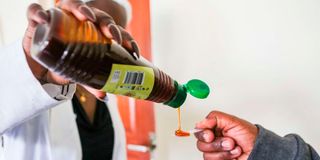
A customer samples Kijani Honey products at the company’s facility in Jamhuri Park Showground, Nairobi, on November 3, 2025.
Photo credit: Billy Ogada | Nation Media Group
They now test and process over 10,000 kilogrammes of honey per month. A kilo is sold between Sh800 to Sh1,000. They work with over 100 beekeepers, and a farmer is paid between Sh450 and Sh600 per kilo of unprocessed honey.
Having started with three workers, they now have 12 permanent employees and five on a casual basis. How have they managed to build a vibrant business? Mr Mwangi says, “We ensure we have enough honey for an all-year-round supply and conduct constant research to improve our products.”