Time flies with great content! Renew in to keep enjoying all our premium content.
Prime
Sweet business venture: Beehive maker turns shortage into Sh3m monthly earnings
Joseph Karuga, founder of Agriwell Kenya Limited, at one of the homes where he has installed a beehive in Kiambu County in this photo taken on September 29, 2025.
For years, with its low operating costs and strong profit margins, Joseph Karuga's beekeeping and honey aggregating venture was a sweet business.
He was a happy entrepreneur. Then, as demand grew, shortages and unreliable supply left him frustrated — until he decided to build the solution himself.
“We were not getting enough supply since most farmers we relied on were still using traditional hives,” he says.
That challenge sparked an idea: manufacturing modern hives. With Sh1.5 million in start-up capital — Sh850,000 from savings and the rest from a loan they have since fully repaid — Mr Karuga and his business partner, Jane Mwangi, launched a venture to produce Langstroth hives.
Starting up
For years, many Kenyan farmers have relied on traditional beehives, yet modern hives offer far greater efficiency, enabling up to five harvests a year compared to just one or two with conventional hives.
Armed with 12 years of experience in the agricultural and livestock sector, Mr Karuga decided to put his expertise into entrepreneurship. In 2022, he co-founded Agriwell Kenya, with Ms Mwangi overseeing marketing and finance while he focused on operations and field development.
“I realised the biggest hindrance to the success of the beekeeping industry is the lack of modern technologies. The majority of beekeepers still cling to traditional hives. Yet with conventional hives, a farmer harvests only once or twice a year, and the harvesting process is disruptive, often compromising quality,” he says.
Just three years into the business, Mr Karuga says Agriwell began to record rapid growth. From an initial output of about 30 hives per month, the company now produces between 300 and 500 units.
“In peak periods, orders can go as high as 1,000 units. My monthly turnover is now between Sh2 million and Sh3 million,” he says.
Operating from a workshop along the Eastern Bypass in Ruiru, the company has grown from two founders to 28 employees, including apiarists, artisans, and administrative staff. By the end of 2024, Agriwell had served over 3,200 beekeepers — some even in urban areas.
“We have customers from as far as the Maasai Mara, Baringo, and West Pokot. We sell the units to them and, in turn, provide a market for their honey. We purchase a kilo at Sh500 from them and resell it at between Sh800 and Sh1,000,” he says.
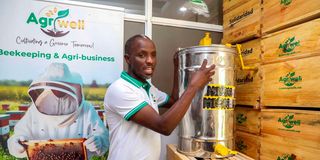
Joseph Karuga, founder of Agriwell Kenya Limited, a modern beehive manufacturing company based along the Eastern Bypass in Ruiru, Kiambu County, during an interview on September 29, 2025.
Photo credit: Dennis Onsongo | Nation Media Group
“The Langstroth hive’s estimated production capacity is 10 to 15 kilos per harvest.”
Inside the hive
Invented in Philadelphia, US, the Langstroth hive revolutionised beekeeping with its movable frames designed according to bee space. This design makes inspection and colony management easier.
Priced between Sh5,500 and Sh9,000, the hives are structured to separate the queen’s egg-laying section from pollen and brood areas.
Each has two compartments: the brood chamber, where eggs are laid and young bees raised, and the super, where surplus honey is stored.
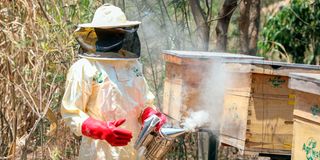
Centrifuge technology allows honey to be extracted without damaging the combs, which are then returned to the hive for reproduction. In addition to hives, Agriwell supplies protective gear, harvesting, and processing equipment.
“The majority of beekeepers are elderly men. To increase production, we must modernise the industry and attract women and the youth. Use of protective gear can help boost gender inclusivity,” he says.
Opportunities and challenges
Mr Karuga sees clear advantages in being a beehives entrepreneur: a growing sector with high demand and rising awareness of climate-smart farming. Still, challenges remain.
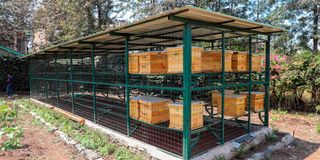
A modern beehive designed by Joseph Karuga, the founder of Agriwell Kenya Limited, stands at a farm in Kiambu County in this photo taken on September 29, 2025.
Photo credit: Dennis Onsongo | Nation Media Group
“The sector is still underdeveloped and no research goes into it, meaning that many farmers are still stuck to traditional beekeeping methods,” he says.
Getting raw materials is another hurdle. “I source well-seasoned pine wood from a cultivated forest,” he adds.
Despite these challenges, he believes the industry’s untapped potential is enormous. “Numbers show that Kenya can only supply itself with about 20 percent of its honey demand. This clearly points to a huge untapped potential,” he says.
The bigger picture
Experts agree. Caroline Gathu of the Kenya Wildlife Conservancies Association notes that conservancies hold immense opportunities.
“In the honey value chain, conservancies have great potential since beekeeping complements conservation. ASAL (Arid and semi-arid lands) regions have ideal tree species and vast open spaces perfect for bees,” she says.
According to the State Department of Livestock Development, Kenya has an annual honey production potential of 100,000 tonnes, yet actual output is only 17,000 tonnes — leaving an 83,000-tonne gap.
“The demand is there, and if ASAL communities are supported with modern technologies, they can bridge the gap,” she says.