A decade ago, Erick Kamau, the co-founder of Waiyaki Way Beekeepers, had an unfortunate experience with adulterated honey.
Additionally, a friend had a similar experience, which prompted research on pure honey production.
“A friend purchased the honey for his ageing parents, little did he know it had been adulterated. For me, I experienced some stomach problems,” Mr Kamau says.
As a honey enthusiast, he decided to visit the National Beekeeping Institute in Lenana, off Ngong Road, Nairobi, to inquire about honey production.
The institute taught him about beekeeping, handling, and honey production.The visit turned into a business idea.
“We understood the importance of bees in the ecosystem, how one should interact with these valuable insects, handle them, process their products, and package honey correctly,” he says.
Armed with Sh500,000 as seed capital sourced from their saving, they started the business.They leased a farm to set up beehives, opened a shop along Muhuri Road, off Waiyaki Way in Nairobi, and bought honey-processing equipment.
Mr Kamau, an information technology expert with a degree from Jomo Kenyatta University of Agriculture and Technology (Jkuat), is the chief executive officer, while his co-founding partner, Philip Muchemi, who has a diploma in business management, serves as the director.
Starting a business at the onset of the pandemic in 2020 was a gamble, but five years later, the entrepreneurs say it has paid off.
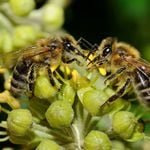
“We chose honey production as a business because of the environmental conservation aspect. It is estimated that 90 percent of pollination is done by bees,” Mr Kamau says.
Apart from producing honey, Waiyaki Way Beekeepers also processes by-products such as propolis, wax, pollen, bee venom, soaps, body creams, and candles.
Propolis is used as traditional medicine due to its antibacterial, antiviral, antifungal and anti-inflammatory health properties.
“The candles we make are mosquito repellents,” Mr Kamau says.
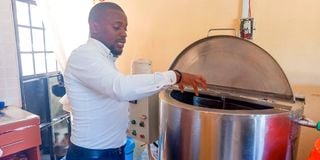
Waiyaki Way Beekeepers Chief Executive Officer Erick Kamau operates a pasteurizer machine at the processing plant at Kinoo area in Kiambu on February 24, 2025.
Photo credit: Billy Ogada | Nation Media Group
They have experienced tremendous growth. Starting with a 4-by-6-foot shop where production is done, they now have an extra outlet. They also have a small processing plant.
They currently have three apiaries [where beehives or bee colonies are kept]; one at their processing plant, which hosts about 20 hives; another in Kambiti, Kirinyaga County, with 25 beehives; and a similar in Naivasha—the most recent addition. At Waiyaki Way Beekeepers, their honey first undergoes processing to prolong its shelf life.
Initially, they refined their honey using traditional methods such as water baths for pasteurisation—an approach that resulted in significant losses.
“We could lose a lot of honey and time using this method. Thanks to technological advancements, we have now overcome these challenges,” Mr Muchemi says.
They have adopted the use of a modern pasteuriser and a honey press for extracting honey from the combs, machines that are efficient and save time.
“Pasteurisation prolongs honey’s shelf life. It is heated indirectly using water at temperatures of about 45 to 50°C,” Mr Muchemi says.
After harvesting, honey is stored in containers before being introduced to the pasteurisers and then transferred to cooling tanks.
“In the cooling tanks, honey takes about three to four nights to separate itself from impurities such as bees, wax, and foreign materials. The impurities float and are manually removed,” he says.
The entire process takes about a week before packaging.Inspecting bee hives is key, especially in determining whether honey is ready for harvesting For mature honey, the combs should be fully capped, with Mr Kamau estimating an over 80 percent maturity rate.
The two bee-preneurs sell their honey in Moyale, Eldoret, Busia, Kisumu, Mombasa, Nyeri, Meru, and Nakuru at Sh800 a kilo.
On average, they produce 300 kilos of honey per month, with a similar amount supplied by contracted beekeepers.
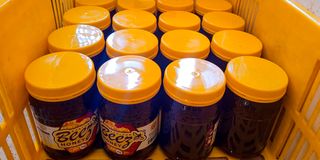
Packaged honey in a crate at Wayaki way beekeepers shop at Kinoo area in Kiambu county on February 24, 2025.
Photo credit: Billy Ogada | Nation Media Group
"We’re unable to meet the high demand. So, we have contracted beekeepers from Narok and Baringo to help us bridge the gap,” he says.
Additionally, they offer training on beekeeping and the supply of hives.
Their top challenge is getting qualified personnel who understand bee and honey handling, and getting a steady market in a country saturated with bad honey.
“When we started, we had difficulties making our products accepted in the market. But over time, with frequent training from the National Beekeeping Institute, we now understand the techniques,” Mr Kamau says.
Tracing honey
To prevent their brand from being imitated by unscrupulous traders, Waiyaki Way Beekeepers has introduced batch numbers—a system that enables them to trace their honey.
In case of customer complaints, they can address the problem efficiently.
For the farmers they have contracted, they have set standards, including locating apiaries far from farms that use chemicals.
A National Environment Management Authority (Nema) certification is one of the requirements for beekeepers near urban dwellings.
If there is one lesson they have learnt is to start with fear but still start, and save more and spend less.
“A notable lesson we have learnt in entrepreneurship is that a failed business has not been started. Once you step into business, get insights from experts and make them your allies,” Mr Kamau says, while encouraging young investors not to underestimate starting small, citing their success as proof of gradual growth.
“Co-founding a business has helped us grow and has fast-tracked scaling up through brainstorming and taking the business to the next level,” he adds.