Andiamo! (Let’s go) It’s a breezy Wednesday evening, and we are by the pool at Nairobi’s Serena Hotel. Three of us raise our glasses and toast in anticipation of a curated journey through Italy.
Around us, jazzy notes curl through the air as small clusters of guests gather at cocktail tables, drinks in hand: sunset-orange Aperol Spritzes and translucent neon-green mocktails that the lady mixologist called ‘the Green Alien’.
Trays of eggplant caponata, zucchini parmigiana, and stuffed bread rolls glide past, carried with effortless poise by the servers. I savour the mashed potato with parmesan and pancetta- light, airy, and indulgent enough to leave me wanting more.
Appetites sufficiently whetted, we find our assigned seats in an upstairs lounge overlooking the pool, each table named after a city in Italy. Mine is Milan, the economic capital of Italy.
Chef Vincenzo Buttice, who is visiting from Italy, is our captain for the evening at the event organised by the Italian Embassy, Italian Trade Agency, and the Italian Institute of Culture and Ambasciatori del Gusto.
“I don’t speak English, I only speak food,” he opens, inviting us to journey through Italy with him. “The first course is the perfect egg, celeriac soup, and truffle pearls. Buckle up and enjoy the meal.”
Buckle up indeed, because while the pale-yellow dish presents with an understated elegance: dark beads glinting against a creamy backdrop in which the egg is fully submerged, the harmony of the velvety soup, the silky, molten yolk, and the delicate pop of the truffle pearls has me rethinking my idea of a perfect egg.
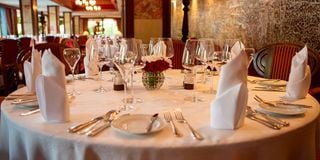
Table setup at Nairobi Serena Hotel, December 3, 2025.
Photo credit: Pool
Further solidifying the dish as a proper start to the evening is its wine pairing, the Ferrari Trento DOC. Nixon Munga, a sommelier, Italian wine ambassador, and our tour guide for the evening, enlightens us about the local name for the Italian straw yellow wine - ‘the bubbles of the mountains’.
“It’s a Chardonnay and Pinot Noir, whose crisp and refined taste matches with the chef’s desire to start the evening in a fresh and fantastic way.”
We nibble on focaccia bread and sourdough sticks from the mountains of Trentino-Alto Adige in the Northern part of Italy, until we arrive at our next stop: Sardinia, the sophisticated mediterranean island full of sandy beaches.
Here, we sample the Rafia Vermentino DOC di Sardegna, served with broad beans, fennel, and either smoked pancetta (turf menu) or squids and Italian caviar (surf menu).
“As served today, the broad beans are quite creamy. The Vermentino’s fresh, citrusy notes and acidity cut through the creaminess to add some vibrancy to the dish,” our knowledgeable tour guide says. “Also, the fact that it comes from an area with lots of seafood makes it the perfect pairing for the squid because as they say, if it grows together, it goes together.”
A few bites of bread later, we find ourselves in Custoza, a northern Italian village. Here, we enjoy the Monte del Fra Ca’ del Magro Custoza Superiore paired with either risotto shrimps, thyme, and lime, or risotto zucchini, lime, and mint.
As the Italians like it, the risotto is perfectly al dente and its rich texture goes hand in hand with the rich intensity of the Ca’ del Magro, their combination like that of two powerful singers with none screaming over the other. Delizioso! (delicious).
Welcome drinks at Nairobi Serena Hotel, December 3, 2025.
Photo credit: Pool
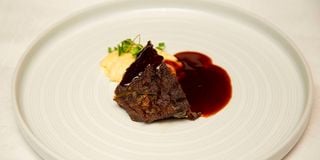
From northern Italy, our company is split into two, one group heading to Sicily, and the other to Tuscany. The low hum of conversation dips a little, replaced with the clink of silverware as those in Tuscany enjoy exceptionally tender veal cheek, melt-in-your-mouth mashed potato and corn and a lovely, dark sauce made from veal stock. To wash it down is the red Ridolfi Rosso di Montalcino DOCG.
“The wine has a kiss of oak to give it enough power to match the veal,” informs our trusted guide.
Those in Sicily dig into a Messina-style fish fillet served with tomato sauce and the Planeta Etna DOC Rosso, a red wine in the style of Pinot Noir, that is light, fruity, and refreshing. The sauce definitely finds a suitable companion in it.
“This is also a wine that someone who does not enjoy strong, dry wines would really like.”
This particular course, the Sicilian course, leaves a number of taste buds reeling, earning itself a number of mentions throughout the evening.
“That taste was a bit unique for me, and I really appreciated it,” comments Innocent Simiyu, who has not only taken a fancy to different cuisines around the world but has also attended a number of wine-pairing dinners.
Monia Posti, a thorough Italian who’s been living in Kenya for the past 31 years, and runs an Italian food company, Queen Deli, also has things to say about the fish-fillet.
“It was really nice,” she croons, “my favourite so far. I have a bit of a sweet tooth though, so I’m eagerly waiting for dessert.”
But before the dessert is served and any of us get the chance to indulge a sweet tooth, the servers bring out a tiny cup of hibiscus, sambuca and passion fruit infusion.
A proper palate cleanser if there ever was one. Sweet, floral, and tangy, the ruby-red drink resets our taste buds and sets the stage for the final leg of the epic journey, the forgotten panettone.
Anything but forgotten, this dessert is a Christmas staple, dare I say, the ultimate one, when it comes to the famously passionate country and its people. The surprise might have been if it was missing from the menu.
The “forgotten” panettone served at Nairobi Serena Hotel, December 3, 2025.
Photo credit: Pool
Classically paired with the Vite Colte La Gatta Moscato d’Asti DOCG, a sweet, aromatic, lightly sparkling red wine from the hills of Piedmont, there’s nothing but clean platters, empty glasses and satisfied smiles, the kind that only good food can produce, by the time the trumpeter tucks away his instrument, the piano man’s notes come to an end, and we all return to the chilly Nairobi night. Arrivederci! (goodbye until we meet again).
A quick cheat sheet to desserts and Italian wines
When you get a hold of a sommelier with enough knowledge to earn an Italian wine ambassador badge, you ask them everything you’ve always wondered about.
First, the assumption is right. Sweet goes with sweet.
“Dry wines leave a sour taste in your mouth, so the first principle would be to have a wine that is ideally sweeter than your dessert,” says Nixon Munga. “But when sweet and sweet meet they amplify each other, so to ensure that your dessert doesn’t become cloyed, the wine should also be high in acidity so it can refresh the palate. This is the second principle.”
Beyond the pairing logic however, the wine expert says there is no such thing as wrong wine for a dessert dish, or any other dish for that matter.
“For me what is important is that people explore wine - go to tastings, find what you like, double down on it, and just enjoy wine,” he advises. “You don't have to be a professional to enjoy wine, all you need to know is whether you like it or not.”
The temperature at which you serve your wine also matters, as the expert says, it affects how you perceive the flavours.
“Most of the time, red wine is served at 15 degrees celsius, though there are some lighter styles that can be served at a lower temperature of around 12 degrees celsius. This is like the Planeta Etna DOC Rosso,” he informs. “White wines should be served at a lower temperature, most of them at 12 degrees celsius.”
For sparkling wines, which are some of the most versatile wines and can be used from the first to the last course, the sweet spot is between eight and nine degrees celsius.
When doing a chocolate and Italian wine pairing, the sommelier would go for a white wine for white chocolate.
“A Moscato D’Asti is a very safe bet. It’s nice, lovely, has a bit of bubbles, and is quite refreshing.”
For dark chocolate, he would go for a Vin Santo or a Marsala, both in the dry style.
Veal cheek with mashed potato and corn, served at Nairobi Serena Hotel, December 3, 2025.
Photo credit: Pool
“If the dark chocolate is above 70 per cent, then I’d suggest a fantastic Amarone della Valpolicella or a Passito-style red wine.”
For classic Kenyan favourites like maandazi, Nixon calls for some creativity.
“Since maandazi is quite rich and sweet, I’d probably go with a Marsala semi Vecchio or a Passito di Pantelleria or Passito di Noto. With these, you can then have your maandazi with jam or something else a little creative.”
For unconventional pairings that he has come across, and they ended up giving him a pleasant surprise, the wine connoisseur names the pairing concept of sour foods with sweet wines.
“They can work quite well, but it's a very tricky balance.”
If he were to recommend a singular bottle for an extensive range of desserts, his go-to would be a sparkling sweet or semi-sweet wine.
“This is because it has the sweetness and can work well with so many different desserts, but also, most of the time, sparkling wines are high in acidity.”