What started as a weekend pastime, roasting meat for family and friends in his backyard has transformed Steve Gitu into one of Kenya’s most recognisable names in the BBQ business.
A decade after experimenting with smoky flavours on a simple home grill, Gitu is now the founder and CEO of Rib Racks Ltd, a fast-growing meat roasting and processing enterprise with a presence across several Kenyan towns.
Today, Rib Racks operates five outlets in Nakuru, Naivasha, Kiambu Road, Kamakis on the Eastern Bypass, and Karen in Nairobi.
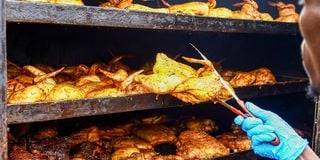
At each location, the aroma of slow-smoked beef, pork, lamb, goat, and chicken draws in a loyal clientele eager for authentic barbecue, an experience Gitu says was missing in Kenya’s heavily nyama choma-dominated market.
For years, Gitu invited family and close friends over on weekends for backyard BBQ celebrations.
He says they praised his marinated ribs, tender smoked cuts, and artisanal sauces, an encouragement that sparked an idea.
At the time, he had spent five years tarmacking, searching unsuccessfully for white-collar employment.
Returning to the meat business, a craft embedded in his family’s history, seemed like the most natural next step.
“My grandmother ran a butchery at Kenyatta Market, and that environment shaped my early understanding of the meat trade,” he recalls. “When the job searches didn’t work out, I went back to what I knew, but with a twist.”
While nyama choma is typically roasted quickly over high heat, barbecue (BBQ) is a slow, deliberate method that cooks meat over low heat for long periods, often using smoke to infuse deep flavour.
The technique breaks down connective tissues, resulting in tender and juicy cuts. This, Gitu says, is what differentiates his offerings in a market where many restaurants stick to routine grilling methods.
From the hobby of smoking the delicacy, he then spotted an opportunity. People loved the novelty of proper BBQ, and they were willing to pay a premium for it.
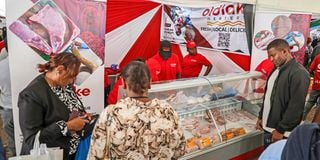
Rib Racks Group’s Business Development partners, Gatarua Gitu (left) and Ahmad Suleiman, at the Nation Media Group Kenya Meat Expo held at the Kenyatta International Convention Centre (KICC) on Friday, August 8, 2025.
Photo credit: Dennis Onsongo | Nation Media Group
With Sh800,000 in seed capital, Gitu started he first Rib Racks outlet in 2018. The early days were tough, he admits. Operating alone, juggling cooking, customer service, supply management, and marketing.
“But the demand kept growing,” he tells the BDLife in an interview.
From roasting just a few kilos a week, Rib Racks now processes over one tonne of meat weekly across all its locations.
Formalising business
The expansion came with a formal business structure, he says. The company now employs more than 150 staff and supports hundreds of jobs indirectly—especially among pastoralist communities in Kajiado and Narok who supply livestock, as well as meat traders in Kiambu County.
“We work with farmers, butchers, transporters, and suppliers. It is a full value chain,” Gitu explains.
Their growth, he states, has been fueled by continuous innovation.
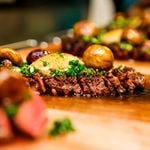
Apart from BBQ joints, Rib Racks has ventured into premium meat cuts such as ribs and steak, processed products including sausages, bacon, chili, sauces, burger patties, and marinated meats, all carrying the brand’s signature BBQ flavour profile.
As the business expanded, Gitu realised that building an empire required more than passion. It required systems, skills, and professional structures. “One of the biggest challenges was the lack of skilled personnel,” he says. “I had to learn the value of hiring qualified staff and investing in training.”
Navigating the financial side of the business was another hurdle. Raising capital for growth required discipline, planning, and strategic borrowing. “Banks have played a big role. Access to credit allowed us to scale operations and invest in equipment and people,” he says.
Gitu’s turning point came when he teamed up with a business partner, entrepreneur Ahmad Suleiman, founder of Old Lake Meatery Ltd.
The partnership, he says, has been integral to accelerating expansion and strengthening Rib Racks’ footprint in the market.
“Everyone brings different strengths,” Gitu says, adding, “You can’t be a jack of all trades. If you want to grow, let professionals take over where they are strongest.”
Old Lake Meatery, a Nairobi-based meat processing company, supplies Rib Racks with a wide range of products including sausage, bacon, specialty cuts, sauces, and marinated meats.
Marketing & branding
Rib Racks also supports marketing, branding, and strategic development, areas Suleiman says are essential for a modern food business to scale sustainably.
“We look at the entire ecosystem—product development, brand positioning, market trends,” Suleiman notes.
The demand for quality meat and BBQ experiences, he says, is huge, and that they see significant opportunities in the niche.
In addition to meat processing, Old Lake runs “Big Smoke,” a flagship BBQ restaurant in Karen that complements Rib Racks’ offerings and contributes to both companies’ growth in the premium meat market.
Suleiman believes success in this industry requires constant innovation. “The meat business evolves. Consumer tastes change. You must invest in people, research, and processes, and ensure the right individuals are in the right roles.”
As incomes grow and urbanisation expands, Kenya’s appetite for premium and flavoured meats is rising, Gitu says.
Old Lake Meatery representatives engage with attendees on the final day of the Nation Media Group Kenya Meat Expo 2025, held at the Kenyatta International Convention Centre on Friday, August 8, 2025.
Photo credit: Dennis Onsongo | Nation Media Group
Consumers are increasingly seeking differentiated dining experiences—slow-cooked ribs, smoked brisket, marinated cuts, and custom sausages, ultimately pushing local entrepreneurs to innovate beyond traditional roasting.
Strategic positioning
With Rib Racks tapping into this emerging market, the founder says, it is positioning itself not just as a restaurant chain but as a vertically integrated meat brand.
The company is also leveraging private catering, one of Gitu’s earliest strategies to supply weddings, corporate events, family functions, and outdoor experiences.
The catering arm he says remains a reliable revenue stream, helping to build the brand long before physical outlets multiplied.
With his determination, he believes that he is able to shape a Kenyan BBQ culture where smoking techniques, signature rubs, and specialty cuts become mainstream.
“There is demand. Kenyans love meat. If you add flavour, they come. BBQ allows you to play around with spices and ingredients, and that is what excites customers,” he explains.
Mr Gitu’s entrepreneurial journey is a blend of resilience, creativity, and strategic collaboration. It has key takeaways.
“You must be willing to do everything and also be willing to let go. At the beginning, you carry the whole business on your back. But as it grows, you must let other people take roles so you can focus on strategy,” he shares the lessons.
He emphasises that starting small is not a limitation. “Start with what you have. I began with one grill, roasting meat for friends. Today, we are running multiple outlets.”