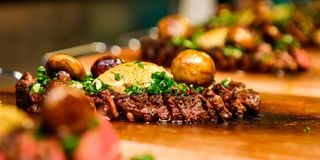
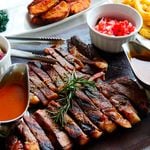
A ribeye- thick, marbled, hits the heat and begins to caramelise. This is not your everyday nyama choma, it is steak from Australia, a prime cut that costs Sh14,000 for half a kilo. In the world of prime meats, Australian beef ranks among the top-quality meats, competing with Japanese Wagyu beef.
In Kenya, more and more people are developing an appetite for these prime meats, and restaurants are responding to the demand.
At Nairobi’s Radisson Blu Chophouse restaurant, executive chef Wayne Walkinshaw speaks of Australian beef with the reverence of a sommelier describing a grand cru, with tales on breed and the alchemy of marbling that turns this steak into an experience. He says the Australian beef carries flavour, heritage, and craft; and that is why it is priced high.
“It comes from Tara Valley. These cattle are cross-fed, not kept in feedlots. What that means is the meat is much tender than the rest. The cows are kept for their quality of meat, not just volume. So the meat is nicely marbled, it will always be tender, it will always be consistent,” he tells BDLife.
For the prime meats newbies, marbling refers to the delicate web of fat woven through the muscle, the shimmering white lines that melt when heat meets flesh, which marries both its succulence and sweetness. So, does Australian beef taste better compared to Kenyan beef? Chef Wayne says they are worlds apart in terms of profile.
“Kenyan beef is more free range; the cows grow more slowly because of their diet. They are lean, so the meat tends to be a bit chewier. Kenyans like that, the meat that bites back. But Australian beef is very tender, sweet and subtle. When you go local, it’s more stringy, mushroomy and very rich in taste,” he says.
The word “subtle”, the chef describes it as meat that does not overwhelm the palate.
Unlike Kenyan beef, which often requires ageing to be tender, Australian beef arrives almost ready for indulgence. “We don’t need to age it. It takes about three weeks to get here. When they slaughter it, it stays a week in Australia, then I keep it for another two weeks. The quality is good already; it doesn’t need ageing. You can age it, but there’s no need, because it already has so much flavour,” chef Wayne says.
Globally, Australian beef has become so popular. The price for Australian beef remains at a near-record high of about $46 (Sh4,000) a kilogramme, a sharp jump from what it was in 2013.
Executive Chef Wayne Walkinshaw at the Radisson Blu Hotel in Nairobi on September 9, 2025.
Photo credit: Billy Ogada | Nation Media Group
Australia exports about 70 percent of the beef it produces. Prime cuts also go to markets including Japan, China and Europe.
“When the Kenyan beef is aged for 40 days, it develops that earthy, mushroomy flavour. But it will never be Australian, or Brazilian, or South African. Each place has its own way of growing and feeding cattle. The flavour profile is different. You can’t copy it.”
Kenya’s appetite for imported meat is still small compared to its local supply. According to the Observatory of Economic Complexity, Kenya imported bovine meat worth about $85,900 (Sh11.1 million) in 2023, with Ethiopia supplying the majority at Sh4.9 million ($56,600) and South Africa following at Sh1.7 million ($19,700).
Smaller consignments arrived from Italy at Sh675,000 ($7,820), the UK at Sh73,400 ($850) and Australia at Sh79,092 ($916).
But chef Wayne admits his own bias: “For me, the local meat is too strong. That mushroomy, blue-cheesy, earthy flavour is not my preference. I like Brazilian, South African, and Australian because they’re sweeter, more palatable for me.”
When ageing his meat, he adds some whisky to it. “What I’ve done is, I take a cheesecloth, soak it in whisky, wrap it around the sirloin, and age that for a week. You get that smokiness of the whisky going into the sirloin. It’s very unique,” he says.
Rolls-Royce of beef
Among the Australian beef cuts that are imported into Kenya—Rib eye, tomahawk, skirt, tenderloin, sirloin, what stands supreme? I ask.
“Definitely the Rib eye. For me, Rib eye is the Rolls-Royce of beef. It’s got a lot of marbling, tender and it’s flavourful. With a tenderloin or fillet, yes, it’s very tender, but it has little taste, and it needs a sauce to bring it together. But Rib eye has so much flavour because the muscle works. It’s meat with character,” he says.
Chef Wayne says Australian beef comes with the etiquette of eating and alcohol pairing. You do not simply order a Rib eye and reach for any drink at hand.
“Australian beef is best paired with red wine or whisky. The two just work perfectly. But a good Shiraz or a Cabernet Sauvignon with Rib eye works because of the fattiness and the juiciness. The richness comes through so nicely as well with whisky and the meat.”
Do you eat Australian beef rare or well done? For a long time, Kenya’s palate leaned toward well-done, a behaviour drawn from their certainty and familiarity. However, the chef says this is slightly changing.
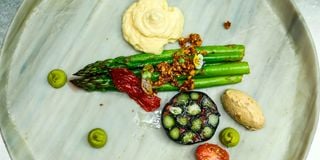
Asparagus salad served at Radisson Blu Hotel, Upper Hill, Nairobi, on September 9, 2025.
Photo credit: Billy Ogada | Nation Media Group
“Kenyans prefer meat that is well-cooked, but the people are getting more educated. They’re willing to experiment. We try to suggest to our clients—if you always order well done, why not try medium rare today?
"We put it on the salt block, cook a bit more, just to experience it. But with meat, the most flavour comes between medium rare and medium, not more than medium. Diners who used to eat well done now order medium, and they can see the difference in the taste and feel it,” he says.
Cooking at home
For those looking to cook Australian beef at home, he says: “Take the meat out from the fridge at least half an hour before cooking so it gets to normal temperature. Season both sides with salt. Heat your pan, a little oil until it smokes, then put your steak in. Seal it, turn it, seal it again. Then add butter, thyme, and slices of garlic.
"Keep coating the beef, basting it, and if you like, put it in the oven for four or five minutes. The most important thing is, after cooking, let it rest for five to eight minutes so the juices settle. The key is a hot pan and a hot fire,” he says.