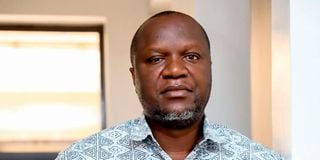
Willis Evans Otieno, a partner at Otieno Ogola & Company Advocates, describes Alego as the promised land. Here, the man he is, goes to meet the boy he was. In Alego, he is not the man filing a legal suit here, chasing a client there, or with political leanings. “When I am in Alego,” he says, “I am in basic mode.”
It reminds him of the old days when everything worked. Garbage collection. Tight security. Communal upbringing. Everything worked, until it didn’t. He moved to Nairobi to have a chance at that thing called success.
In Nairobi, he owns a three-legged beaded stool, a totem of power passed down from his paterfamilias. On this stool, he channels his ancestors and bemoans first the dearth, then the death of good manners in society. From it, he also conjures up an elderly sage, frothing with wisdom from the tweeting gods of Alego — where, he believes, the Garden of Eden will one day descend. He hopes to be its chosen gardener.
Authenticity. I believe that the most important thing in a person’s life is to identify why they were born, and the submission of that to me is that we are here to fulfil the will of God, in service to God and humanity.
My path is law, and I must apply it to serve humanity to the glory of God, and I am not being a typical Bible-wielding politician. I’m here by the grace of God, and that’s shaped my path to date.
What question are you trying to answer with your life?
Service. Why do you exist in the first place? You cannot say that you are born to enjoy life, live a good life at the expense of others. You are born to serve the fulfilment of the glory of God.
What do you think is your greatest virtue?
Honesty. I’m authentic. I don’t lie.
What is a uniquely personal struggle you’re fighting?
Hypocrisy, and how to learn to live with hypocrites. You must accept that you live in a society that not everybody ascribes to the views or the values that you have. And you must coexist with them. And sometimes I have to accommodate and respect authority views that don't hold the same values that I do.
Isn’t that just human nature?
It’s not human nature. I don’t believe that humans are bad people. For instance, a child doesn’t know anything about colour, race or tribe. When they meet us, they relate in a very humane way. So innate in the human, I believe, is good. But then the social construct has been that as a man grows, he’s deconstructed, taking him away from his innate value. Selfishness, greed, hypocrisy, lying. These are not innate human traits.
Can you legislate good manners?
You cannot. Good manners can only be taught and educated. And that is one thing that is lacking in our country. Greed has superseded everything. Basic courtesy, someone wants to join the road, and you’re on the main road, but you don’t allow them to pass. You may be right legally, but morally you’re wrong.
What do we need to know about how you grew up to understand the man you now are?
I grew up in a basic household, surrounded by love from my family and community. There was no demarcation about which child was from which home; we were just all children playing together, eating together, and we’d watch television, about 30 children in a small room [chuckles].
But we would all fit watching the soap operas and Indian movies. We felt that we were one happy community, not haunted by negative, toxic ethnicity or politics.
It only became political after the Structural Adjustment Programmes, when many people started losing jobs and families started breaking down.
Before then, it had been a functional society: you had security, cleaners in the estates, provided by the government. Garbage was collected every two days by the municipal council. There was a community centre, a social hub, where we would go to watch TV. It was joy, bliss. Now we have children living in high-rise apartments who, if lucky, may have their parents take them to a shopping mall to play at the weekend
You have become quite popular on social media thanks to your X (formerly Twitter) dress downs, but also offline in your courtroom battles. Do people act differently around you?
I wouldn’t say people act differently. The majority of the people, when I’m in a public space, walk up to me and say they love my zeal and that I should not tire of fighting for us. Many Kenyans innately want the common good; they have just been forced to accept this mediocrity. Now I restrict my public appearances because it can be quite overwhelming. As an optimist, I believe in the inherent good of man, and it only takes a few good men who speak, and then you’ll see the majority join in.
Have you watched the movie A Few Good Men?
Yes, of course, many years back [chuckles].
How do you take care of yourself as a man and reward yourself? The best reward I give myself is to go to Alego, the land of paradise, where the Garden of Eden will land, haha!
That’s where my home is. In Alego, I keep a few animals, birds, ferocious dogs, et al. It is green, serene and quiet, and all I do is sleep, walk my dogs, and think of the welfare of my dogs and plants. Basic engagement is the ultimate therapy. I try to go at least once a month, but sometimes every three months, depending on my schedule.
What has this done for your life?
It makes me appreciate the beauty around me, which you sometimes don’t even notice when you’re too busy. As a person, your mind is a scatterbrain. You don't focus on anything in particular. But taking time out and pulling back from your daily hassles, just to be basic, is important. The hardest conversation I have there is maybe talking to a neighbour and hearing about a bullfight the previous evening.
Willis Evans Otieno is a partner at Otieno Ogola & Company Advocates.
Photo credit: Lucy Wanjiru | Nation Media Group
What would you say is the greatest blessing of your life?
God giving me a platform to be his vessel. To fulfil His will. He has given me a family. Some people take that for granted. To have your parents is a blessing, a wife, and you have an immediate social comfort from people who look at you as one of them.
Your father?
My father passed away at 80 years old this year. I thank God for the period we spent together.
Are you a father yourself?
I’m a father of many [laughs].
That's a typical political answer.
I’m the one in the public space, not my family members. I take it as unfair if I expose them to what I chose for myself. But when they want to come, I say, 'Come'. Because we must learn one thing, that some of the bad habits you see in the public space are children and family members who feel entitled. If you want it, create your own path. I believe family should stay as a family, and if you are coming to the front, come as a politician, and we will meet as thus.
What has being a father helped you understand about being a son?
Being present, that’s the most important thing; it's about presence. This is not about just material goods, but being around. You get to learn more in life just by being around these old folks, for they are the encyclopaedia of experience. I have learned more about the Luos from my father than I have read in any book—and I have read many books.
What’s an item you have that reminds you of your father?
A three-legged beaded stool, which I keep proudly in my house. No one can sit on that stool [chuckles].
Do you declare family decrees on that stool?
Haha! No, I sit on that stool when I want to be in sync with my ancestors. I don’t use it as a symbol of authority to dictate, but understanding that I am here now, and that I will also hand over that stool to the next generation.
Willis, what is the strangest thing you have done for love?
[chuckles] My wife says that the first time we started talking, I told her I had to marry her. We spoke for almost four hours, and she said I was very spooky, but look at her now, where is she? Haha!
Four hours. Must have been quite the conversation.
Haha! I had come from abroad, and it was only the second time we had spoken. I called her just after I disembarked. I went through immigration and took a cab to my house in Lang'ata, all while still on the phone — there was no expressway or Southern Bypass. We spoke for almost the whole afternoon and I only disconnected the call at around 6.30 pm to make dinner [chuckles].
I asked her what she remembers from that call, and she said I said, ‘I want to marry you’.
What makes a good husband?
Just respect your wife.
What has been your biggest fashion crime today?
I used to mix and match my agbadas at university — those Nigerian outfits — and I would wear them to class in Moi University, haha! People on campus found me very strange.
Did it come with the accent, too?
Haha! No, just the looks [chuckles].
What makes someone memorable?
The impact. What feeling do you invoke in somebody? I hope that for me, that should be one of service. If they feel that I am serving them, not leading them or lawyering them.