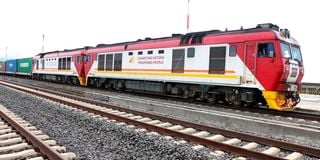
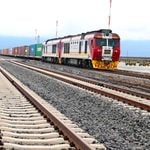
The standard gauge railway (SGR) saw its revenue rise 19.96 percent to Sh15.9 billion during the first nine months of this year compared to a similar period last year, lifted by a rebound in passenger traffic and sustained growth in cargo.
Data from the Kenya National Bureau of Statistics shows that passenger tickets rose 6.5 percent during the period to 1.9 million travellers as more commuters took the Madaraka Express despite higher fares introduced at the start of last year.
This saw passenger revenue surge 14.2 percent to Sh3.3 billion.
Cargo freight revenue, on the other hand, grew 21.6 percent to Sh12.6 billion, signalling the continued dominance of containerised cargo as the backbone of the SGR’s commercial performance.
Cargo volumes hauled between Mombasa and internal container depots terminals increased 13.6 percent to 5.4 million tonnes, reflecting growing demand for rail haulage among importers.
Cargo trains have remained the major revenue engine for the SGR since the service was launched in 2017.
Importers have increasingly leaned towards rail transport due to predictable transit times, minimal cargo losses, and tighter enforcement of cargo evacuation rules at the port.
The strong freight performance aligns with Kenya Railways’ strategy to deepen volumes on the Mombasa–Naivasha corridor while also linking more inland depots through the metre-gauge network.
The growth in earnings offers some relief to the financially strained SGR operation, which has historically relied on Treasury support to meet recurrent expenditure.
The revenue gap has complicated efforts to align the business with its original promise of generating enough revenue to meet its costs and repay Chinese loans used for its construction.
The loans, amounting to hundreds of billions of shillings, were sourced from China Exim Bank to fund the Mombasa–Nairobi section and the extension to Naivasha.
Kenya borrowed a total of $5.08 billion (Sh659.1 billion at current exchange rates) in 2014 and 2015 from China to fund the Mombasa-Naivasha SGR line.
Repayments for the loans – which were on a mix of concessional and commercial terms - kicked in from January 2020 after a five-year grace period. Repayment of the debt has put pressure on the country’s external financing obligations at a time when revenues remain below loan servicing requirements.
The rebound in passenger traffic has also helped the SGR claw back from last year’s performance dip triggered by fare hikes and a temporary shift by some passengers to cheaper road transport.
Passenger ticket prices were doubled in January 2024, pushing first-class fares to Sh4,500 from Sh3,000 and economy fares to Sh1,500 from Sh1,000 on the Nairobi–Mombasa route. Kenya is pursuing an extension of the SGR from Naivasha to the Malaba border to integrate its network with Uganda’s proposed standard gauge line.
The $5 billion (Sh648.7 billion) extension is expected to be funded largely through Chinese financing, although negotiations remain ongoing.