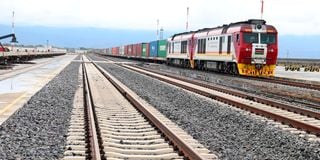
Kenya will hand over the operation of the upcoming standard gauge railway (SGR) line from Naivasha to Malaba to a private investor in a strategic shift aimed at easing the financial burden of the mega infrastructure project on taxpayers.
The two phases of the SGR extension—from Naivasha to Kisumu and onward to Malaba—are expected to cost approximately Sh645.95 billion ($5 billion).
Transport Cabinet Secretary Davis Chirchir said the government will finance the construction of the railway infrastructure, while a private investor will supply the rolling stock, including locomotives, passenger coaches, and freight wagons.
“We have a framework where we are seeking to commercialise aspects (of the project) which are profitable,” he said.
“So with that investment of $5 billion, we will be looking to reduce the portion that would otherwise go to freight: buying the engines, buying the bogies and the rolling stock.”
The investors will recover their cash from passenger and freight charges while paying the State a fee for use of the modern railway and stations.
Rolling stock is capital-intensive, and by offloading this to private investors, the government hopes to avoid heavy upfront spending and cut loan requirements. Kenya has been in discussions with the United Arab Emirates and China to secure financing to extend the railway.
The railway connecting the port of Mombasa with landlocked neighbours, as part of China’s Belt and Road Initiative, ended in Naivasha in 2019, 468 kilometres short of the border with Uganda after a funding hitch.
The private sector component in the extended SGR will ease the accumulation of Chinese debt amid demands from Beijing that the track yield adequate revenues to refinance loans tapped for the project.
Loans due to China stood at Sh692.6 billion as of December 2024 and mostly comprised debt for the Mombasa to Nairobi section of the SGR.
Mr Chirchir said the government would focus on delivering the core infrastructure, including tracks, stations, control centres, signalling systems, tunnels, and level crossings.
However, he did not provide a detailed breakdown of how the $5 billion will be allocated between infrastructure development and the procurement of rolling stock.
The first phase of the SGR, linking Mombasa and Nairobi, was completed in 2017 at $3.8 billion (Sh490.92 billion).
This included civil works, stations, and rolling stock, largely financed through a 90 percent loan—about $3.23 billion—from the China Exim Bank, with the Kenyan government covering the remaining 10 percent.
Between 2014 and 2017, the government allocated Sh106 billion to procure the initial batch of locomotives and wagons.
Exim Bank also financed Phase 2A of the SGR, a 120-kilometre line from Nairobi to Naivasha, which was completed in October 2019 at $1.5 billion (Sh193.78 billion).
The line terminates in Suswa, where its abrupt end has disrupted plans to efficiently move cargo to landlocked neighbours of Uganda, Rwanda, Burundi, and the Democratic Republic of Congo.
Plans to extend the line to Kisumu and Malaba were shelved after China shifted its focus away from funding large-scale infrastructure projects.
To finance its mega infrastructure projects amid limited fiscal space, Kenya is increasingly turning to public-private partnerships (PPPs), including tolling for roads.
In the case of rail, the government plans to adopt a freight concession model, where a private investor is granted exclusive rights to operate cargo services on a publicly owned railway line for a fixed period under agreed terms.
“We are seeking a freight concession. The way we build a road and [people] can buy their vehicles and run on it—we will build the rail, get investors to do the rolling stock, and concession the freight,” said Mr Chirchir.
He was speaking during the Council of Ministers meeting of the Northern Corridor Transit and Transport Coordination Authority (NCTTCA) in Nairobi on Friday.
Mr Chirchir confirmed that plans to extend the SGR are at an advanced stage, with feasibility studies and route mapping having been completed. He added that land compensation for affected residents is already underway.
Phase 2B of the SGR, linking Naivasha to Kisumu over 262 kilometres, will pass through Narok, Bomet, Kericho, Nyamira, and Kisumu counties. Phase 2C, covering 107 kilometres from Kisumu to Malaba, will cut across Kisumu, Vihiga, Siaya, Kakamega, and Busia counties.
Earlier reports had indicated that Kenya was expected to raise 30 percent of the total project cost, or about Sh193.78 billion, with the balance to be financed by a Chinese firm.
However, Treasury Cabinet Secretary John Mbadi has since revealed that Kenya is pushing for China to fund the entire project, following President William Ruto’s State visit to Beijing in April during which he held bilateral talks with President Xi Jinping.
China, once Africa’s top infrastructure financier, has significantly scaled back large-scale lending as part of a strategic shift. For over a decade, it channelled billions into African roads, railways, ports, and energy projects under the Belt and Road Initiative (BRI).
But growing concerns over debt sustainability, repayment defaults, and shifting global priorities have prompted Beijing to embrace smaller, commercially viable investments and PPPs over sovereign loans.
Despite the retreat from direct lending, Chinese firms continue to dominate Kenya’s PPP space. Companies like China Road and Bridge Corporation (CRBC)—the builder of both the SGR and the Nairobi Expressway—have leveraged state-backed financing and rapid execution capacity to win multi-billion shilling infrastructure contracts.