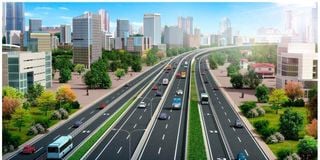
President William Ruto’s commitment to the dualling of the Mau Summit to Rironi highway marks one of the most consequential infrastructure milestones in Kenya’s recent economic history.
The project is not just a road but a strategic economic booster, which will open up businesses and enhance Kenya’s competitiveness globally.
The Mau Summit–Rironi corridor is a backbone of Kenya’s transport and commercial network. It links the Rift Valley and western Kenya, together with the Lake Region Economic Bloc, to Nairobi and the Mombasa port as well as the Northern Corridor, the busiest trade route in East and Central Africa.
The upgrade of this corridor to a high-capacity highway will significantly reduce commuting time, logistical expenses and ease the movement of millions of people and thousands of businesses. These are key areas of improvement in boosting the economy to emulate high-value investment.
The scale of the road infrastructure has multiplier effects in various sectors in the economic aspect. Reduced transportation costs translate into lower prices for goods, higher profit margins for businesses, and increased competitiveness for exporters.
Agriculture, which forms the economic heartbeat of regions served by this highway, will particularly benefit from faster and safer access to national and regional markets.
Manufacturers will also gain from more predictable freight movement, enabling just-in-time production systems and greater supply-chain reliability. These are the building blocks of a modern, export-oriented economy.
International experience demonstrates that countries achieving rapid economic transformation consistently invest in world-class transport networks. China, for instance, lifted millions out of poverty through an unprecedented expansion of highways and logistics corridors that connected interior provinces to industrial hubs and global markets.
Rwanda’s accelerated growth has partly been driven by intentional upgrades of key transport channels, which reduced business bottlenecks and attracted long-term investors. Even the United States’ post-war economic boom was fueled by the development of the interstate highway system, which unified markets and unlocked national productivity.
Singapore, the model that Kenya wants to follow, made the efficiency of infrastructure the basis of prosperity. Its roads, ports, and transport systems were developed not as political statements but as economic tools designed to attract capital, expand trade, and ensure seamless movement of goods and people.
Kenya’s Mau Summit–Rironi project aligns perfectly with this philosophy: infrastructure is not an expenditure; it is an investment in long-term competitiveness.
By constructing such modern transportation arteries, Kenya signals predictability, seriousness, and readiness for global business.
Investors look not only at policy frameworks but also at the physical ease of doing business. A nation where goods move efficiently, where logistics are predictable, regions are connected, and markets are accessible becomes inherently attractive for capital. Every kilometre of improved highway helps close Kenya’s competitiveness gap with emerging economic powerhouses and strengthens its value proposition as the gateway to East Africa.
Mau Summit-Rironi highway will also create jobs, directly through construction and indirectly by enhancing business activities. Industrial parks, development of real estate, tourism along the corridor, wholesale depots and agricultural aggregation centres will naturally form the outcome once the transport friction is minimised. This is the way infrastructure creates inclusive growth: through opening possibilities way beyond the tarmac.
This type of project demonstrates national will and Kenya’s aspiration to prosper. It is impossible to become a modern and prosperous country while relying on outdated transport networks. By investing boldly in such a high-impact corridor, Kenya is laying the foundation for an efficient, interconnected, and globally competitive economy.
The Mau Summit-Rironi highway is not just a road; it is a statement of Kenya’s economic destiny. It is an indication that the country is willing to transform its infrastructure to first-world standards. The project will also attract more people and investments, unlocking human potential and the markets.
Jamlic Munyasya is an economist and business consultant. Email: [email protected]