Time flies with great content! Renew in to keep enjoying all our premium content.
Prime
‘Pirikania’: Tracing the long journey of progress through pain
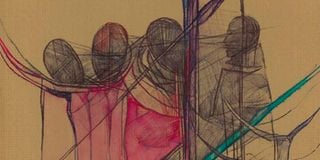
Study for Mahindas Ol Pur, Kipeto II(2025) by Kahare Miano, Aqua Pen, Watercolour & Ballpoint on Bond Paper, exhibited at One Off Contemporary Art Gallery, Nairobi.
If pain had a voice, Kahare Miano would express it through his chords. He would sing like a griot, sharing a philosophical story shaped by experiences of going through hell and back. Kahare, however, is an architect and a painter, and the language that best captures his experience is found in the spaces where colours and parallels intersect.
At his current exhibition Pirikania, Pain and Progress at One-Off Contemporary Art Gallery, Kahare lets that language take physical form. The works feel lived-in, touched by both restlessness and restraint.
Pirikania, a Turkana word meaning “to make an effort towards a goal”, follows his previous show at the same venue last year. Then, Kahare presented sketches from his travels and experiences across the northern frontier of Kenya. It was unabashedly colourful and warm. This new body of work bends inward. It is less travel diary, more personal excavation.
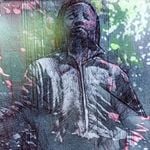
Pirikania Landscape Matters: Getting Ready (2025) by Kahare Miano, Ballpoint, Oil Pastel & Watercolour on Paper, exhibited at One Off Contemporary Art Gallery, November 2025.
Photo credit: Pool
The architect and visual artist in him merge here. His lines are both technical and emotional, some precise like surveys, others trembling or abruptly broken. “Adversity and suffering are part of the design of this existence,” he tells the BDLife. “Going through hurdles makes it an easy choice to recalibrate focus.”
In Pirikania, pain becomes tangible. It appears in those repeated erasures, in the half-finished shapes he refuses to complete neatly, in the tight, anxious clusters of pen marks. Progress shows up in the layering, each colour wash a small push forward, each line an insistence on showing up again.
Kahare speaks plainly about the ideas behind the work. “Every man or woman who goes through suffering has a moment to reflect. That’s where value is assigned,” he pauses, and then adds, “We are designed to be a little bit defiant.”
A standout piece, Anxiety in Elwak, pulls memory into the room. Greys dominate the composition, textured like old photographs, with a thin red line running across the middle—an echo of the 1980s memories he often references, when life felt sharp-edged and stripped to essentials.
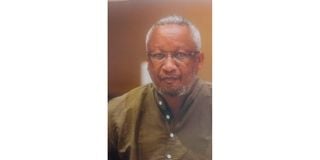
Studio portrait of visual artist Kahare Miano, Nairobi, November 2025.
Photo credit: Pool
Working on Pirikania gave Kahare clarity for his next project, though he is careful not to separate his identities as architect and painter. “Whether the lines are technical or free, it doesn’t matter,” he says. “The important thing is that an outcome exists.” In the studio, this outcome often emerges slowly: layers added, scratched out, and reworked over weeks.
The title itself, Pirikania, anchors him. Sometimes it represents purpose; other times, desperation. “I made it appear poetic because I didn’t want the work to be about me,” he says.
But in the same breath he acknowledges that the word mirrors the realities many Kenyans are living through—social, political, economic pressures that make the idea of progress feel hard-won.
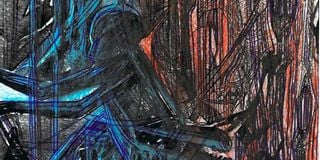
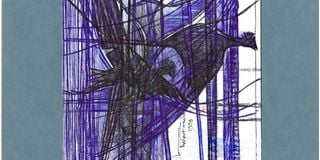
Treasured Totems: Naivasha Bird Life III(2025) by Kahare Miano, Mitsubishi Ink & Ballpoint on Cartridge Paper, exhibited at One Off Contemporary Art Gallery, Nairobi, 2025.
Photo credit: Pool
The exhibition reads as both wound and salve. The unfinished pieces hold as much power as the polished ones, as though he is saying that what remains unsolved is still worthy of being seen.
His slow, almost stubborn process becomes part of the message. When asked how his work has evolved over the past year, he shrugged: “Painfully slowly.”
Still, the slowness feels honest. It is the pace of someone pushing through, mark by mark, towards a horizon not yet fully formed.