Time flies with great content! Renew in to keep enjoying all our premium content.
Prime
Macharia Kamau: The fearless diplomat, reluctant retiree
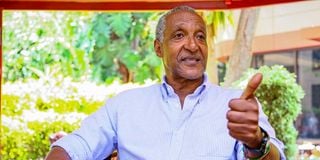
Macharia Kamau gestures during an interview in Westlands, Nairobi on September 20, 2025.
Photo credit: Wilfred Nyangaresi | Nation Media Group
“I’ve been happy most, if not all, of my life,” Ambassador Macharia Kamau says. “My dad always slipped a shilling under the pillow when the tooth fairy came. So I grew up believing in a magical world.”
Magical indeed—for few Kenyans have carried their flag into as many global rooms. Over nearly four decades, he has served for 14 years as Kenya’s top diplomat, including nine years as Ambassador to the United Nations and five years as Principal Secretary for Foreign Affairs.
By the time he left the UN system, Mr Kamau had already built a stellar career. He served twice as Resident Coordinator and Resident Representative—in Rwanda and Botswana—and earlier as UNICEF’s Area Representative in the Caribbean, overseeing programmes in 15 countries from Jamaica to Suriname.
At just 32, he was shaping policy at scale, having risen from UNICEF headquarters in New York, where he was Chief of Section, after stints in Kenya, Zambia, and Namibia.
Today, he continues to shape global conversations as a Member of the International Science Council’s Commission on Science Missions for Sustainability, Senior Advisor to the Trade Development Bank Group, Chair of the UN Secretary-General’s Peacebuilding Fund Advisory Group, and Board Member of the Equity Group Foundation.
“You have to put yourself in the most advantageous position to get the greatest advantage from life,” he says. Then, true to form, he arrives at Asmara Restaurant in stylish linens and loafers, a fedora casting a shadow on his jaw—pausing, mid-stride, to greet the resident cat; some habits of statecraft, it seems, never retire.
How is retirement treating you?
Retirement, really, is recalibrating your life, taking back some control. Watching my parents, my peers, colleagues around the world, even my old schoolmates, I’ve realised retirement requires early, serious attention. Very early.
In this country, we don’t have a proper social support system. No real safety net, only poverty. So when you retire, you’re not retiring for yourself alone. You’re also retiring for your children, your relatives, and even your old workmates. They all still expect support.
And then there’s the reality of ageing, illness, and the costs that come with both. The cost of illness is staggering. Insurance here cuts you off around age 75 or 80, no matter how many years you’ve paid in. Yet, that’s exactly when you need it most. I’ve watched too many friends disappear from the scene. You just don’t see people my age around anymore.
Sure, you can throw yourself into church or community, but even that has limits. I’ve seen relatives devote themselves fully to those spaces, and still, they lose the verve for life. What keeps you alive, strong, and engaged is doing interesting things—finding reasons to stay curious, to keep that spark.
What are you doing to keep that spark?
For me, retirement came with a lot of self-consciousness, partly because my first one was forced on me much earlier than I expected—at 48. I had to leave the UN suddenly, without full control of the circumstances. After 24 years there, I decided to join the Bill and Melinda Gates Foundation.
What struck me then was how quickly all the institutional trappings vanish. At the UN, I was a “big boss”—young, yes, but already a Resident Coordinator twice. Do you know what that is?
It sounds important.
[Chuckles] It is. By the time I left the system, I had served in that role twice—in Rwanda and Botswana—and earlier as Unicef’s Area Representative in the Caribbean. At 32, I was already shaping policy at scale after stints in Africa and at Unicef headquarters in New York.
So, when I left for the Bill and Melinda Gates Foundation, it felt less like a leap than a continuation. I was used to the trappings of the UN—flags on my car, governments at my call—so stepping out was an eye-opener, and I’m glad it came early.
Not long after, Kenya faced a challenge. Some European countries were pushing to move Unep back to Europe. President Kibaki asked me to return and join the fight. I had been away nearly 30 years, and I was ready.
As Kenya’s Permanent Representative to the UN in Nairobi, we not only defended Unep but also strengthened Nairobi as a UN hub. Gigiri’s roads, Limuru Road’s expansion, the diplomatic police unit, even airport protocols for UN staff—those changes sent a clear signal: Kenya was serious about hosting a UN headquarters.
What did your folks do?
My mother was a farmer here in Red Hill. She kept dairy cows, pigs, and did horticulture. She was strong and opinionated, which was good for us—it kept us on the straight and narrow.
My father worked for the church all his life. He was General Secretary of the National Christian Council of Kenya, which in his early days was simply the Christian Council of Kenya. He was among its founders, joining in the early 1960s soon after being released from colonial detention, where he had been held for five years.
He had been picked up around the same time as Jomo Kenyatta—they had taught together at Githunguri College, near where my grandparents lived. On my father’s side, my grandfather was a mason, my grandmother a farmer.
On my mother’s side, my grandfather—whom I am named after, Macharia—was a colonial-era magistrate who oversaw traditional court cases. My grandmother was both a farmer and a trader, entrepreneurial, she was well-to-do. Her mother, my great-grandmother, was also known for her industry.
What would you say was your launching pad? Would you say you were privileged, leaving for further studies at that time?
Kenyans were destitute then because it was just after independence. Everyone was. So when I hear this nonsense about dynasties, I roll my eyes. What dynasty? Jomo Kenyatta had no shoes.
Look at his early photos — standing by a bicycle, barefoot. Dynasty is five generations of wealth. This man went from a shoeless trader to president at 65, after detention and hardship. That’s not a dynasty. That’s survival. But we live in an ignorant society, so the myth persists.
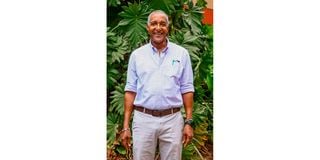
Macharia Kamau poses for a picture during an interview in Westlands, Nairobi on September 20, 2025.
Photo credit: Wilfred Nyangaresi | Nation Media Group
My lot — those of us finishing high school in the 1970s — were the first real batch to apply abroad. You’d walk into a cultural centre on Tom Mboya Street, flip through a huge book of universities, write a letter by hand, post it, then wait weeks. Eventually, a letter came back: “We accept you.” Then came the financial aid forms. Countries like the US, UK, Australia, and Germany were generous then, wide open. That’s how many of us made it.
My parents weren’t rich, but they were intelligent, resilient, stoic. They taught us purpose and patriotic pride. That’s why my passion for Kenya shocks some.
After detention, British benefactors sponsored my father to study theology in the UK. But he didn’t want to be a pastor; he went into administration instead, eventually becoming the first African Secretary-General of the Christian Council of Kenya. He had great influence on us.
My mother was only 20 when my father was taken to detention, left with two children. Anyone whose husband was detained was treated as an enemy of the State, harassed constantly.
Imagine being 20 and facing that. It made her resolute, and she raised us to be the same — to hunker down together, to never fully trust the State. Because the State can be destructive. Religion too, even though they were both deeply religious, they warned us of how it can be used destructively.
So you aren’t religious?
I’m spiritual; that scepticism shaped us. Even today, I support the church — I renovated the old colonial church we attended as children. I have nothing against the church, but anyone with eyes and ears can see the dysfunction in religion today — Islam hijacked by fundamentalists, Christianity riddled with its own problems. My parents saw it too. They were deeply conversational people.
When I brought friends home from high school, meals were always at the table. My dad would challenge something I said: “What are you talking about? That’s not true.” My friends would panic — “Oh my God, you’re going to get beaten!” But my parents never raised a hand. If we disagreed, they asked for evidence. Why do you think that? Where are you going with it?
That’s how I grew up. No fear of power. And later, with politicians who expect you to shrink before them, I simply couldn’t. My parents encouraged openness, debate, and intellectual combativeness. You could disagree, but you could not insult or fight. They set very clear boundaries.
Looking back, I still wonder how they became such modern parents. Even compared to the most “sophisticated” societies today, they were ahead of their time.
What are you trying to unlearn at your age, 65?
I think I started unlearning things in my 40s. Travel, exposure, and endless self-help books made me conscious that certain behaviours had to go.
First was time. I realised you can’t be consumed by one thing to the point of distortion. I’d seen people swallowed by religion, others by alcohol.
I love my beer; I love my wine. But I had to learn to socialise with it, not abuse it. Travelling helped: in Italy, France, America, people sipped wine to lubricate conversation, not to fall over drunk. I had to unlearn that culture of waking up with a hangover and pretending you could still perform. You can’t. Not when your work is intellectual, not manual.
I also had to unlearn how men treated women. My father was progressive, treating my sisters as equals—annoying when we were children, but invaluable later. Many men still talk down to women today, but I couldn’t.
I called myself a feminist in my 40s, which at the time was almost avant-garde. It reflected my strong mother and liberated sisters. For me, it was simple: a woman’s place is not in the kitchen.
And there was the discipline of work. My career demanded 12 to 14-hour days, weekends included. I enjoyed it, but now, in my 60s, I’m trying to unlearn the anxiety that comes with slowing down.
My day is still scheduled by the hour. I still hit the gym four days a week, because I like looking the part, feeling strong. But I ask myself: how do I ease up without feeling slothful?
Maybe in my 60s, I’ll still need to unlearn some things. But truthfully, I think I did the heavy lifting in my 30s and 40s. That’s when I righted the ship.
What was the best decade of your life?
Every decade of my life has blown me away. My teens were probably the hardest years of my life. I was small, vulnerable. I’ve seen photos from high school WhatsApp groups—everyone in the rugby and soccer teams. I never made it. I had a bit of a lip and got into a fracas with the bigger boys. It wasn’t easy.
But my 20s were a pleasant surprise. College in Worcester, Ohio, gave me space to come into my own intellectually. For the first time, I felt competent, even successful. I returned home to a broken country, but personally, I was thriving—working at Rank Xerox, doing well in business. Then, almost begrudgingly, I joined the UN after one of my Harvard professors roped me into a project. Suddenly, I was in South Africa, Botswana, Lesotho, and Swaziland—unthinkable at the time of apartheid. That’s when I began to see myself as a professional, a development practitioner.
My 30s accelerated everything. By 32, I was Chief of Section in New York. By my late 30s, a UN resident coordinator in Botswana, a post many retire into. I celebrated my 40th birthday in that role. My 40s took me from Botswana to Rwanda, then back home as Kenya’s ambassador. It was a difficult transition for a few months, but I righted the ship. My children were doing well, my career thriving.
In my 50s, I went to New York again, where I built a legacy I’m still proud of. My 60s brought me home. It was politically difficult, heavier than I’d have liked, but still an extraordinary decade.
I’ve always lived intentionally. Every decade, I’ve planned for. My decision to step away wasn’t because the president wanted me out—it was because I wanted something different. Others cling to power; I move on. I can already see my 70s will be amazing.
What do you regret?
Do I have regrets? For a while in my 40s and 50s, I wondered if I should have stayed home instead of joining the UN and spending 45 years abroad. But coming back, seeing my peers, I realised I wouldn’t have changed in the ways I did: how I use my time, how I read, think, invest in myself. My biggest worry was my children—not wanting them to grow up rootless, as aliens. Thankfully, they’re all home now, rooted. That gives me peace.
What part of your character do you feel needs development?
In my 30s and 40s, part of our training in those institutions was personality testing. You know, those assessments that tell you what type you are. I came out INTJ—introverted, intuitive, thinking, judging. The TJ was my problem: the judging, the impatience.
I even put my children through it. Those tests hold up a mirror. They show you who you are—say, impatient—and then force you to ask, how impatient? How do you handle it? They make you see what you need to adjust.
Because I worked in a global institution that invested heavily in people, we did a lot of these workshops. One trait I had to confront was my intolerance for fools. My friends will tell you, “He doesn’t suffer fools.” And it’s true—I can’t stand people with nothing to say who insist on saying it anyway. They’re everywhere—in offices, in politics, on social media.
For me, that was a real challenge, because they drain time and space. I had to learn to manage it. My solution? Silence. I let them talk, I don’t engage.
What's your greatest fear?
Are we going to make it as a country—truly maximise our opportunities? Yesterday I was giving a lecture on Kenya at 100, looking ahead to 2063. The first thing I asked was: What makes you think Kenya will even be there in 2063?
Plenty of countries never made it to a century. The Soviet Union disappeared. Ethiopia split. Eritrea, Sudan, South Sudan—gone. Somalia fractured into pieces. Yugoslavia, once thriving, vanished. We take too much for granted, treating politics and the economy with a kind of brazen ignorance that already holds us back from reaching our potential. I fear that will continue.
Globally, I worry too. I am a child of the liberal global order that rose after 1945. It created progressive institutions and a freer world. But perhaps that cycle has run its course. Conservatism is resurging, and if not managed, we risk sliding into a vicious global culture—where movement is curtailed by skin colour or nationality. Already, what was easy in my youth—getting a scholarship, studying abroad—is now almost impossible.
At a personal level, of course, there are fears for one’s children. You spend your later years investing not in yourself but in them, hoping they’ll be okay. But I don’t carry many fears for myself. I’m not anxious about heaven or hell.
My father freed us from that, so my mind is free to see the world as it is.