Dr Nelson Kuria has been in retirement for nearly a decade now. But has he? Retirement, he has discovered, is many things—one of them an oxymoron. He chuckles at the contradiction.
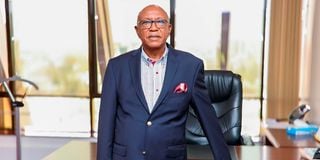
“I’m sometimes busier now than when I was a Group CEO,” he says from his office on the 11th floor of CIC headquarters. Behind him, a wooden coat hanger holds his jacket—a metaphor, really, like a footballer’s hung boots.
After entering the insurance industry in 1982 and leading CIC as CEO for 14 years until 2015, he could have easily stepped away entirely. Instead, he has found himself in what he calls "a different season"—one where the former CEO has become a sought-after chairman and board member across Kenya's corporate and social landscape.
As Group chairman of CIC, he also chairs the boards of SMEP Microfinance Bank, Enwealth Financial Services and Africa International University, while serving on the boards of Kenyatta National Hospital, Habitat for Humanity, the Kenya Society of Professional Co-operators, Citam and the Institute of Directors of Kenya.
"Many people live in denial as retirement nears, fearing the uncertainty," Kuria reflects. "For me, I saw it as a season: a time to serve, and then a time to live, leaving space for others to lead."
Through it all, he has maintained the same unassuming posture—defined not by what he has accumulated, but by how he continues to serve.
I see you have some nice notes written there in preparation for the interview. What are some of the questions you were anticipating?
No, I was just reflecting on the areas that I've been serving since retirement. You’d be surprised—I’m sometimes busier now than I was as a Group CEO.
That’s one of the interesting things about retirement: it becomes what you make of it. Still, it depends heavily on the profile and relationships you’ve built over time.
I’ve seen how valuable those relationships are, often in unexpected ways. I’ve always enjoyed building and managing connections across the spectrum—fellow CEOs, senior figures, peers, and even juniors.
In fact, it’s sometimes the juniors I once worked with who have recommended me for board positions I never imagined. That has been a powerful lesson: the value doesn’t only come from connections at the top, but also from those you nurtured at every level.
Many people assume you can only lean on peers or seniors, but experience has taught me otherwise. These lessons aren’t found in books—they come from living them.
What does a Group chairman’s day look like?
Incidentally, I don't come to the office often. As Group chair, my role is clearly set out in the board charter: I lead the board, and the Group Managing Director (MD) leads the company.
That’s where many organisations go wrong—when chairs overstep and act like CEOs, conflict follows. Governance best practice has always been my passion, so I’ve kept the lanes clear.
Many people wondered if, having been Group MD before, I’d be tempted to cross over. But I’ve always said: I’d be the last person to compete with my MD.
That’s why I rarely come to the office. Apart from board or committee meetings, I only meet the Group MD twice a month for two to three hours, to get briefed on operations in Kenya, South Sudan, Uganda and Malawi.
As chair, I serve as the link between management and the board. I ensure I’m well briefed before board meetings so I can guide effectively. Even in media matters, I draw the line—if it’s about CIC’s business, that’s the MD’s role, not mine. Technology has also helped, with many committee meetings now virtual.
How is the experience of leading leaders?
[Chuckles] Thank you, Jack, for that question. Leadership depends on how you understand the role of the board. Even as chair, I see myself as one among equals. My role is simply to moderate meetings, provide guidance, and ensure an effective link between the board and the CEO.
Many people misunderstand this and assume a chair should “boss” fellow directors, but that’s not the case. Good practice also dictates that board members don’t approach the CEO individually—they should channel issues through the chair. That keeps relationships tidy and functional. For me, the chair’s role is about moderation, guidance, and emotional intelligence.
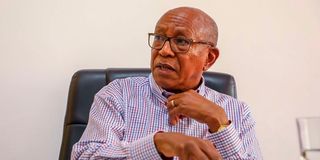
CIC Insurance PLC Group Chairman Dr Nelson Kuria during an interview at his office in Nairobi on September 16, 2025.
Photo credit: Lucy Wanjiru | Nation Media Group
Often, fellow board members are just as experienced—if not more—than you. You simply have the privilege of chairing at that moment. That realisation keeps you humble. Respect is crucial.
Every board member is different, with their own temperaments and ways of reacting. The chair must understand and manage those dynamics, ensuring decorum, mutual respect, and a healthy boardroom environment.
You worked for many decades, and now that you are retired, I’d love to know what you have learnt about the value of time.
Jack, that is a million-dollar question. Time has always been a critical resource for me, shaped by my very humble beginnings. My parents were poor labourers on a muzungu farm in Nyandarua, and from an early age, I learnt discipline through routine. In the 1960s, I would wake at 4am to milk cows and walk two and a half kilometres to deliver milk before school.
In the evenings, no matter the weather, I prepared napier grass for the cows, finished chores and still managed my homework. That daily rhythm taught me to apportion time carefully and instilled the work ethic that has carried me through life.
Even as Group CEO, I was always the first in the office—at my desk by 6am—and often the last to leave. My colleagues teased me for arriving before the cleaners, but it became part of who I am.
Even in retirement, I remain an early riser with the same discipline: sleep early, wake up early and use time deliberately. My daughter, who is a lawyer, jokes that my childhood amounted to child labour, but I remind her that for us then, it was necessary. Those routines became the foundation of my ethic, my resilience and my respect for time.
What are some of the notable things you struggled with when you were a CEO for 14 years?
One of my struggles has been trusting too easily. I give people the benefit of the doubt until they fail me. For years, I wondered if that was a weakness, but I’ve come to see trust as better than suspicion. Trust obliges people to rise to responsibility.
Most I trusted excelled, freeing me from micromanagement and creating a culture of empowerment. That mindset helped transform CIC into a high-performing institution where employees felt trusted and, in turn, earned customer trust.
Discipline is another area I hold dearly, sometimes to the point of impatience. Meetings began at 7am or after customer hours, never in between. I was known to lock the door on late comers. My values also shaped my leadership.
Raised in a Christian environment and schooled by the Christian Brothers, I was taught service, modesty and purpose beyond money. At CIC, I accepted a lower salary and, for the longest time, drove a small car because the mission mattered more than appearances.
Did you actively plan for retirement, or did it come rushing at you from nowhere?
Yes, I planned well for retirement. I actually retired at 61—though the age was 60, I was given a two-year extension to oversee regional expansion and finalise projects. But the bigger preparation was psychological. Many people live in denial as retirement nears, fearing the uncertainty.
For me, I saw it as a season: a time to serve, and then a time to live, leaving space for others to lead. That mindset made the transition easy.
In fact, I left before my extension was up—after 10 months I told the board I’d rather rest, because I had carried a heavy load for many years. I left in high spirits, with no struggle.
From March 2015, I gave myself a full year to unwind. I declined board offers until 2016. Instead, I travelled with my wife to visit our daughter in the US, caught up on movies I had never watched, switched off my phone, visited relatives and immersed myself in social activities—weddings, funerals and family gatherings.
That break allowed me to reset completely. By the time I began taking on new responsibilities in January 2016, I was refreshed and ready.
Having the discipline to respect each season was crucial. It showed me that I didn’t need to bow to peer pressure or public opinion about what I “should” be doing. The transition became not only smooth but deeply fulfilling.
What period of your life did you experience the most turmoil?
By the time I was in my early 40s, before becoming CEO at 47, I had reached the level where succession battles become most vicious.
At that stage in any organisation, people are jostling, sometimes ruthlessly, for the top job. If you don’t have a clear philosophy on how to handle failure and ambition, you can easily become bitter, carrying grudges for life.
I knew that as I rose, others also believed they deserved the CEO role. For me, that was never the problem—everyone has a right to aspire, just as I did. The problem is when ambition turns unethical, when the tackles become vicious. Even when I became CEO, I refused to retaliate.
My philosophy was simple: if God destined this for me, it would be mine. So instead of retribution, I rebuilt relationships—even with those who had undermined me. Ironically, some of my fiercest rivals became my strongest allies as we rebuilt CIC.
That period was not only tumultuous at work but also demanding at home. Many of us in that generation—the so-called baby boomers—sacrificed family time, often telling ourselves we were working hard so our children would never know the poverty we knew. But the truth is, our families paid the price. Children needed us at school events, on visiting days, in the small but important moments—and too often we weren’t there.
Part of it was also the lack of mentorship. Where I grew up, very few ever went to university. There was no one to guide us, no one to say, “If you take this path, you’ll become an economist, or a lawyer.” We were left to find our way, often by the grace of God. That absence of mentorship made the balancing act harder, and many times, the balance tilted towards work.
When do you feel like you were in the prime of your life?
By the time I was 42, I was leaving Kenya National Assurance, where I had served as Chief Manager of the General Insurance division—the biggest arm of the business. But because it was a parastatal, those were the days when even general manager appointments came straight from State House.
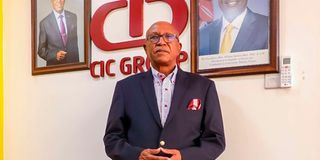
CIC Insurance PLC Group Chairman Dr Nelson Kuria during an interview at his office in Nairobi on September 16, 2025.
Photo credit: Lucy Wanjiru | Nation Media Group
I knew I had probably reached the highest technical level I could. So I chose to leave. I worked briefly in the private sector, then joined CIC in 1998.
That transition period, from Kenya National to CIC, was perhaps the most exciting of my career. It was when my philosophy of leadership truly took shape.
Having seen an institution crumble, I told myself—and I prayed—that if I was ever given the opportunity to lead, I would prove that ethical, principled leadership can make all the difference. CIC became the stage where I set out to demonstrate exactly that.
I suppose your financial needs now are not as pressing as they may have been earlier in your life. What's your relationship with money now in retirement?
One of the blessings of my retirement is that I planned early. By the time I left, my children had finished school and the mortgage was cleared.
My obligations were minimal, which freed me to enjoy retirement without anxiety. What gives me joy now is not how much I have, but how much I do. I walk, I read, I serve, I spend time with people.
Many retirees retreat into solitude because their relationships were transactional, built on position. When the title disappears, so do the calls, and it can get very isolating.
I built genuine relationships, so today I can share a cup of tea with anyone, anywhere, without fear. I walk the streets of Nairobi freely.
What matters most in this season is mentoring. I value it when a young entrepreneur tells me my counsel saved him/her from a mistake or helped them build something lasting.
That, to me, is wealth. It’s why I continue to serve in the cooperative movement—where my legacy lies, and where my purpose still calls me.
Some laugh at a former CEO walking instead of being chauffeured, but walking keeps me healthy and connected. Often, someone stops me to say, “You helped me buy my house” or “Because of you, my children went to university.” Those are the true rewards of leadership.