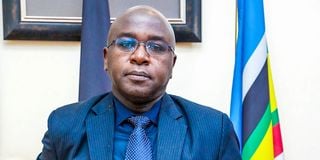
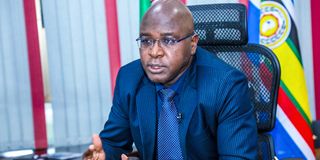
At only 12 years old, Humphrey Wattanga left home for boarding school. He later attended Alliance High School, where he topped the KCSE [Kenya Certificate of Secondary Education] exams in 1990, followed by a degree in Biochemical Sciences (cum laude) from Harvard University and an MBA from the Wharton School of the University of Pennsylvania. These are the experiences that shaped him into who he is today, the Commissioner-General of the Kenya Revenue Authority (KRA).
Before this appointment, he was the managing director of Meghraj Capital Group, the investment banking advisory arm of the Meghraj Group, and an international firm founded by Meghji Pethraj Shah (MP Shah). He is a platinum member of the Kenya Institute of Bankers.
His intellectual heft is not in doubt, but does he ever get tired of being “smartest man in the room”? To be smart, he says, is to be aware. “You have to continually improve.”
As a tax collector, do you think people somewhat resent you?
[Chuckles] I think tax collectors, from as far back as the days when Jesus walked this path, had a reputation which has not been easy to change. I don’t take it personally, but I represent, and I’m part of an institution called KRA, which in and of itself has built an association and a reputation with the public over the period of its existence, which is 30 years.
We acknowledge that that has not necessarily been a favourable reputation over the years. The question is, what is it that we have learned in the past, and how do we improve on it going forward so that we can be seen to serve the public in much more favourable terms? I seek to transform tax administration and the tax processes to be as painless and passive, and even pleasant to our clients as possible.
I have to say, you sound well media-trained.
Haha!
Looking back at your career, what was your Eureka! A moment that made you realise you were onto a good thing?
After I finished high school, I went to medical school at Chiromo.
Then, having been the top student in Kenya in the KCSE, I got this scholarship to go to Harvard University, where I studied biochemistry, trying to contribute to science and see how we could bring advanced molecular genetics and scientific research to Africa to attend to our specific set of medical challenges.
But then I realised for us to have the technology and the capacity to do advanced research,we need resources.
One thing led to another, and I got the Nelson Mandela Hope Worldwide that took me to the Wharton School of Finance, where I slowly drifted into finance and technology, graduating in 2000, at the peak of the dot-com economy.
In 2002, the dot-com bubble burst, and the company that I was working for was then acquired by the biggest telecommunications company in the US, AT&T, which then bought into South Africa Telecom.
I was part of the team that was then sent to South Africa, where my three-month assignment turned out to be almost nine years.
That was a great opportunity to view the challenges and opportunities in Africa from a developmental perspective.
Within that time, I was engaged by the government of South Sudan.
After the signing of the Comprehensive Peace Agreement on January 9, 2005, I was one of the economic advisers. We then moved into Juba. As you can see, it has been an adventure. [chuckles].
What does it take to get here?
Foremost is diligence and recognising that you need to work hard and effectively take advantage of the opportunities. Our parents instilled in us that education was the principal path out of the circumstances we were raised in.
You have to push yourself into available opportunities and work to excel once you get into a position so that you can rise above your peers, get recognised, and almost always, that opens more doors for you. It’s hard work and discipline.
There’s hard work and discipline, but how much luck does one need for their name to be whispered to the right ears?
I’m not certain one can quantify luck [chuckles]. Because luck is an opportunistic event. You want to be ready and prepared if and when that aspect of luck happens. I wouldn’t say I’ve been lucky.
Kenya Revenue Authority (KRA) Commissioner General Humphrey Wattanga Mulongo during the interview at his office in Nairobi on August 25, 2025.
Photo credit: Lucy Wanjiru | Nation Media Group
Looking at my journey, to some extent, I have made an effort toward something, despite the uncertainty. And then maybe what you then call luck comes. But it’s not something that just appears out of the blue.
You’ve studied at Wharton and Harvard, you were the top KCSE student in 1990, and the 20th nationally in the 1986 KCPE. You are quite the intellectual and bookie. Do you ever feel “not smart”?
Haha! You don’t go about feeling smart. If there’s anything like smartness, I think it is a thirst for knowledge, a desire to improve oneself in terms of technical know-how, social capacity, and not just purely academic per se.
To be smart in a complex context, such as the one we exist involves a lot of consciousness, which is partly technical, partly social, partly political. So, it's a composite of all those things. And it’s an evolving aspect. To be smart is to be aware; you have to continually learn, engage, improve, and consult.
If you were to interview and hire yourself for one skill, what would that be?
The ability to interrogate and analyse situations, what we call, in a very simplistic sense, SWOT [Strengths, Weaknesses, Opportunities, and Threats] analysis.
The ability to move into a space and understand the context and figure out where the gaps are and the very strategic or tactical input that is required to have the greatest impact.
Which of your career moves paid off immensely?
Leaving the US for Africa. In 2004, I moved to South Africa and established a corporate finance and transaction advisory firm. This venture gave me extensive exposure to, and a deep understanding of the developmental challenges, as well as the immense potential and opportunities on this continent. It was an alignment that put me on the exciting journey of tackling some of Africa’s most pressing challenges.
Now that you occupy this seat, are you ever that friend in “high places” whom people call because “Humphrey can make this or that go away”?
It’s only human that your friends or those who have access to you will try to reach out to address their issues and challenges. I’ll be available to listen, which is an important part of intervention. Whether I act is a different matter [chuckles].
You occupy a position where you’re more often than not in a Mexican standoff situation. How do you not let that seep into your personal life?
It begins with you understanding your mandate, and responsibility, and the degree of freedom that you may or may not have.
I think with that clarity in mind, because in most cases, the asks that might come to you, some people think that because you occupy this space, you can do anything.
My priority is collecting taxes and mobilising resources for the critical development of this country. I'm here specifically to maximise the mobilisation.
What did they not tell you about this seat?
The way the organisation is funded. I spend a significant amount of my time looking for funds to run the organisation. But there's always the notion, even among some fairly senior people in government, that KRA collects these trillions, so it should have enough first for itself.
But that's not the way the government is set up, and specifically for this organisation. We are funded through the normal budgetary processes, and I am constantly seeking resources to run the organisation.
What has leadership taken from you that you did not expect to lose?
I've been fortunate to be in leadership for a long time, since high school, where I was appointed the school captain at Alliance High School.
That was quite the experience, in the sense that, in terms of limitations, what it takes from you, sometimes that's the flexibility and some relative freedoms that many others enjoy.
Because you have to be self-conscious to a large extent, which, I should note, is not necessarily a bad thing. You can't just pop up anywhere and say anything. Also, to some extent, it limits your availability to friends and family.
Having been a leader throughout your life, when do you ever just discard the cloak and be a man? A father, a husband, a Humphrey.
I don’t think my children recognise my titles [chuckles]. Largely, I try to find a day, like say on Sunday, go recharge, spend time with them, or sometimes take a few days of vacation. Sometimes it is just as simple as waking up early, having breakfast with the children, and then, if possible, take them to school, and then go and become Commissioner-General.
You're a high achiever. And naturally, we talk about “filling one's father's shoes”. Do you think that puts pressure on your children?
I imagine it does to some extent. But I think we've gotten here partly because of the push that we got from our parents. For them, it was about trying to ensure that we take advantage of the opportunities, particularly education, so that we can cross over to the other [better] part of town.
For our children, it's different. They are already in this part of town [chuckles]. Our task now is to find a way to instill the importance of staying focused, disciplined, and working hard, but without necessarily burdening them, trying to make them who you are, or that they feel they can't emulate what you've done.
You want to balance it in a way that they can also chart their own path and succeed in whatever it is they want to do without trying to mirror you.
What part of fatherhood don’t you currently have a handle on?
I’d like to spend more time with the children, especially as they get older. Time moves very fast, and in my case, I pretty much left home when I was 13 to go to high school.
Looking back, I effectively never went back home because it was a boarding high school, then Chiromo, then I went to the US for 21 years, and by the time I came back, my parents were old.
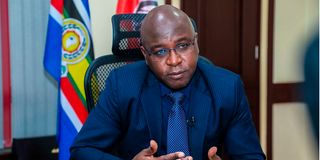
Kenya Revenue Authority Commissioner-General Humphrey Wattanga pictured during an interview at his Nairobi office on August 25, 2025.
Photo credit: Lucy Wanjiru | Nation Media Group
My dad passed away five years ago and since then I have always stayed mindful that I have a very short time with my children, a small window of time to have influence and impact before they leave. That is what concerns me: When will I have that?
Has being a parent made you understand your father more?
When I was going to boarding school, my parents were moving from Nairobi to Kitale, and even then, we never went home during most of the holidays. But I understood my dad. He was a smart guy, fairly driven in his own sense, an accountant. It’d be interesting for him to learn that, though I’m not one, I’m effectively leading an organisation full of accountants.
We eventually become our fathers.
Yeah, I think so.
When you look back over your life, what feelings come to you?
A journey driven by a desire to push the envelope and pursue my passions, both from a professional and social perspective. To build and hold a family together. And when I say family, it’s the greater family while maintaining and building on my co-friendships from the hood to the US.
Have your friendships become more vital with age? And when did that realisation come, having been all over the world?
I've been fortunate, I know it sounds like a broken record, but you can't talk to an Alliance guy without it being mentioned, haha! For those of us who went to Alliance, wherever we went, we were always there.
When I was at Harvard or Wharton, there were Alliance people there, like John Gachora of NCBA. Most of us are now back in Kenya, and we had the opportunity to continue with our friendships.
I've also been fortunate to still maintain, not to the extent I would have liked, some of my friendships from where I grew up, in Uhuru Estate Primary School and my Buruburu days.
What has success not fixed?
That’s a very difficult question [chuckles]. Success is a relative term and a journey. I cannot say this is it, that I’m successful, I’m fixed here.
The relative success that I’ve had has only inspired me to aspire to greater successes, with the objective of having a bigger and greater impact in the lives of those that I love and care for, and in the community and the nation-state that I exist and that has given me the mandate and the obligation and the responsibility to provide that advancement and provide an angle for a long-term sustainable impact going forward.
You've managed me there, but since we are chasing the day, I’ll ask one final question. When you look in the mirror, what kind of man do you hope to see?
I hope to see somebody who's happy and fulfilled in having optimally and fully applied themselves and leveraged every opportunity that they came across, and in so doing, having had the desired impact to make a difference.