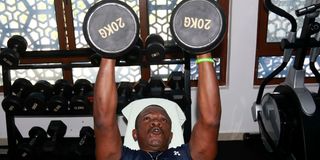
Most people would blame the Mombasa heat for skipping workouts. Ordinarily, you will be wiping sweat that formed before the warm-up even begins. However, Morris Ongere has lived in that heat his entire life, and somehow, he has carved out a physique that defies both the weather and the passage of time.
At forty-nine, with his fiftieth birthday looming, he has remained what the young men at Nyali Beach call “fit like a dhow sail”— taut, purposeful, and seemingly defying the natural laws of aging.
Mombasa, with its heavy blanket of humidity, is not where one expects to find a man of Morris’ age well-toned with impressive musculature, like someone who trains in crisp morning mountain air. Yet Morris cracked a code—a rhythm of breath, sweat, and smart training—that allowed him not only to survive the heat but to also thrive in it.
“Training under the heat of Mombasa can be challenging. To maximise your workout in Mombasa or at the Coast, you have to be extra disciplined; there aren’t two ways about it. That means waking up early around 5am before the sun comes out. By the time humidity starts to roll in at 7 am, you’ve already done a significant part of your workout.”
There’s a second option too, though not as forgiving.
“You can also wait until the sun sets and train in the evening. But that can be challenging, especially if you’re just visiting and not used to the heat. Some nights, the humidity still rules.”
But since he became a fitness trainer after quitting his job as a chef, a profession he’d never truly loved, many of his clients prefer working out in the evening after work. And so he found a way to make it enjoyable, allowing everyone to forget, even for a moment, the punishing Coast humidity.
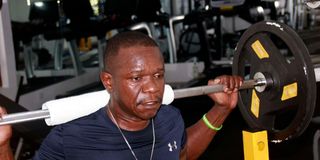
Morris Ongere performs a barbell back squat at the Shaza Fitness Centre in Shanzu, Mombasa on November 8, 2025.
Photo credit: Kevin Odit | Nation Media Group
“For my evening sessions, I realised I need to make it fun because people are already tired from work, and the humidity can only make it worse. So making the classes engaging and fun eases the day’s dullness. So what do I do? I incorporate a lot of music that people enjoy with easy workouts and dance, which I am very good at choreographing because I used to be a dancer during my younger days. When people are together, laughing and challenging each other, they forget about the heat. They forget they were working out at all and look forward to the next class.”
But for his own personal training, Morris says his approach is rather different from what he does with his clients.
“Most of my clients want to shed a few kilos, so I have to craft exercises to address that, and that means lots of cardio, bearing in mind the cuisine culture at the Coast is carbohydrate-heavy. But when it comes to me, I do things rather differently,” Morris explains.
During his younger years, he did a lot of cardio, especially long-distance running—something he can no longer keep up with at 49.
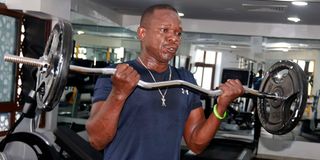
Fitness instructor Morris Ongere performs a barbell bicep curl at the gym in Mombasa.
Photo credit: Kevin Odit | Nation Media Group
“For years, I used to do a lot of cardio,” he recalls. “A lot of dancing and long-distance running. It got even worse when I went into full-time fitness because many clients want to lose kilos, so that means constant cardio classes. But a lot of cardio eats up your muscle. And as you age, you need more muscle for longevity and functionality. To ensure I do not lose the muscle I built when I was younger, I focus more on strength training. At this age, I prefer it to any other form of exercise.”
Morris goes further.
“You are looking for the muscles to make the body move, and that is very crucial as you age. When you do strength training, it gives you more power, more energy to do things.”
But for Morris, even though he needs muscle, he no longer seeks to bulk up—only to maintain.
“I don’t need extra muscle. I just need to maintain what I built during my young years when I had the power to lift heavy. Now, I can’t lift heavy anymore because I fear injuries, which can be very stressful. So I don’t push myself too hard with weights. But to ensure my muscles are triggered, I do strength training five times a week.”
Morris says he has made peace with time. His body is different now—not worse, just different. He no longer chases the heavy weights he lifted at twenty, when 120 kilogrammes felt like a personal challenge. Now he lifts lighter—80 kilos maximum for chest press and squats. It’s more strategic now.
He has learned that three times a week of strength training is enough. That touching each body part—arms, legs, core—with intention is better than exhausting himself daily. That long-distance cardio, which he loved in his youth, no longer serves him the way targeted strength work does.
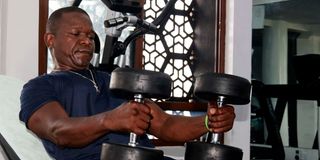
Morris executes a flat dumbbell chest press.
Photo credit: Kevin Odit | Nation Media Group
It is wisdom earned through decades of listening to his body instead of lecturing it. Sometimes when life happens, he breaks for two or three weeks and starts all over again. No shame, no self-flagellation—just the patient work of rebuilding.
“When you are adapted to this kind of life, if you miss even a week, your body feels messed up, your mind is messed up, and when you go back you feel weak. But there is no problem with starting again, because there is muscle memory. So you shouldn’t worry when you go back to working out after a break and realise you aren’t as strong as you were before the break. Sometimes the body needs that—to rest and start afresh.”