Esther Shisoka has an unmistakable magnetism that makes you pause mid-sentence when you first meet her. It lies in her warmth and charm, and in the quiet confidence that seems to radiate effortlessly from deep within her. Perhaps it is a glow honed over decades of doing humanitarian work around the world, touching lives and gathering wisdom.
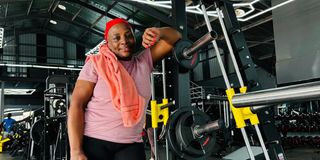
When we meet on a crisp morning at a gym on Kiambu Road, she has already been working out for half an hour. It’s 7.30 am. She is wearing a red bandana and is drenched in sweat, smiling as if the session were a leisurely stroll rather than the gruelling routine her coach, Sophie, has put her on.
“How old do you think I am?” she asks, her eyes twinkling mischievously as she meets my curious gaze.
I scan her face, taking in the smooth skin and luminous energy, and noting the absence of any tell-tale signs that usually betray one's years.
“Fifty… at most,” I say.
She bursts into laughter. “People have given me even less than that,” she fires back.
It’s hard to argue with that. At 62, Esther looks as though she has managed to turn back time.
“I still look pretty, don’t I?” she teases.
For Esther, fitness isn't a New Year's resolution or a vanity project undertaken in a midlife panic. It's woven into the fabric of who she is. Movement has never been a hobby for her, but a way of life.
She has been active since childhood, and though life has presented her with familiar challenges — career, motherhood, changing priorities and an evolving body — she has never wavered in her commitment to staying fit.
"I've been active all my life, since I was a young child," she explains, between sets of a full-body workout.
"But of course, as you get older, a lot changes. Life gets in the way, there's the job, the family. As a woman, your body transforms with time. But even then, I've always found ways to ensure I'm consistently working out."
Her humanitarian work is a passion that she has pursued for years and it demands extensive travel. She spends weeks or even months in different countries, addressing crises, building programmes and changing systems. It's the kind of schedule that would give most people her age, or even younger, a convenient excuse to abandon their fitness routines.
Not Esther, though.
"Even when I'm away on such trips, I will always find ways to stay active. Who says I can't stay pretty at 62?" She dissolves again into her signature laughter.
Back surgery
But beneath the hearty laughter and easy smiles lies a more complex story. Even as she pumps iron with focused determination and admirable precision, a nagging, often excruciating pain courses through her back. This is evident in the slight wince between reps, the momentary pause before lifting, and the careful adjustment of posture.
"My threshold for pain is quite high, so I tend to ignore a lot of stuff. I began feeling it (the back pain) about three years ago and assumed it would go away over time, but it didn't. The pain would come and go. However, with time, it got so much worse, so excruciatingly painful that sometimes I couldn’t walk or sleep well."
Last year, she finally decided to seek answers.
“The MRI scan revealed that one of my spinal discs had moved out of position.”
When the misaligned disc presses against her sciatic nerve, the pain travels from her lower back to her hip and down her knee. “Some days can be really painful,” she admits.
So why does she keep lifting weights? Why maintain such an active routine while dealing with an injury that would stop most people in their tracks?
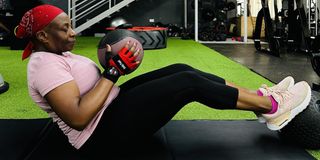
Esther Shisoka works on her core, performing a Russian twist with a medicine ball.
Photo credit: Sinda Matiko | Nation Media Group
Esther smiles, revealing both defiance and discipline.
“That’s why I have coach Sophie with me. She guides me and makes sure I don’t do anything that can make it worse. But I can’t just sit and do nothing. That’s not me.”
Surgery is her only remaining option after physiotherapy and chiropractic sessions failed to help, and it has already been scheduled for January.
Until then, she is simply adjusting her workouts, keeping them lighter but refusing to stop altogether.
Given her lifelong level of activity, her doctor is confident that she’ll be back on her feet within a month of the operation. Esther can’t wait.
The injury has slowed her progress, limiting the targets she has set for her body. She misses her former stamina and the intense, unrestrained challenges she once set herself.
The irony of her injury isn't lost on her. The very activity that defined her vitality for years is what caused this setback. According to her doctor, the displaced disc stems from decades of intense running.
"I used to do lots of running and half marathons. I would clock probably 100 kilometres every week," she recalls.
"The doctor says the movement of the disc was a result of the constant impact of my leg hitting the pavement during all those years of running."
Each chapter of Esther's fitness journey reveals another dimension of her athletic past.
"That's why I tell you, it would be torture for someone to ask me to pause from exercising because of the back issue. You know, when I started, I used to do track and field, play field hockey, and then run. In between all that, I also trained in karate."
The karate story
"That phase kind of ended when I was about to get my black belt because I was moving to another continent," she says with a hint of regret.
"But I can tell you, with karate it's like riding a bicycle: Once you learn it, you never forget the moves. If you don't ride for a while, when you get on, you might wobble, but the groove doesn't take long to get back. The same applies to karate."
Those three years of karate training were transformative. They sharpened her reflexes, strengthened her mobility and taught her the kind of discipline that still anchors her today, even in times of pain.
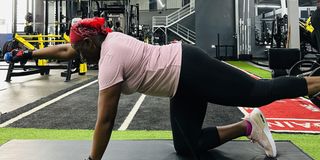
Watching her perform a knee plank — balancing gracefully on one knee with the other leg suspended in the air while holding a dumbbell steady with one arm — makes her point immediately clear.
Esther Shisoka works on her core and balance by performing a knee-to-elbow plank with a dumbbell.
Photo credit: Sinda Matiko | Nation Media Group
“Karate instils a different level of mental discipline,” she explains. “It teaches body movement, agility, and strength, just not with iron weights. You use your own body weight. People think karate is just fighting, but it’s really about mastering how your body moves. When you see those mid-air flips and kicks, that’s because someone has learned to control their own weight. And if you can control your body weight, everything else, your agility, balance, functionality improves. Not many people can handle their own body weight. I tell you, men used to be scared of me.”
Even at 62, Esther plans to return to karate, but this will depend on her recovery after surgery.
Watch what you eat
Once the weights have been racked and the sweat has been towelled away, Esther’s discipline extends to her home.
She is intentional about what she puts on her plate, a commitment she believes is especially crucial for women navigating their menopausal years.
“As you age, your metabolism slows down. Exercise helps, yes, but it can only do so much when age is working against you. That’s why I’m very cautious about what I eat,” she says.
She speaks candidly about menopause — another chapter of change that is often unspoken of yet deeply felt.
“Women my age go through hormonal shifts that can be so unpleasant, the hot flashes, mood swings, sweating, and sleepless nights. Exercise helps, but diet is key. Hormones are triggered by what we eat, so you have to feed your body nutrient-rich foods to help keep them in balance.”
For Esther, that balance comes through a simple routine. She practises OMAD (one meal a day), often enjoying a clean, wholesome plate of chicken or fish paired with a bowl of homemade vegetable salad, which she eats later in the day.
“I’ve never had a sweet tooth. I don’t take sugar at all. Even my white tea is sugarless. I also try hard to stay away from wheat and any processed foods.”