Time flies with great content! Renew in to keep enjoying all our premium content.
Prime
How firm filled frozen-fries gap KFC once plugged with imports
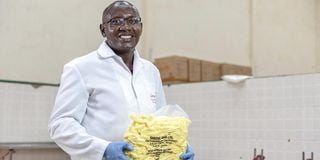
Humphrey Kaigi Mburu, Founder & CEO of Sereni Fries Ltd, displays freshly cut fries at the company’s Mlolongo factory in Machakos County on February 16.
When KFC’s announcement in 2021 caused a social media storm with its revelation that it was importing frozen cut potatoes from Egypt, Humphrey Mburu saw an opportunity to take his enterprise into the next phase of growth.
At the time, Mr Mburu was already supplying fresh potatoes to Nairobi eateries through his company, Sereni Fries Ltd. He knew the demand for convenience-ready fries existed, but the KFC saga exposed something bigger.
“That moment confirmed what we had always suspected,” he recalls. “There was a huge untapped market. Kenya.”
It was also a reality check moment for him when KFC approached Mr Mburu to supply them after encountering logistical challenges importing frozen fries.
“Luckily, we had equipment, so we began exploring frozen fries at our Mlolongo facility. But we didn’t meet KFC standards initially,” says the entrepreneur who was a banker at Fina Bank before venturing into potato processing.
This only pushed him to improve and in 2024 set up a new line for frozen fries. “The industry has grown in leaps. Very few people still import frozen fries,” he observes.
Journey to industrial processor
Mr Mburu’s journey into the business began long before the online uproar. In 2012 he had his light bulb moment.
“I was talking to a friend who operated a fast-food restaurant in town. He was lamenting about the value-chain challenges they faced as an industry, especially around handling French fries. As he talked, I realised that if I could take away their headache and offer a solution in potato handling, there was a business opportunity,” he recalls.
At the time, most restaurants bought raw potatoes and processed them at the back of their outlets, a labour-intensive process that created significant waste-management challenges. The big idea, therefore, was to create efficiency for restaurants by delivering fresh-cut potatoes.
With a Sh175,000 loan, he set up Sereni Fries as a sole proprietorship and later quit his job in May 2013.
“We started in Mlolongo, Machakos in a small room where my first employee and I worked at night. I would then deliver potatoes to all three of our clients in my Toyota Probox.”
Those early days were “messy but instructive”, he says. Through mistakes and miscalculations, especially on potato varieties, Mr Mburu learned the demands and standards of the industry.
The greatest lesson from that season, he says, was to always be willing to learn and never fear making mistakes.
A key strength of his business model has been audacity. Mr Mburu cracked the code of asking for business very early. Before their first year ended, he had secured a major client.
“I knew someone who worked at the Hilton Hotel. He introduced me to the executive chef, a Frenchman, who immediately saw the brilliance of our idea. He asked for a sample; we delivered it the same day, and he approved it and placed our biggest order then—30 kilogrammes, which we delivered immediately.”
About a year later, the business had grown significantly. “We were pushing about 200 kilos a day. That made us realise we needed more people, more space, and more water to manage growth.”
They relocated to a bigger space in Mlolongo. Mr Mburu’s brother joined as an investor after buying into the vision. In the same year, Sereni Fries onboarded Big Square, Naivas Supermarkets, and their biggest client to date—Chicken Inn, operated by Simbisa Brands Kenya.
A major turning point came through a trip organised by the Dutch Embassy for Kenyan industry players to the Netherlands. “We explored the entire value chain and learned how to market better. It made us realise the impact this business could have back home. That trip confirmed that I was in the right industry.”
Their growth led them to an even larger facility, and in 2016 they moved to their current 9,000-square-metre operations plant in Mlolongo. Around this time, they made an important discovery: “We quickly noted that for every 100 kilos you process, you need one person. Understanding scaling and capacity from an informed standpoint changed everything.”
By 2019, the business seemed to have plateaued.
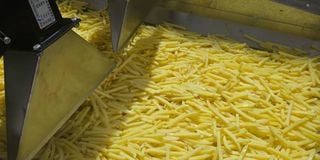
The potato-cutting process at Sereni Fries’ frozen-fries factory in Naivasha, March 2025.
Then came 2021. A market ready to be claimed revealed itself. Besides KFC, other restaurants also started making inquiries about frozen fries.
Mr Mburu says,“That’s when we made the decision to move into frozen fries properly.”
Funding has been necessary at every phase of expansion. How has Sereni Fries achieved this? “We have grown in two ways: reinvesting our profits and through loans from a local bank that has believed in us since 2015.”
The core of their business—the potato—must be the right variety and quality. “Kenya is saturated with a variety called Shangi, which is not suitable for the products we make. After returning from the Netherlands, we began working with seed companies to introduce better varieties.”
Today, Sereni Fries works directly with farmers growing their preferred varieties, eliminating middlemen and ensuring quality. “We have a network of about 3,000 farmers from all potato-growing regions, both smallholder and large-scale. Our top varieties now are Markies and Challenger. ”
Sereni Fries operates nine fresh-cut potato outlets countrywide, employing 65 people, and one frozen-fries line in Naivasha, employing 73 people.
“With frozen fries, it’s easier to operate from one central location because the product does not need to get to clients as quickly as fresh-cut. We supply the entire country from Naivasha.”
Their production has grown nearly 800-fold. “We started with 30 kilos a day; now we do 9,125 tonnes annually. We plan to scale even further. Outside Kenya, only Egypt and South Africa do this kind of business. The potential in the Sub-Saharan region is huge. We are eyeing Uganda, Tanzania, Rwanda, and beyond.”
Industry knowledge has also propelled their growth. “We now know things we didn’t know when starting out. Knowledge increases efficiency, reduces wastage, and grows margins.”
What is Mr Mburu’s long-term vision?
“My idea for Sereni Fries is to lead a potato revolution in the region—both in production and marketing. We want to steer it. The market is untapped, and if we are deliberate, it can become a key economic driver.” He notes that Kenya will host the World Potato Congress in 2026. “If you ever needed a sign, this is it.”