On the outskirts of Kitengela, Kajiado County, a one-acre farm hums with an unusual kind of life.
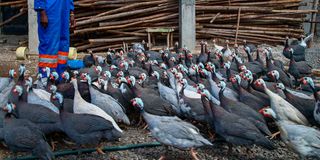
We arrive and the first thing that greets us is the high-pitched calls of hundreds of guinea fowls roaming freely on the farm. Here, Fredrick Omondi keeps guinea fowls, Brahma chickens, and other rare ornamental birds.
Mr Omondi started the agribusiness three years ago, with only Sh50,000 as capital.
“I started with just 23 guinea fowls and three Brahma chickens,” he says.
Today, the engineer-turned-farmer has over 800 guinea fowls, 300 Brahma chickens, and around 400 Kenbro birds.
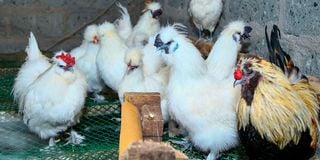
Mr Omondi has also diversified into ornamental species such as Japanese Silkie and Polish Bantams, totalling about 50 birds.
“I chose poultry because it requires little space but offers great potential,” he says, adding, “And guinea fowls, especially, have proven to be a game changer.”
Kimalat Holdings Co-founder, Fredrick Omondi Obuya holds guinea fowl eggs at Kimalat Holdings poultry farm in Kitengela, Kajiado County, on October 14, 2025.
Photo credit: Wilfred Nyangaresi | Nation Media Group
The venture into guinea fowl and ornamental birds farming was born out of frustration and experimentation. Like many agribusiness beginners, he initially started with chicken farming, mostly keeping the Kenbro type.
However, repeated disease outbreaks nearly wiped out his first flock. That experience led him to think of keeping alternative birds. He did research that included visiting farmers rearing ornamental birds, and veterinarians.
“That is how I discovered guinea fowls are the best,” he says.
The birds, he says, are hardy, disease-resistant, grow faster, and are light feeders. They also rarely fall sick compared to other birds, he explained.
His business primarily focuses on breeding. He now breeds white, lavender, helmeted, and royal purple guinea fowls, which he sells at an average of Sh4,000 per pair. A mature guinea fowl, he explains, can lay up to 300 eggs a year, making it ideal for keeping as pets and for profit. When the BDLife visited, he had 700 guinea fowl eggs he was hatching for chicks.
“They are perfect for both farmers and pet lovers,” Mr Omondi says. “For farmers, they are reliable layers, and for pet owners, their beauty and temperament make them a delight.”
Over the years, he says, the more he learned about them, the more passionate he became. “They are intelligent and fascinating birds to rear,” he says.
Mr Omondi says farming is now his full-time occupation, though he hasn’t entirely stepped away from engineering. From time to time, he still takes on construction projects alongside his business partner, Timothea Owiti, with whom he co-founded Kimalat Holdings Ltd.
His training as an engineer has been beneficial on the farm. It has given him a unique approach to farming, one that is structured, data-driven, and systematic.
Kimalat Holdings Co-founder, Fredrick Omondi Obuya tends to his guinea fowls at his poultry farm poultry farm in Kitengela, Kajiado County, on October 14, 2025.
Photo credit: Wilfred Nyangaresi | Nation Media Group
“Engineering has taught me how to plan, build, and maintain systems. I have applied the same logic to poultry farming,” he says.
His farm is efficiently organised, with automated water drinkers, well-ventilated pens, and a semi-free-range system that allows birds to forage while ensuring control over the food they eat.
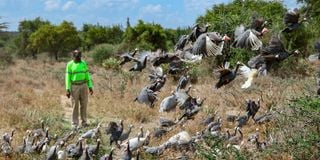
His farm borders bare land with bushes and grasses, where he releases the birds to fend for themselves. For the free-range mode of feeding his birds, he releases them in groups of 200 and has trained them to an extent that they return to the farm when the sun sets.
Keeping costs low
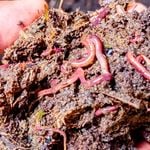
Crucially, Mr Omondi has embraced organic and insect-based feeding. His birds feed on protein-rich insects like grasshoppers and ants, supplemented with vegetables, kitchen leftovers, and organic waste. “These protein-rich foods help the birds grow faster and healthier,” he says.
Through the feeding model, he has managed to cut the farm’s operational costs by about 70 percent. His sustainable feeding approach not only reduces costs but also promotes natural bird health and immunity.
On good days, he earns good money after selling his guinea fowls for Sh4,000 a pair, the Polish Bantam for Sh7,000 to Sh8,000 per bird, while the chicken’s prices are dictated by demand.
Japanese Silkie ornamental birds at Kimalat Holdings poultry farm in Kitengela, Kajiado County, on October 14, 2025.
Photo credit: Wilfred Nyangaresi | Nation Media Group
He recently started exploring selling his Japanese Silkie, which go for Sh6,000 per bird. His customers include local poultry farmers, pet lovers, and ornamental bird enthusiasts. “Some buy them for breeding, others for aesthetics,” he says.
Own hatching, he explains, allows the farm to maintain quality control and reduce dependence on external suppliers.
Three years down the road, his hard work has started paying off. Apart from good returns, he recently won the 2025 Nairobi International Trade Fair award, during the just concluded Agricultural Society of Kenya (ASK) show.
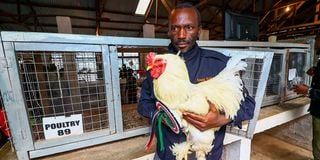
His white Brahma cock, affectionately named "The White Giant", was crowned Supreme Champion in the poultry category. He also sold over 300 birds at the show, each going for Sh2,500.
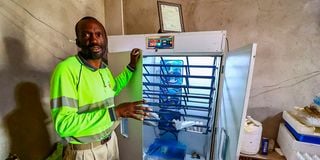
Kimalat Holdings co-founder Fredrick Omondi Obuya stands beside an incubator at his poultry farm in Kitengela, Kajiado County, on October 14, 2025.
Photo credit: Wilfred Nyangaresi | Nation Media Group
His bird weighing 5.5 kilogrammes stood out for its size, health, age, and grooming.
“My bird scored highly in all those areas. Brahma cock is a beautiful bird. In some countries, people keep Brahmas purely for ornamental purposes because of their beauty and calm nature,” he says.
Sh10,000 White Giant
The "White Giant", valued at Sh10,000, is only nine months old. It is part of a breeding line that traces back to his first Brahma, which weighed seven kilogrammes before it died.
“Every success and challenge teaches you something new. You learn, adapt, and improve with each generation,” he says.
Despite his success, Mr Omondi admits the entrepreneurial road has not been smooth. “In the beginning, I lost birds to diseases and poor feeding,” he says.
Currently, space and market expansion are his biggest challenges. “We have outgrown our one-acre land,” he says at his busy compound.
He is now exploring ways to expand and reach new markets, emphasising that one should not put all his or her eggs in one basket.
His vision is to scale up to a larger farm that integrates a modern hatchery, demonstration centre, and training facility for aspiring poultry farmers.
Kimalat Holdings founder, Fredrick Obuya, with his award-winning Brahma chicken at the 2025 Agricultural Society of Kenya (ASK) Nairobi International Trade Fair, held at Jamhuri Park showground on October 3, 2025.
Photo credit: Wilfred Nyangaresi | Nation Media Group
“There is a huge interest among young people, and I want Kimalat Holdings to be a training hub for them,” he said.
From a one-man show, he now employs four permanent workers. “At first, I was doing everything myself, feeding, cleaning, and sales. Now I have a team that helps run daily operations,” Mr Omondi says.
Growth factors
Another factor behind the agribusiness’s steady growth, he says, is having a partner who helps structure operations and build vital networks. He believes that collaboration is a powerful catalyst in entrepreneurship.
“Co-founding makes scaling easier. We share ideas, divide responsibilities, and bring different strengths to the business,” he says.
Fredrick Omondi Obuya, co-founder of Kimalat Holdings, stands beside solar panels that power his poultry farm in Kitengela, Kajiado County, on October 14, 2025.
Photo credit: Wilfred Nyangaresi | Nation Media Group
He believes Kenya’s poultry sector holds immense potential for youth employment and agribusiness innovation, as demand for quality birds, both for white meat and ornamental purposes, is growing fast. And with proper management and creativity, poultry farming can be a sustainable source of income.
His advice to aspiring farmers?
“For one to be allowed to breed guinea fowls, you require a permit from the KWS [Kenya Wildlife Service], which costs Sh1,000 per year. Then do your research before starting. Talk to people in the business, learn from their experiences, and start small. Success does not come overnight. Even with a small space, you can grow.”