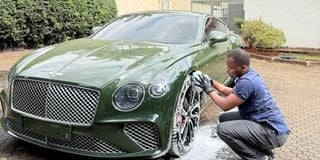
The first time Malcolm Kirago held the keys to a Bentley, there was some hesitation because it wasn’t his car. In fact, it was the first Bentley he had ever seen up close with leather that still carried the smell of newness, an engine note that made him marvel before settling into the driver’s seat.
His job? Not to drive it, but to restore it. It has become a thriller teaser into a world of cars, Mr Kirago only grew to admire.
“First of all, I had never seen a Bentley before. My work makes me have mind-blowing encounters with all these luxurious cars,” he says.
What took him there was a skill that many Kenyans are beginning to appreciate: car detailing.
Unlike the normal car wash service, car detailing is the art and science of stripping down a vehicle, cleaning it piece by piece, with the outcome looking like a machine that just rolled off the showroom floor.
In Kenya, a car wash service would often cost Sh300, a service that takes about 30 minutes. Alternatively, would you entertain the idea of paying Sh15,000, or even more, to have your car cleaned?
At 31,Mr Kirago is your typical street-smart CEO. He did not go to university. “I instead became my own student, I learned almost everything I know from YouTube, online resources, and by practising. That self-education helped to change my mindset. I always believe that knowledge is everywhere if you’re willing to put in the hours to find it,” he says.
His early career zig-zagged through vlogging, artist management, and social media marketing. But when Covid-19 hit, he had to have a changed way of working.
Malcolm Muturi detailing the left wheel of a Bentley Continental GT.
Photo credit: Pool
“When Covid came, everything stopped. I realised businesses were booming, and they didn’t have the social media processors to create content. I started, not as a content creator, but by creating ideas for these companies. If you look at my detailing videos, they are very meticulous. I show things that are supposed to be seen,” he says.
That meticulousness, coupled with his passion for cars, became the seed for Urban Detail, his premium detailing business. He began with a friend’s Mazda CX-5.
However, his work now spans Nairobi’s most coveted machines, from Range Rovers and Mercedes S-Class sedans to the likes of Porsches, Bentleys, and Ferraris.
The car wash vs car detailing gap
For decades, the car wash business has been one of Nairobi’s most ubiquitous small businesses. On any major road, a motorist can pull into a car wash bay and have their ride cleaned.
Even at high-end petrol stations or luxury neighbourhood wash bays, a “premium car wash” might cost Sh3,000 to Sh5,000.
But detailing is a different game in the wash.
“A normal car wash focuses on speed and volume. It’s mostly about how many hours, how many cars they can wash in a day. With detailing, we focus on precision, protection, and presentation instead of just soap and water,” Mr Kirago says.
The difference is not just in its cosmetics. “We use specialised products, premium equipment and techniques like paint correction, leather treatment and protective coatings. A car wash makes your car look clean. Detailing makes your car look better, last longer, and feel like it’s a new car. It’s the difference between a quick wash and a premium experience,” he adds.
The cost? “My prices are tailored to each client because every car has different needs. Before giving a final quote, I normally do an inspection to assess the condition and level of work required. On average, a premium detail can range between Sh15,000 to Sh30,000 for SUVs, while specialised work like paint correction or aircraft detailing is priced higher depending on the service,” he says.
Inside the process
Unlike a quick rinse-and-go, detailing can be a whole day affair. It begins with the wheels to prevent dirt splashing back after the body is cleaned, before moving to the exterior paintwork and finally, the interior.
“We normally do a total teardown of the interior, we clean the roof, the carpet, the seats. For us, it’s not just wipe downs. We normally use chemicals for this cleaning. I can spend at least five hours detailing one car,” Mr Kirago says.
Every vent, every pedal, every stitch of leather is addressed. “From the start to the end, everything has to be spot on. Someone once texted me, ‘hey, you missed this spot.’ So we have to be spot by spot. You can't afford to leave a thread of dust with such payments.”
The business is not just about the expensive rides; it extends to the people who own them, and those people often demand discretion.
“Privacy when filming content — not everyone wants their car, home, or location shown online. I have had to learn to balance between content creation and discretion,” he says.
Mr Kirago’s clientele is the likes of corporate executives, entrepreneurs, and car collectors who own fleets of luxury models. He recalls finding forgotten items inside vehicles “a couple of dollars, a gold chain, just normal stuff that might be misplaced” and insists professionalism requires returning everything exactly as it was found.
This discretion is part of why high-net-worth clients trust him to service their machines at home.
The global benchmark
Globally, detailing is a big business; in the US, it is a $14 billion industry. The car bays in Los Angeles or Miami have tiered packages that offer basic interior deep cleans with some extending to ceramic coatings that don’t come cheap.
In Japan, car detailing is practised with an obsessive discipline, following “kaizen” principles of incremental improvement. In Dubai, mobile teams service Lamborghinis in air-conditioned garages, applying protective coatings that withstand their desert heat.
Kenya is only beginning to discover this world, since for decades, the car wash was enough. However, as wealth grows and luxury imports multiply, the appetite for services like detailing is rising.
The challenges
Building this niche, Mr Kirago says, has its own challenges. He says that sourcing authentic chemicals and equipment in a market flooded with counterfeits is one. Educating clients on why detailing costs 50 times more than a car wash is another.
There is also the constant pressure of evolving standards. “Clients expect premium work and so I have to stay ahead by investing in new techniques, and equipment. It’s a challenge but also keeps me sharp,” Mr Kirago says.
And unlike a car wash, detailing cannot be rushed. A job can block out an entire day, which means the business will have to rely on fewer, higher-paying clients rather than high daily turnover.
His business, like any other, has its highs and lows. “In good months, especially when we have SUV clients or special projects like aircraft detailing, we do around Sh400,000 to Sh600,000 in gross revenue. But there are definitely slow months, like when it rains or people travel,” he says.
What has set Urban Detail apart is not just service, but how the service has been put out. Mr Kirago’s social media videos have been compressed into satisfying one-minute clips that have made him build a following among car lovers.
“Businesses don’t like being sold to anymore. I have to entertain, and then from that, innovatively sell it to you as well. And that’s what I’ve been doing with my videos, they are called satisfying videos,” he says.
Malcolm Muturi detailing the left wheel of a Bentley Continental GT.
Photo credit: Pool
Kenya’s car culture is changing. Car clubs, Sunday meets, and social media groups are nurturing a new generation of enthusiasts who see their vehicles from a lens that focuses beyond it being a mode of transport, but as an investment worth protecting.
Detailing is set to grow with this culture, as more car lovers import high-value cars, the demand for preservation and privacy will deepen.
Lessons
When it comes to his work, Mr Kirago says his entrepreneurship journey has been a series of lessons earned through trial and error. “The biggest lesson for me has been that consistency beats excitement. You can start with a lot of energy, but it’s the act of showing up every day that really builds something,” he says.
He adds that he has had to learn how to adapt in a changing motor market. “The clients change, not forgetting how the markets shift. You have to keep growing with it. The moment you stop learning, you start declining.”
Still, Mr Kirago admits he has had his own fair share of challenges. “The market itself has its challenges because a lot of people still think of car wash, not detailing. So there’s a lot of education involved.”
Car detailing, the cleaning expert says, is still a niche service in Kenya, and convincing customers to pay premium prices for what they often assume is a glorified car wash can be tough. “It’s also getting more competitive. I focus on quality instead of lowering my prices, because in the long run, your work speaks louder than discounts.”
“The key is to plan, market consistently, and stay focused no matter the season. That’s how you survive,” he adds.