There’s nothing quite like freshly-cut stems and fragrant blooming buds when it comes to adding life and colour to a space. Arranged well, they have this uncanny ability to boost the mood for any room and add a unique touch that never goes out of style. But it doesn’t come cheap.
Live floral arrangements are high-maintenance. They require time, effort, and a pretty penny, which is where the artificial flowers come in: You get all the joy of the real thing but without breaking the bank or your back for that matter.
As we get into the festive season, you might want to consider this alternative, not just for your decor, but also as a gift that will not wilt.
And maybe you’re there thinking, no way, those things are tacky. But the quality standards have gone up in recent years.
There is, for instance, this offering in the market called ‘real-to-touch artificials.’ These, unless you have a very good eye, are nearly indistinguishable from the real thing.
Capturing the attention of entrepreneurs everywhere, they have managed to transform the global artificial flowers market into a multi-billion dollar industry with projections that only point upwards.
Irene Nkatha, a flower designer who runs Zurie Crafts, is one such entrepreneur. She discovered these permanent botanicals while on the brink of losing a corporate marketing job.
“I’d seen signs that my company was about to close down and was in the process of trying to figure out my next game plan, when I started observing this online trend where birthday parties were being styled,” she says. “They’d moved away from just being about a simple cake to backdrops, balloons, and all sorts of themed parties.”
Applying research to this observation, she landed first on paper flowers. Armed with an artistic background, a knowledgeable friend, and a strong desire to make it work, she crafted her first flower ever and two weeks later got a baby-shower event.
“The day after the event, I got a call from the lady in whose honour the baby- shower was thrown and she was almost in tears. Apparently, she’d been looking for someone who could make paper flowers for her baby’s nursery room and we’d gotten the colours exactly right, so she was calling to ask whether she could keep them.”
Bringing this stranger’s dream to life was the thing that stuck with Ms Nkatha and fueled her passion enough to launch her into modern floristry. There, she started off with fresh blooms but eventually, while seeking the convenience of not having to go to the market every so often, she stumbled upon silk flowers.
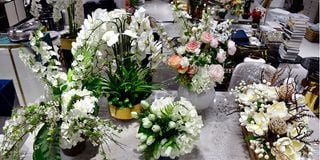
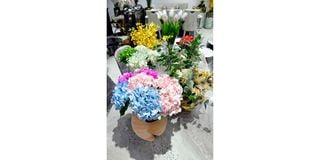
An assortment of artificial flowers on display at Décor by Aimer shop located at The Nord Mall on November 29, 2025.
Photo credit: Francis Nderitu | Nation Media Group
These, she discovered, were not only beautiful, they also made available a lot of variety and options that were not present in the fresh flowers market in Kenya. This, in terms of both flower types and colours.
“In Kenya we are known mainly for roses. If I were to arrange a standard fresh flower bouquet today, it would have chrysanthemums (mums), maybe carnations, and some greenery, or baby’s breath. But abroad, for example, they don’t even use mums unless it’s for a funeral. They have flower farms that sell a lot of things that are not accessible to our local market,” she reveals. “But with artificials, whether the flowers are in season or out, you always feel fine.”
Carving a niche for herself, Ms Nkatha now does floral installations for all kinds of spaces - homes, lodges, restaurants, studios, stores, you name it, and she does them on walls, ceilings, signages, as table centerpieces, even on cakes. She also rents out arrangements for all manner of events.
“Now there is a global trend with artificials because the quality went up but also because of sustainability. People want something that can last,” she notes.
“And artificials really work for something like Christmas where you can pack up your garlands or your wreaths and reuse or repurpose them next time. I’m also seeing a lot of them during Diwali, especially flowers like Marigolds which don’t grow here, and during themed holidays like Mother’s Day.”
She also credits the growth to an increased appreciation for aesthetics.
“There’s a boom in luxury. People are educated and are no longer what our parents were. Now there’s a deeper appreciation for fine things all around the world.”
The artificial flowers trend, according to the flower expert, received a fresh breath of life from the bringing-the-outside-in trend (bringing nature indoors), and from high-end fashion designers like Chanel who adopted and incorporated artificial blooms in their work.
“All interior design trends are determined by the fashion industry,” she says. “And then there came people like Kim Kardashian using paper flower walls as backdrops for product launches and it became a thing.”
Now her most frequent orders are for “backdrop flowers, welcome signages, and centerpieces for the home.”
Ann's bold leap of faith
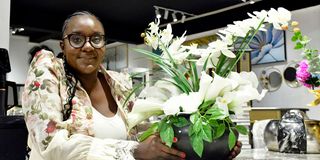
Elsewhere, when Ann Wakaimba opened Decor by Aimer just a year ago, she wasn’t sure how the market would respond to her bold leap of faith: premium lifelike artificial flowers priced between Sh15,000 and Sh45,000. But today, the young business is already carving a niche in Nairobi’s design market.
Ann Wakaimba founder of Décor by Aimer pictured with some of the artificial flowers on sale at her shop on November 29, 2025 located at The Nord Mall.
Photo credit: Francis Nderitu | Nation Media Group
Though they stock an extensive range of decor pieces including vases, books, wall art, clocks, mirrors, furniture and kitchenware (from thermoses to wine glasses), flowers remain Decor by Aimer’s heart, accounting for around 30 percent of the total sales.
“The flowers were there from the start,” Ms Wakaimba says. “I started with my own tastes but with time, I’ve learned what people love and now I only pick what’s best.”
But why artificial flowers?
“Being a mother, I realised that I didn’t have the time to take care of fresh flowers, so I ended up picking artificial because they are easy to maintain and don’t spoil,” she says.
Still, she wasn’t interested in just ordinary faux flowers. Her shelves are lined with orchids that look freshly cut, tulips whose stems feel convincingly flexible, and roses that carry scented notes and even thorns.
“At first, people hesitated at the price and would say they’re too expensive, but they have since come to appreciate the realness and uniqueness of the flowers. Those who understand the value are okay with spending a little to get it.”
With quality determining her pricing, Ms Wakaimba is deliberate in sourcing the best. She travels widely – to Turkey, Thailand, Dubai, even London, just to see what the global market is offering, before curating her own collection and placing her order in China, ‘the big market’. To maintain exclusivity, she rarely ever imports in bulk.
“Especially for unique flowers, I can bring only 10 pieces per flower and that’s it,” she says. “If you bring say 1,000 pieces, everyone ends up with the same flower and then there is no uniqueness.”
Though she stocks a wide variety including hydrangeas, roses, and even shrubs, her best-sellers include orchids, lilies, and tulips, flowers she describes as being ‘in a class of their own.’
Her main customers are homeowners, particularly those who are looking for statement pieces for side tables, corners, or entryways where fresh flowers would wilt within days. She also sees churches go for the white arrangements to decorate their altars.
The shop sees a peak in sales during the festive seasons, particularly in December, when most people are revamping their houses and making them more beautiful for guests. And though her prices usually remain constant, the decor shop often runs promotional offers, sometimes from as early as November through to Christmas.
Of challenges, Ms Wakaimba cites damages. “This is mostly during transportation. They are very delicate, so it makes it very challenging,” she says. “There is a time when I imported six orchids, and when they arrived, they were all broken.”
Still, she takes it all in stride, her philosophy staying firm. “When you put your mind to something, just go all in. Learn in the process, but don’t do it half-heartedly. Go fully.”
Pure love for flowers
For Armstrong Ngure Kiarie, the man behind The Flower Guy, an artificial flowers shop in Nairobi’s Stage Market, the appeal of the permanent botanicals lies in their unfading vibrancy, versatility, and their ease to work with.
“People are lazy. They don’t want to take care of the real ones so they have really come to appreciate the artificial ones,” he says.
“With these, there’s no watering, no pruning, no checking up on them, you only have to dust them every now and then. You are also able to find the artificial form of a flower that would be otherwise difficult to get.”
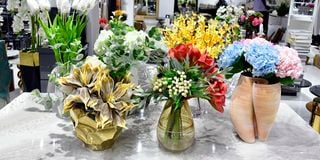
An assortment of artificial flowers on display at Décor by Aimer shop located at The Nord Mall on November 29, 2025.
Photo credit: Francis Nderitu | Nation Media Group
Having started his business in November 2020 out of a pure love for flowers and all things landscape and interior decor, Mr Kiarie speaks of an exponential growth in the artificial market, which tends to peak in the holiday seasons.
“At a time like now, there are many decorations that are going on. And with a lot of people wanting to take pictures, you find that the need and desire for backdrops, floral arrangements, and the general Christmas decor, has gone up.”
Still, it has not been without its challenges.
“Pricing is a challenge because while there is a standard market price, some sellers lower their prices to levels that don’t even make sense.”
He has also struggled with coming to terms with copycats in the industry who can quickly turn a unique concept into something commonplace.
From inquiry to sales- driver
Miriam Nyambura Wambugu, owner of Shwan Decor, tapped into the artificial plants and flowers market following a query by a hotel-owning client. Today, while she sells other decor items, her imported plants make for 70 percent of all her sales.
“My main buyers include resellers, the hotel industry, and salons,” Ms Wambugu states. “And the plants that sell the most are the hedge panels, olive trees, and cherry blossoms.”
Already receiving bulk pre-orders for the festive season, Ms Wambugu is expecting a busy time ahead even as she continues to market her wares mostly online.
When it comes to the prices and affordability, Ms Nkatha suggests that while many people expect the man-made offerings to be cheap, they’re actually not, unless of course, the quality is wanting.
“They’re expensive at first, but if you’re going to have them for a long time, you will return your money over and over again,” she assures.
Often asked about which of the two is superior, Ms Nkatha says “Life these days is no longer about this or that, it’s about this and that. That said, the artificials borrow everything from fresh flowers and in that respect, the fresh flowers will always take the cake.”