Time flies with great content! Renew in to keep enjoying all our premium content.
Prime
Dried vegetables open export market for farmers group
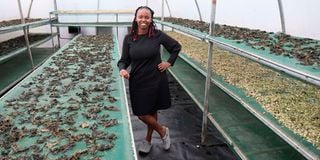
Tabitha Muthoni inspects vegetables drying inside a hybrid solar dryer at the Cheer Up Programme facility in Matathia, Kiambu County, on October 23, 2025.
When a group of farmers began drying farm vegetables to reduce post-harvest losses, they never imagined the venture would grow so rapidly that it would pave the way into export markets.
In Lari, Kiambu County, indigenous vegetables grow easily, thanks to the climatic conditions, but most of it goes to waste because of lack of markets and poor roads.
“About 30 percent of the vegetables that we dry now is for the export market,” says Martin Chege, the operations manager of Cheer Up Programme, which was founded in 2003 as a church group to help orphans.
It was started by nine members, but the group has grown to 20 members and found a profitable niche in drying traditional vegetables such as black nightshade (commonly known as managu or sucha), amaranthus (terere), spider plant (saga), and cowpea leaves (kunde), sukuma wiki (kales), spinach, and cabbages.
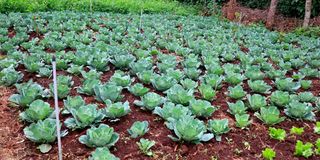
Cabbages growing at the Cheer Up Programme farm in Matathia, Kiambu County, on October 23, 2025.
Photo credit: Bonface Bogita | Nation Media Group
At their processing plant in Matathia village in Lari, they also dry stinging nettle (thafai), herbs like rosemary, and fruits such as pineapples and green bananas.
The bananas are milled into flour and blended with vegetables, and cassava to make a nutritious porridge flour.
“We currently supply a variety of dried vegetables to the Middle East, the US, Canada, and several European countries. Locally, we mainly sell to arid and semi-arid land regions,” Mr Chege says, adding that before they started exporting, they had to obtain a phytosanitary
certificate from Kenya Plant Health Inspectorate Service (Kephis) and an export certificate to ensure products are pest-and disease-free.
“We are keen on how the vegetables are grown, they must be organic,” says Mr Chege.
Tabitha Muthoni, the operations manager in charge of sourcing vegetables, contracting farmers, procurement, and training, says the group has grown over the years from drying 500 kilos a day to thousands.
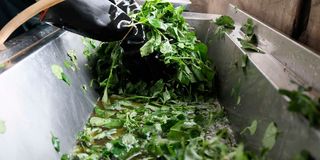
Traditional vegetable, commonly known as terere, being washed before drying at the Cheer Up Programme facility in Matathia, Kiambu County, on October 23, 2025.
Photo credit: Bonface Bogita | Nation Media Group
“Each vegetable variety averages one tonne every three days, apart from cabbages which do about 1.5 tonnes,” Ms Muthoni tells the BDLife.
Prices depend on the vegetable type. A kilo of dried sukuma wiki or spinach sells at Sh700, while indigenous vegetables fetch from Sh800 per kilo. “Saga, which is rare, goes for Sh800 a kilo, and flour between Sh800 and Sh1,500,” she says.
“We have a huge online presence, which helps us reach foreign markets through referrals and exhibitions,” she adds.
Kenya Bureau of Standards (Kebs)-certification has helped.
Besides members who supply the facility with fresh produce, Ms Muthoni says they have contracted over 40 farmers across Kiambu, each earning about Sh50 per kilo. “Since our supply as members is still low, we work with groups in Ndeiya, Kijabe, and Githunguri,” she adds.
Land size is not a limiting factor, even smallholders can supply, provided they meet standard operating procedures (SOPs) and comply with horticultural export standards.
Supplier farmers are trained on agroecological practices, growing crops organically using animal manure instead of synthetic fertilisers.
Drying machines
Monicah Wacuka, one of the founding members, says Lari is a major vegetable-producing area, but much of the harvest used to go to waste.
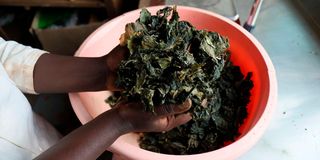
Dried traditional vegetable, commonly known as terere, at the Cheer Up Programme facility in Matathia, Kiambu County, on October 23, 2025.
Photo credit: Bonface Bogita | Nation Media Group
“Drying vegetables extends shelf life, we earn better prices, and generate sustainable income for farmers. We began with a timber-and-wood solar dryer that cost about Sh70,000 to construct,” she says, adding that members raised the funds through contributions.
Over the years, they have advanced to modern dryers, gained market exposure, and accessed funding. “Operations became automated,” Ms Muthoni says.
In 2024, the group upgraded to a hybrid solar dryer, which uses briquettes for heating during cold or rainy seasons, marking another growth milestone.
From members working as volunteers, the enterprise has now employed five full-time staff.
One of the beneficiaries is Rose Wangui, a mother of three and member since 2003. She says the business has enabled her to educate her children.
“I grow cabbages, sukuma wiki, and traditional vegetables on a quarter acre of land and supply the facility,” she says.
Drying procedures
The vegetables must be mature, healthy, and tender.
Mr Chege, who oversees production, from receiving, sorting, washing, blanching, drying, packaging, and labeling, explains that after thorough quality checks, vegetables are cleaned in stainless-steel basins and rinsed well. “They are then blanched, dipped in salty boiling water for three to four minutes, and cooled using ice-cold water,” he explains.
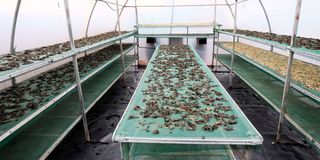
Traditional vegetable, commonly known as managu, drying inside a hybrid solar dryer before packaging at the Cheer Up Programme facility in Matathia, Kiambu County, on October 23, 2025.
Photo credit: Bonface Bogita | Nation Media Group
The salt helps kill bacteria and retain the plants’ colour. The vegetables are then taken to the hybrid solar dryer, where they are turned twice daily to enhance drying.
“Between harvesting and drying, it should not take more than a day. In three days, they are ready for packaging,” says Mr Chege, noting that hybrid dryers and briquettes have significantly shortened drying time.
Challenges
As they seek to reach full profitability, their journey has not been without challenges.
Upgrading to a modern facility and embracing digital solutions initially met resistance. “Some members were skeptical about technology, a few left, while others stayed. Digital literacy was a major issue, especially for older members,” he says.
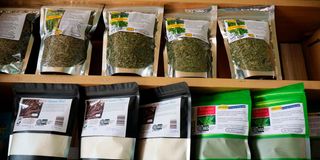
A variety of farm products packaged at the Cheer Up Programme facility in Matathia, Kiambu County, on October 23, 2025.
Photo credit: Bonface Bogita | Nation Media Group
There is also the headache of access to credit for expansion and poor road infrastructure, which delays supply and delivery.
If there lessons they have picked as entrepreneurs, it is the power of collaboration: “Our growth has been driven by unity, which has attracted support from development partners,” says Ms Wacuka, “The journey in entrepreneurship has taught us that the biggest lessons are knowledge, research, especially about markets, and having a clear target of what you want to achieve.”