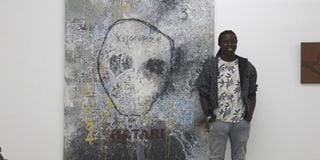
At Redhill Art Gallery, Onyis Martin’s new exhibition, Too Many Words, unfolds as an expansive meditation on how societies speak—visually, verbally, and through the residue of everyday life.
The show departs from conventional mixed-media collage by positioning posters, paint, and sculptural surfaces as the primary language through which urban experience is both recorded and contested.
What emerges is an exhibition that asks viewers to consider not only what is seen, but how meaning is constructed in the space between seeing and saying.
Martin, long recognised for his dexterity in mixed media, has again anchored this body of work in the materials that animate Nairobi’s streets. His approach, rooted in collage since childhood, has remained materially consistent even as the “specifics” evolve.
He explains: “My work looks at time in the sense of the interactions of people and nature and the relationship that people have in the specific pockets of time… I have always been a mixed media artist, from the first collages I did when I was six years old to the present.”
In Too Many Words, posters become the dominant device through which Martin interrogates power, restriction, aspiration, and consumption. Pulled from Nairobi’s walls, the posters in these works act as social barometers, revealing what communities desire, fear, or are urged to obey.
“In my exhibition, I talk about movement in terms of how human beings’ movements have been restricted or determined,” he notes. “When on a wall, there is written no idling, you are already being restricted whether you are an idler or not.”
This seemingly simple observation opens into a larger critique: Who writes the rules of public space? And to whom are they directed?
The posters also reveal the city’s layered consumption patterns. “What people are advertising in a particular area tells you what people are interested in consuming,” he says.
By juxtaposing political campaign graphics, club advertisements, and ubiquitous waganga posters, Martin builds a visual timeline of evolving public appetite from 2014 to the present. The contradictions within this consumption, especially the disavowal of witch-doctor services despite the abundance of their posters, become part of his inquiry. “There has to be a return,” he notes, pointing to the hidden economies that complicate Nairobi’s urban narratives.
The conceptual core of Too Many Words is a metaphorical wall, one that holds every attempt at mark-making, from graffiti to children’s scribbles to commercial messaging. It’s a wall on which language accumulates faster than it can be deciphered.
“To be able to describe what you saw doesn’t necessarily create in mind the picture of what you saw,” Martin explains. “It is in this gap between verbal and visual that I am staying.”
The work, therefore, is less about literal communication and more about the “gray of being unable to explain in full comprehension” what any mark intends. Viewers are invited into this grey zone, where meaning is overloaded, contested, or simply lost.
In the exhibition, mixed media is handled with sculptural intentionality. Posters form the skin; spray paint and collage interventions build depth; canvas is reworked to mimic the fragmentary, over-written surfaces of the city. These choices echo the physicality of urban mark-making—ripped posters, painted-over messages, traces competing for visibility. His new work feels more structurally assertive, as if the surfaces themselves have become living archives of interference and renewal.
Martin’s formative years at the Mukuru Art and Craft School quietly underpin his technical breadth.
“Mukuru was set up in such a way that it was the older artists who were guiding us… you were teacher and student and vice versa to the artist standing next to you in the studio,” he recalls.
This peer-to-peer apprenticeship forged the collaborative, cross-disciplinary attitude that continues to shape his practice: “Technically, I am constantly shifting from one medium to the other while retaining a specific.”
These biographical threads matter only because they illuminate his current practice; its rigor, its material complexity, and its instinctive grasp of urban visual language.
Though Martin has been active for more than a decade, Too Many Words carries the urgency and freshness of a practice steeped in observation and social critique.
His themes—freedom, movement, technology, consumerism—are not explored through rhetoric but through the material culture of the city itself. The posters, stains, textures, and fragments form a visual sociology that is both intimate and panoramic.
Ultimately, the exhibition is a study in excess: too many signs, too many instructions, too many desires, too many competing narratives. Yet Martin’s work resists resolving these tensions. Instead, it captures the lived noise of contemporary society and the impossibility of containing it in coherent speech.
Too Many Words is, fittingly, a show that speaks most clearly in its silences—in the spaces where language falters and images take over.