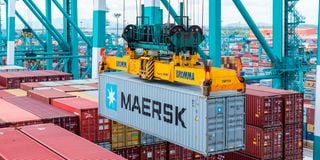
Danish shipping group Maersk, which controls more than 30 percent of cargo at the Mombasa Port, has introduced an operational cost imports (OCI) fee for cargo destined for the gateway to regional markets, sparking concerns among traders who projected higher business costs.
Kenya's largest shipping line, which handles approximately 300,000 containers annually at the Mombasa port, this week announced it will introduce the OCI fee effective December 1, 2025, to cover additional operational expenses related to container inspections.
The fee will be billed alongside freight charges and follows similar charges OCI charges introduced for other regions, such as the Central African Republic, to address operational costs.
"As part of Maersk's ongoing commitment to maintain high service standards and reliability across our global network, we wish to inform you of the introduction of an OCI fee for shipments destined for Kenya, effective December 1, 2025 until further notice. This surcharge is being implemented to offset the additional operational expenses associated with container inspections," the shipping firm said in an advisory to clients.
In the tariff, the shipping line will charge $18 (Sh2328.56) for a 20-foot container and $33 (Sh4269.03) for a 40-foot container, while reefers will be charged $33 (Sh4269.03) and $43 (5562.44) for 20- and 40-foot containers, respectively.
Kephis began inspecting all cargo containers, both loaded and empty, in July 2025. The move, however, was met with an uproar, as traders in crop products reported massive disruptions to their businesses owing to the inspection rule, with some cargo consignments left behind at the Mombasa Port as impatient shipping lines set sail amid delays.
According to Kephis, all shipping lines and agents since July 1 this year are required to share the manifest for both imports and exports with the department in advance to facilitate efficient inspection and compliance.
To facilitate the inspection, shipping lines and agents were required to pay Sh500 and Sh2,000 for the container and vessel inspection fee, respectively.
Traders said that they are now worried Kenya will become one of the most expensive routes to import and export goods following the introduction of the new fees.
The Shippers Council of Eastern Africa (SCEA) CEO Agayo Ogambi said the fee will affect bulk importers due to increased cost and urged the government to rethink the funding model for government agencies.
"Traders have to increase operating fees, which will be passed on to consumers to recover the new charges imposed by Kephis. Our members have expressed deep concern regarding the potential implications of this cost on the competitiveness of Kenyan imports, the overall cost of doing business, and the stability of supply chain operations," he said.
The official also questioned whether the surcharge was reviewed and approved in accordance with Kenya’s maritime regulatory requirements.
"Despite the costs, we want to know the methodology and justification for this levy and if it met the principles of transparency, fairness, and reasonableness expected under shipping regulation frameworks. Kenya should put measures in place to protect shippers, importers, logistics operators, and the wider economy from unilateral cost introductions by shipping lines without prior consultation," said Mr Ogambi.