In the crowded lecture halls of Kenyan universities, a silent crisis is unfolding: a faculty shortage of professors.
The higher learning regulator—the Commission for University Education (CUE)— reports that the share of professors has been shrinking, while enrolment in undergraduate and master’s programmes has risen.
The commission warns that the faculty shortage looks set to dim the generation of knowledge and mentorship in the universities.
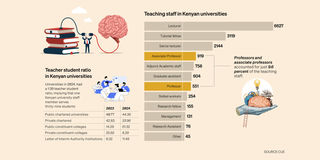
The CUE data indicate that full professors accounted for 3.6 percent or 551 of the 15,383 academic staff attached to both private and public universities last year.
The regulator’s report further shows that associate professors accounted for six percent of the teaching staff.
This category of lecturers is yet to demonstrate continued excellence in research, teaching, and service to earn the promotion to full professor.
Tutorial fellows accounted for 20.3 percent or 5,500, and graduate assistants at 3.9 percent—many of whom are early-career academics often with master’s degrees—had more pronounced roles in teaching, stepping in where more experienced lecturers are lacking.
“Overall, the data suggests that while universities are sufficiently staffed at mid-level academic ranks, there is a notable underrepresentation at the professoriate and research levels, which could impact mentorship and knowledge production capacity,” CUE notes.
The teaching gaps and funding crisis, which have left public universities in deficit, have forced the institution to tap part-time lecturers or adjunct staff.
The number of adjunct staff more than doubled in the year to 2024.
“There was a rise in adjunct academic staff, which more than doubled from 379 (2.62 percent) to 758 (4.93 percent), suggesting universities are increasingly relying on part-time or external teaching personnel,” said the regulator.
Most public universities are struggling to meet their expenses, including staff salaries, which have made lecturers’ jobs less attractive, hurting the talent pipeline.
Young graduates with master’s and PhD are preferring to seek careers outside universities as budget cuts at research universities have hurt the size of doctoral programmes.
“The proportion of tutorial fellows—entry-level academic staff—declined from 3,498 (24.22 percent) to 3,119 (20.28 percent), while graduate assistants dropped from 815 (5.64 percent) to 604 (3.93 percent).
This drop may raise concerns about the future academic talent pipeline and succession planning in universities,” said the CUE.