If you visit any of Kenya’s golf courses at the weekend, you’ll see familiar faces from boardrooms and C-suites striding across the fairways. These are men and women who have built companies, closed billion-shilling deals and steered industries. Yet many of them fall into avoidable traps when they pick up a club, which keeps their handicaps high.
Professional golfer Simon Njogu, who is currently competing in the Professional Golfers Kenya (PGK) Equator Golf Tour, says that this paradox is no coincidence; it mirrors the very mindset that drives success in business. The only difference is that, unlike in business, money can’t buy better scores in golf.
“Many amateurs chase the ‘perfect swing’ in lessons, but they rarely practise shot-making under pressure or in awkward situations. Range-perfect isn’t course-ready,” he says.
According to Njogu, hitting hundreds of balls on manicured mats might make a swing look good on video, but golf is played on uneven ground, in unpredictable wind, and under the weight of expectation.
The obsession with perfect technique, he adds, often blinds players to the discipline of playability — the real skill of adapting when the ball doesn’t lie perfectly.
“They can rehearse a driver swing for hours, but rarely simulate punching out from trees, hitting from a divot, or scrambling after a poor tee shot,” he says. “Yet those are the moments that decide whether a round ends at 79 or balloons into the 90s.”
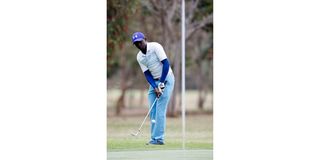
Simon Njogu follows his putt at the 15th hole green during the Kabete Open 2019 Round 3 at Vetlab Sports Club.
Photo credit: Chris Omollo | Nation Media Group
Buying performance
The second trap, Njogu says, is financial, and it is a problem that CEOs are particularly vulnerable to. “They constantly change clubs, balls, or training aids, thinking that the equipment will bridge the gap,” he says.
He adds that it is not uncommon to see amateurs arrive on the course with the latest driver model or a dozen new premium balls, believing that technology will mask their inconsistency.
While he doesn’t dismiss the importance of good equipment, Njogu cautions that it does not replace adaptability.
“Consistency and adaptability matter more. The wrong club fit can ingrain bad habits, but swapping equipment can become a distraction from the real work of learning to deliver repeatable shots under pressure.”
He says that, for example, a shaft that is too stiff forces a player to generate speed that they don’t have, while a lie angle that is too flat pushes them into an over-the-top motion.
Beyond that, Njogu says that premium balls or blades are meaningless until a player’s swing is stable enough to maximise on their skills and put them at an advantage.
Simon Njogu follows the progress of his tee off from the 16th hole tee during the Kabete Open 2019 Round 3 at Vetlab Sports Club.
Photo credit: Chris Omollo | Nation Media Group
The illusion of effort
The pro golfer says there is also the illusion of effort, whereby amateurs boast about pounding hundreds of balls in a single practice session, forgetting that this is akin to mistaking quantity for progress.
“Deliberate practice is rarer, but far more valuable. It is about simulating the course conditions, picking targets, playing pressure games and training the mind just as much as the body,” he says.
The driving range, he cautions, can be deceptive because it removes consequence. On the range, a bad shot simply means grabbing another ball. On the course, however, it costs strokes, and sometimes the ball itself. This explains why so many golfers perform well in practice but crumble under competitive pressure.
The most common and expensive blind spot, according to Njogu, is neglecting the short game.
“Many amateurs spend 80 percent of their time on full swings and almost none on chipping, pitching or lag putting, yet that’s where most strokes are saved,” he says.
Elite players, Njogu says, excel by mastering the 100-yard-and-in zone. CEOs who spend hours working on drives and ignoring wedges are, in effect, leaving strokes all over the course.
Business instincts a double-edged sword
In business, aggression and risk-taking often pay off. In golf, however, they’re punished.
“They pull the driver because it feels right rather than asking, ‘What’s the smart shot here?’ Many doubles and triples come not from poor decisions but from poor swings,” Njogu says.
The professional argues that confidence is not the same as impulsiveness.
“Confidence is a decision after clarity, where you tell yourself that this is my plan, and you trust it. Impulsiveness is a decision without clarity that feels right in the moment.”
Golf, he says, forgives confident misses but punishes the reckless choices.
When it comes to the business tool that amateurs tend to ignore, the golf pro says that on the course, many executives play purely by how they feel. They rarely track fairways, the greens in regulation, or putts per round.
“Without data, it is impossible to know where strokes are leaking. However, professionals should measure everything. They should monitor every shot, track where they lose strokes, and make adjustments grounded in evidence. The data tell the story and point the way forward,” Njogu says.
He also emphasises that performance does not only depend on the technique; the shoes, gloves and clothing also play a powerful role.
“Fatigue in the feet bleeds into the swing late in the round; poor traction causes slips; ill-fitting gloves ruin grip security; restrictive clothing interferes with rotation. How you dress affects your mindset. Research confirms that attire shapes confidence. Amateurs laugh this off, but pros take it seriously.”
While most amateurs blame 'swing breakdowns' for their poor finishes, Njogu says the real culprit is mental fatigue. He explains that when decision-making is impaired, routines break down and many small errors are made.
Simon Njogu follows the progress of his tee off from the 14th hole tee during the Muthaiga Open Golf tournament on February 17, 2019 at the Muthaiga Golf Club
Photo credit: Chris Omollo | Nation Media Group
“Pros train mental stamina deliberately for the tournament play, pressure drills, shot routines, and visualisation. But amateurs rarely do that; they simply hope for focus to last. That hope often fades by the 14th or 15th hole, turning a strong start into a disappointing finish.”
What does it take to go pro?
Some CEOs, bitten by the competitive bug, dream of turning professional later in life. But, Njogu is candid about what that really takes.
Elite amateurs who turn pro usually accumulate 5,000–7,000 hours of deliberate practice, playing 50–70 competitive rounds per year, plus gym and mental training. Even with ample resources, the process takes four to eight years, and not everyone makes it.
“A late-starter needs five to seven disciplined years. That means structured practice, relentless short-game work, tournament immersion, athletic conditioning, and a team of coaches. But the real signal of potential is not the 300-yard drive, it is how a player thinks, resets, and performs under fire,” he explains.
Njogu believes that striking a smarter balance between technical training and real play, anchored in feedback, sharper course management, and respect for the short game, can transform any golfer’s performance.
“The fastest way to lower scores is usually by sharpening the weakest link,” he says.