Time flies with great content! Renew in to keep enjoying all our premium content.
Prime
STEM emerges main pathway for learners in first CBC exams
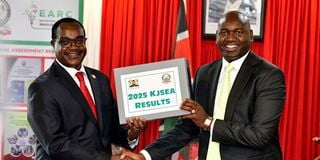
Education Cabinet Secretary Julius Migos (left) presents to State Department for Basic Education Principal Secretary Julius Bitok the 2025 Kenya Junior School Education Assessment exam results at Mtihani House on December 11, 2025.
Photo credit: Francis Nderitu I Nation Media Group
More than half of the candidates who sat the 2025 Kenya Junior School Education Assessment (KJSEA) demonstrated readiness to pursue courses in Science, Technology, Engineering, and Mathematics,(STEM) in Senior School, underscoring a decisive tilt toward science-oriented learning as Kenya accelerates its shift to the competence-driven system.
The performance is set to pile pressure on senior schools to reinforce laboratories and technical capacity, as the system must now absorb an unprecedented concentration of science-pursuing learners.
The KJSEA test, taken at the tail-end of grade nine, marked the final checkpoint for the pioneer junior school cohort, closing a crucial phase of the competency-based curriculum (CBC) and setting the stage for full pathway specialisation.
“The assessment of learners at grade nine comprises 20 percent from the Kenya Primary School Education Assessment, 20 percent from the school-based assessment in grades seven and eight, and 60 percent from the summative evaluation at grade nine. This summative evaluation is the KJSEA,” said CS Ogamba.
This year, the exam, which covers STEM, social sciences, as well as arts and sports pathways, was taken by 1.1 million learners who completed the three-year junior school phase under CBC.
Of these, 59.09 percent showed potential for the STEM learning pathway, while 46.52 percent qualified for social sciences covering history, economics, and civic studies, and 48.73 percent showed a leaning towards arts and sports, which includes creative and physical education tracks.
The assessment uses an eight-point performance scale grouped into four clusters, with the best being ‘exceeding expectations’, followed by ‘meeting expectations’, ‘approaching expectations’, and ‘below expectations’, with each cluster further divided into two to capture nuanced performance.
In the just-released results, Creative Arts and Sports as a subject delivered the strongest outcome nationwide, with 96.84 percent of learners hitting the ‘approaching expectations’ threshold and above under the ministry’s consolidated assessment report.
Agriculture, Kiswahili, and Social Studies followed, with each recording more than 92 percent of candidates achieving the designated competency levels.
Mathematics and Kenya Sign Language subjects registered the lowest proportions of learners meeting and exceeding expectations relative to the other subjects, although more than half of the candidates still met the baseline standards.
The KJSEA test combines written papers with practical projects and draft exercises to measure applied competencies, focusing on problem-solving and critical thinking, marking a shift towards integrated skills rather than routine memorisation.
Learners sit the assessment at the end of junior school after completing three years in the CBC system, following six years of primary school and two years of pre-primary education.
The Ministry said the assessment informs placement into senior schools, which have been clustered according to pathways, with all the KJSEA candidates set to be placed starting next week.
“Learners will be placed in senior schools based on their performance and selected pathways, in line with the recommendations of the Presidential Working Party on Education Reform,” said CS Ogamba.
Senior school capacity currently stands at 2.2 million spaces across 9,540 institutions, giving the country a comfortable buffer for the full junior to senior school transition.
These schools have been formally clustered by pathway, allowing each learner to join an institution aligned with the competencies demonstrated in the KJSEA.
Placement is set to conclude by December 20, enabling Grade Ten reporting from January 12 under the ministry’s revised academic calendar.