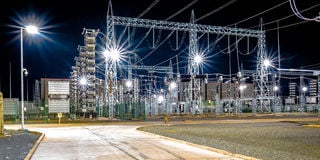
Completion of six key electricity transmission lines could delay amid a funding shortfall of $383.23 million (Sh49.6 billion), in what could derail efforts to strengthen the grid and boost power supply.
A review of the ongoing projects by the Kenya Electricity Transmission Company (Ketraco) shows that it has already secured $411.17 million (Sh53.2 billion) for the projects against a total capital investment of $794.40 million (Sh102.8 billion at current exchange rates).
Funding hitches could result in these lines not being completed by the 2030 deadline, hindering Kenya’s ambitions of boosting electricity supply by revamping the transmission network.
The lines will provide alternative routes and increase the capacity of the network to evacuate power from local sources and across the region.
The six lines include one running from Loiyangalani to Marsabit to evacuate power from the largest wind power farm in Kenya and another to increase the capacity to import electricity from neighbouring Uganda.
“Approximately $411.17 million of outstanding investments have been secured/committed through development assistance and EPC (engineering, procurement and construction) + financing arising from government-to-government memoranda of understanding,” Ketraco says in a transmission lines strategy.
“This implies that there is a financing gap of $383.23 million that relates to the 400kV (kilovolt) Lessos-Tororo, 220kV Garsen-Hola-Bura-Garissa…”
An overloaded and ageing network in some parts of the country has hampered Kenya Power’s efforts to ensure a steady supply of electricity, underscoring why completing the six lines is key.
The other lines set to be affected by the funding deficit are 220kV Isiolo-Marsabit, 220kV Kamburu-Embu-Thika, 132kV Makindu substation, 220kV Olkaria 1-AU-Olkaria IV, a line-in-line out on Juja/Naivasha, 132kV- Maai Mahiu and the 220kV Loiyangalani-Marsabit line.
The lines span 1,709 kilometres, and the associated substations have a combined capacity of 4,166 megavolt-amperes (MVA), which are critical to the country’s quest to bolster electricity supply.
In the past, Ketraco has failed to complete transmission lines within set deadlines, primarily due to funding hitches on the part of contractors.
The most notable example was the delayed completion of the line that evacuates electricity from the Lake Turkana Wind Power plant in Loiyangalani.
Ketraco is mainly banking on the public-private partnership (PPP) model to fund most of the network upgrading works, amid inability by the Exchequer to budget enough cash for these projects.
The firm recently disclosed that it is betting on the PPP model to bridge a funding gap of more than $4 billion (Sh517.8 billion) over the next 20 years.
Plans to start construction of the first PPP-funded transmission lines are already at an advanced stage, with these lines to be delivered by Africa50 and PowerGrid Corporation of India.