Telecoms operator Safaricom Plc has raised Sh20 billion from the first tranche of its corporate bond after a 177 percent oversubscription of the offer which closed on Friday.
Total bids received for the offer were Sh41.6 billion, surpassing the target of Sh15 billion which handed the telecoms operator the window to take an additional Sh5 billion in a green shoe option.
Investors participating in the offer have locked in a fixed interest rate of 10.4 percent per annum for the five-year paper expected to mature in December 2030.
“Following strong investor demand, Safaricom has exercised the Sh5 billion greenshoe option, thereby increasing the total allotment for Tranche 1 to Sh20 billion, which enables Safaricom to accommodate heightened investor demand and remains within the Sh40 billion programme limit approved by the Capital Markets Authority (CMA),” Safaricom said in an update.
The company announced the Sh40 billion medium note programme (MTN) last month for the purposes of financing and refinancing green projects.
The corporate bond which is the largest by a listed firm has revitalised the corporate debt market on the NSE which has been starved of action with the only other recent issuer being EABL which just raised Sh16.7 billion.
The corporate debt segment has been dented previously by issuers who went belly up soon after issuing their notes including Imperial Bank and Chase Bank.
Microlender Real People, which has Sh1.63 billion in outstanding notes, also ran into a scandal after raising funds which were diverted to its parent firm in South Africa.
Safaricom previously tapped Sh30 billion sustainability-linked loan or green bond from a consortium of local banks including KCB, Absa Bank Kenya, Standard Chartered Bank Kenya and Stanbic Bank Kenya.
A green bond is a type of fixed-income instrument that is specifically earmarked to raise money for climate and environmental projects.
Safaricom finance costs have increased recently, compounded by capital spending in its new business in Ethiopia.
The telco’s capital expenditure in the current financial year is estimated at between Sh72 billion and Sh78 billion where spending on Kenya is projected at between Sh54 billion and Sh57 billion.
Spending in Ethiopia is estimated between Sh18 billion and Sh21 billion.
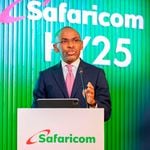
“In Kenya, we remain focused on executing our strategy through segment-led execution and integrated solutions and our customer business will deepen partnerships to accelerate 4G+ devices access and availability alongside scaling content solutions,” Safaricom's chief executive officer Peter Ndegwa said previously.
The operator closed its half-year period ended in September 2025 with a debt of Sh117 billion, including Sh61.2 billion in long-term borrowings and Sh55 billion in short-term borrowings.
It reported a 52.1 percent rise in its half-year profit to Sh42.7 billion, helped by a smaller loss in Ethiopia and M-Pesa’s double-digit growth.
Safaricom’s net profit grew from Sh28.11 billion a year earlier. The telco is expected to declare an interim dividend in February next year.
The operator remains the subject of further corporate action as the government prepares to cede a 15 percent stake and future dividends in the firm to South Africa’s Vodacom Group in a deal expected to raise Sh244.5 billion for the exchequer, reducing its dependence on debt to fund its budget deficit.
The National Treasury is expected to receive Sh40.1 billion in upfront dividends as part of the transaction, with the amount representing a discount on expected shareholder payouts from its remaining 20 percent stake.
The transaction requires requisite approvals from major regulators including the Competition Authority of Kenya (CAK) and the Communications Authority of Kenya (CA) in addition to the green light of Members of Parliament.