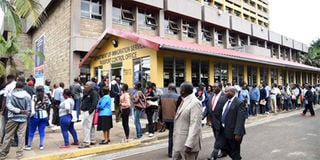
New passport application centres are set to be established in Nairobi and several counties across the country in a move aimed at ending the chronic congestion at Nyayo House.
The Interior Ministry proposes new centres in Westlands, Upper Hill, Makadara, Kiserian, Athi River, and Thika amid increased demand for key travel documents such as passports as Kenyans pursue job and education opportunities abroad.
It also recommends decentralising passport services to Malindi, Voi, Kwale, Isiolo, Machakos, Lodwar, Narok, and Siaya counties to ease pressure on Nairobi and reduce long-distance travel for applicants.
The proposals mark a shift from piecemeal interventions at Nyayo House towards a structural redesign of Kenya’s overstretched passport issuance system.
The Immigration Services headquarters has, in recent years, struggled with runaway demand and repeated incidents of operational breakdowns, turning the building into a symbol of bureaucratic paralysis.
The pressure on the system has been more pronounced in the past months, driven by government-backed labour migration programmes as well as general higher international mobility by Kenyans.
Immigration data shows daily passport demand now averages about 5,000 applications, translating into more than 1.8 million annually.
These numbers have overwhelmed the existing infrastructure, contributing to backlogs that previously topped 700,000 applications and spiked after sustained system outages.
This demand has routinely outstripped the State’s capacity to procure passport booklets, forcing the government last year to enlist the National Intelligence Service (NIS) to secure supplies amid a global shortage of printing materials.
In March last year, the then Interior Cabinet Secretary Prof. Kithure Kindiki told Parliament that the immigration department required three million passport booklets every 90 days against an available supply of just 1.5 million.
Despite the intervention, the system continued to choke under the strain, with a major collapse in April last year halting receipt and collection services and pushing the backlog towards one million applications.
Early this year, Treasury moved to stabilise the fiscal standing of the department by allowing it to retain a fifth of its internally generated revenue, before later raising its budget for the financial year ending June 2025 to Sh20.1 billion in supplementary allocations.
The planned decentralisation of the application centres, especially to the counties, could mark the first real attempt to bring passport services to underserved regions, reducing the need for cross-country travel and cutting waiting times for rural applicants.
Higher immigration fees introduced last year—such as raising the cost of a 34-page passport to Sh7,500—have dramatically increased government collections, offering new revenue that can be reinvested into the mapped-out service expansion.
The Treasury in February this year apportioned an additional Sh5.9 billion to the State Department of Immigration and Citizen Services to boost the issuance of key documents, including e-passports, electronic travel authorisation, and third-generation identity cards.
The additional funds provided through a supplementary budget raised the department’s overall budget for the financial year ended June 2025 to Sh20.1 billion, up from Sh14.3 billion.