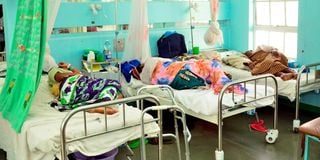
Some lower-tier healthcare facilities in Kenya, especially the private ones, are providing services beyond their resource capacity, the latest national survey has revealed, highlighting weaknesses in health regulation and raising concerns about patient safety and the quality of healthcare delivery.
The Kenya Health Facility Assessment, which surveyed 3,605 facilities across all 47 counties, found that many Level 2 and 3 facilities, which are designed to provide only basic outpatient and preventive services, have expanded their operations to include major surgeries, caesarean sections, and inpatient care.
Such procedures are usually the remit of Level 4 and 5 hospitals, which have the necessary surgical theatres, blood transfusion units, anaesthesia capabilities, and emergency response teams.
“The facilities are misclassified by the Kenya Essential Package for Health (KEPH) level, or they are offering services beyond their capacity/scope. Most of the misaligned facilities are private,” read the report.
Under the Kenya Essential Package for Health classification system, healthcare facilities are categorised from Level 1 (community services) to Level 6 (national referral hospitals), with each level expected to deliver specific services.
The report, which assessed the quality of care, service availability, and readiness, further highlighted gaps in maternal and newborn services, which are crucial indicators of the performance of the healthcare system.
Of the 6,132 facilities providing delivery services nationwide, only 37 percent had all seven Basic Emergency Obstetric and Newborn Care (BEmONC) functions.
Among the 949 Level 4 and 5 facilities offering delivery services, only 46 percent had all nine Comprehensive Emergency Obstetric and Newborn Care (CEmONC) functions.
While all Level 5 hospitals met the standard, less than half of Level 4 hospitals did, revealing significant disparities in readiness.
This means that many women are giving birth in facilities that lack the full emergency capacity to manage complications such as postpartum haemorrhage or birth asphyxia, which are among the leading causes of maternal and neonatal deaths in Kenya, accounting for nearly 60 percent of these fatalities.
The Ministry of Health attributed these trends to several related factors. In rural and peri-urban areas, patients often seek treatment at the nearest facility, even if it lacks advanced care capabilities. Additionally, weak regulatory enforcement and gaps in licensing mean that facilities can operate without routine reassessment.
The survey also revealed significant shortages in healthcare infrastructure. Only 17 percent of health facilities have on-site oxygen generation plants, which are a critical lifesaving resource during obstetric emergencies or surgeries. Many facilities also lack essential delivery devices, such as flowmeters and cannulas.
Kenya has fewer than 1,000 adult ICU beds nationwide, and only around four percent of facilities provide inpatient oncology or psychiatric services.
This forces many patients to travel long distances or to forgo treatment altogether.
While emergency response systems remain fragile, only 64 percent of facilities have Basic Life Support ambulances, and just 31 percent are equipped with Advanced Life Support units, severely limiting referral and emergency response capabilities.