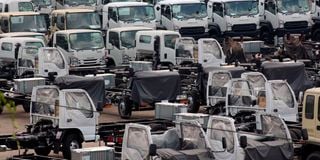
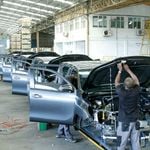
The number of locally assembled motor vehicles rose 11.4 percent in the nine months to September, with increased production expected to increase in the coming years as more models are introduced in the market.
Data from the Kenya National Bureau of Statistics (KNBS) shows that firms such as CFAO Mobility Kenya, Simba Corp, Isuzu East Africa and Transafrica Motors assembled 10,075 vehicles in the review period.
This was an increase from 9,040 units produced in the same period last year.
More dealers have announced plans to assemble more models locally to take advantage of tax incentives offered by the government, a trend that is expected to lead to increased output at the assembly plants.
The government exempts assemblers from the import duty of 35 percent levied on fully built vehicles.
Completely knocked down (CKD) parts headed to assembly plants are also exempt from 20 percent to 35 percent excise duty levied on imports of fully built vehicles, depending on the engine capacity and fuel type.
Assemblers also pay a lower import declaration fee of 2.5 percent compared to the standard 3.5 percent.
The two percent Railway Development Levy (RDL) is also reduced to 1.5 percent for assemblers.
The government offers the tax benefits in a bid to create more jobs and attract more investment in the local automotive industry.
South Africa, which produces vehicles for many markets in Africa, has one of the biggest basket of incentives for investors in the motor vehicle industry in the continent.
Local assembly can lower vehicle prices by up to millions of shillings, with dealers of commercial units such as pick-ups, trucks and buses making the biggest investment in local production.
Dealers have also moved to assemble more passenger cars locally over the past few years, seeking to gain competitive pricing in a market where used imports remain the most popular due to their relatively cheaper prices.
Some new cars led by models from markets such as China, Malaysia and India have however become more competitive in terms of pricing compared to used models imported into the country.
Global Motors Centre, the distributor appointed to sell Jetour brand of cars in the Kenyan market, is investing Sh1.4 billion to start assembling the Chinese models in Mombasa from the first quarter of 2026.
Electric vehicle (EV) company Tad Motors has also unveiled its first five locally assembled sedan and SUV models in Kenya.
Most of the assembled vehicles are sold in Kenya, with some exported to Uganda and other regional markets. The major assembly plants include Associated Vehicle Assemblers (owned by Simba Corp), Isuzu and Kenya Vehicle Manufacturers (KVM) which has contracts with multiple dealers including Urysia Limited. [email protected]
Unlock a world of exclusive content today!Unlock a world of exclusive content today!