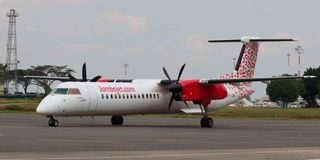
Low-cost airline Jambojet plans to triple its fleet and launch longer routes, including new destinations in West and Southern Africa over the next five years as revenue surpasses the $100 million (Sh13 billion) mark on increased demand.
New Jambojet chairman Ayisi Makatiani, who is returning to lead the airline’s board more than a decade after his first tenure, said the carrier plans to acquire two aircraft within the next 12 months and sustain expansion over the next five years to triple its fleet from the current 11.
The expansion will allow Jambojet to increase frequency of flights in Kenya under the De Havilland Dash 8-400 plane as well as acquire other aircraft to deepen presence in East Africa and enter markets in West Africa, South Africa and North Africa.
“At the moment, our aircraft can operate flights of up to two and a half hours. We plan to extend this to destinations such as Kigali, most of Tanzania, Ethiopia, South Sudan and Zanzibar. After that, we will begin the second phase of our scale-up by acquiring aircraft capable of flying up to five hours,” said Mr Makatiani in an interview. “This will allow us to reach farther destinations, including parts of South Africa, West Africa and North Africa. To achieve this, we may introduce a different fleet, shifting from the current propeller planes to jet aircraft that can cover longer distances while preserving Jambojet’s low-cost model.” Mr Makatiani did not give the size of budget that will be required over the next five years but said it could run into millions of dollars given that each aircraft could cost between $30 million (Sh3.9 billion) and $40 million (Sh5.2 billion).
The airline launched in April 2014 as a subsidiary of Kenya Airways (KQ) and has enjoyed success, with annual revenues crossing Sh13 billion and its market share in domestic flights hitting about 53 percent.
Jambojet’s parent, KQ, once embarked on a similar expansion under ‘Project Mawingu’ but this proved unsustainable, forcing it to scale back years later under the ‘Operation Pride’ strategy.
However, Mr Makatiani said the low-cost carrier is not about to run into the same misstep, given the demand in the market.
“The signals we are getting right now is that we probably can even triple today under the same market. Customers are already complaining about limited seats—you try to book a flight to Kisumu or Mombasa today, and chances are you won’t find a seat. That tells us there’s still room to add more planes,” said Mr Makatiani.
“But growth has to follow sound business discipline. You must constantly watch your unit economics and ensure that every additional aircraft contributes to profit rather than loss. With proper economies of scale, each new plane should lower costs, improve efficiency and enhance the experience for both staff and customers.”
Mr Makatiani said part of the options to acquire a new fleet include leasing the planes to save it from tapping huge loans or hurting its liquidity.
“This is exactly how we built Jambojet when we first started. We rented the aircraft and the technology, essentially leasing everything and paying as we went. It is a structure that allows you to grow while only acquiring the assets once your cash flows can support it,” said Mr Makatiani.
Jambojet currently flies to six destinations from its primary hub in Jomo Kenyatta International Airport to Mombasa, Eldoret, Kisumu, Malindi, Ukunda (Diani) and Lamu.
The airline also operates three routes from its secondary hub in Mombasa to Kisumu, Eldoret and Zanzibar.
Mr Makatiani said the local expansion will capitalise on the rising demands on routes such as Nairobi-Kisumu and increase Jambojet’s market share by at least 10 percentage points over the next five years.
He explained that maintaining the low-cost model will allow the airline to appeal to highly price-sensitive customers and open travel to new groups of people who have never flown before and would like to reach far off destinations.
“The model will also serve tourists who want to hop between cities as well as business travellers. Many companies that once sent employees by bus will now be able to fly them on Jambojet. And for travellers heading to or from places like Kigali, whether to shop in Nairobi or to connect to international flights, Jambojet can provide that short-haul link,” said Mr Makatiani.
In 2019, Jambojet's fleet was acknowledged by global aviation intelligence provider, ch-aviation, as the youngest fleet in Africa at about three years.