Who is Bhartesh Shah? You really can't answer that question adequately when you sit with the man for under an hour. Sure, he's the CEO of SBM Bank after 29 years in financial services, holding executive positions at I&M Group, Equity Group Holdings, Standard Chartered Bank, Citibank, and Midland Bank (HSBC) across Eastern Africa, Singapore, and the United Kingdom.
He holds an MBA from Warwick Business School. His children are now adults, his nest empty. His wife, Shruti, is a banker turned life coach. He plays padel three times a week. He's 52, but not interrogating life with any particular question in this season that he calls his summer season. Winter, he says, hasn’t come.
When his hair started thinning in his late 20s, he decided to get ahead of nature and has shaved his head daily ever since. A stoic look, one that signals intent. He dresses with the precision of a man who hates loose strings.
He loves to travel—52 countries and counting with his wife—and if he were a country, he wouldn't be just one. He'd be Japan for its humility, Singapore for its discipline, UAE for its courageousness. He doesn't look back with regret and operates by a simple principle: don't borrow for consumption, borrow for growth.
But other than that, you really don't know the man. Maybe it's how he plays his cards. Maybe it's because he doesn't dwell in the past—no "coulda, woulda, shoulda" occupies his mind. He frames every setback as a lesson, not a loss. The truth is, Shah seems less interested in being known than in being useful. And right now, that means building something that outlasts the conversation.
How old are your children?
My daughter is 21. My son is 19.
Has fatherhood been kind to you?
Oh yes. They grow up too fast. I mean, I just remember the other day, I was, you know, taking them to matches. Rugby or hockey or whatever. And now my daughter's graduating in May next year. Oh, when I look back, I loved every bit of it—because those are moments I'll never get back.
When they're young and you're waking up at 3am to change nappies or whatever else, at the time it seems like, 'What did I get into?' But when you look back, those are the memories that sustain you. I'm so glad I had those experiences. I wouldn't change a single thing.
What childhood memory are you most fond of?
It wasn't a pleasant memory, but I look back at it fondly. I'm an only child who grew up in a joint family. Our household had 15 people—the typical Indian household.
My parents had me very late, so my mother was very protective. One of the personality traits I had was that I was extremely shy. Forget public speaking if Iwas in a group of at least four people—and I'd shake too.
But I had this great English teacher, Mrs Bunsal. She said, 'No, you're going for this debate.' The audience was probably about 100 people, and she knew my personality and everything. That was her way of getting me out of my shell. She helped me work on all the talking points for the debate, and I crammed them so I could go up and regurgitate them—as opposed to a proper interactive debate.
But it helped me overcome my fears. Today, if you ask me to speak in front of a stadium full of 100,000 people, I'd do it. But that was the beginning point.
What are your regrets in life?
You know, here's the thing—I don't have regrets. I don't look back. Even when I wanted to do something and could have done it but didn't, I don't look back with regret. Because at the end of the day, everyone has a choice between mediocrity and beyond mediocrity.
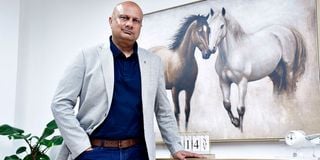
SBM Bank CEO Bhartesh Shah poses for a photo after an interview at the banks offices located along Riverside Drive on November 14, 2025.
Photo credit: Francis Nderitu | Nation Media Group
Most people talk about balance and all of that. My view is that if you want to be good at something, there's no such thing as balance. You have to make sacrifices. Otherwise, the definition of balance is mediocrity—trying to keep everything the same. That's mediocrity.
So, if you want to be good at something, whatever it is—it doesn't need to be a career, or anything specific—there's no such thing as balance. You have to make some sacrifices. Some things have to suffer.
In my personal life, in the pursuit of my career and my family, I didn't do things that I could have done. But do I regret? No.
What are your pet peeves?
Dishonesty. I grew up in a household, in a generation, where people shook hands and did deals without any paperwork because someone's word mattered a lot. But I think we've lost that.
How old are you now?
52
How would you describe this season?
Summer. I'm enjoying it. I mean, I get to do what I'd say whoever's up there has prepared me to do. I believe in fate and karma, and that everything that happens happens for a reason.
While it may not seem that way—especially if something bad is happening and you're thinking, 'What? Why?'—when I look back at my life, everything has always happened for a good reason, which came to light later on.
Like I said, I've been in banking for 29 years—Standard Chartered, Citibank, Midland (which is HSBC), Equity, I&M, and now here. Different banks, different experiences, different personalities.
You learn a lot about how to do things, but more importantly, how not to do things. All of them have prepared me for this. So I'm enjoying it. I get to do what I think is my calling.
So, if this is your summer, you must have had a winter.
It hasn't come yet.
When were you most unsure about life?
When I was coming back from the UK. I had a job there and everything was going well, but my dad needed me back here—only child and all of that.
Coming back, I was really confused. I wondered, should I continue with banking? Banking in Kenya at that time wasn't as developed as in the UK, though now it's miles ahead in many ways. I considered going into business, but then reasoned what was the point of all the studying? Was that a waste? That was one moment of uncertainty.
The second was moving to Singapore. Moving and working in Botswana—I mean, yes, it's different, but it's similar. The warmth is still the same. But moving to a totally different country on a different continent and doing something still within banking, but very different, was a very unsure territory.
I remember before I moved, I called several of my colleagues and said, 'Listen, if things don't work out, can I come back and count on you for a job?' All of them said yes, but that was the second most unsure moment as well.
When did you feel like you were getting into your own self as a man?
All I'd say is I'm still evolving. But I would say the distinctive periods were where when I changed for the better when I met Shruti, when we got married, and when we had our first child.
All of those periods brought different perspectives that I would have never considered otherwise in life. They help me think, they help me grow, and they help me evolve as well.
So, there's no one 'aha' moment where you can say, 'This happened and I became a man.' You're learning and developing all the time. I'm still learning and developing right now—forget work, I'm talking about as a human being, as a husband, as a father.
Think about it as a father. Depending on your children's ages, there's love, then you've got to be disciplined, then you move to being a friend, then a mentor. It's a journey. No one tells you that on this date you have to move from here to here. You've got to observe the personalities, but you've also got to be self-aware.
Is there a new skill you're learning right now?
Padel, on the sports side. But I've always been learning. I'll give you an example. A few years ago, when data science and machine learning were getting a lot more interesting, I did a short executive course—it was three months at Harvard—then I did a year-long course at Berkeley, mostly online, but you go there every three months for a week or so.
Right now I'm developing further on that—data science, machine learning, and now artificial intelligence (AI). I'm learning because I find it fascinating and because I think the world's going to change in a dramatic way.
I was privileged enough to be there when the internet phase of the world took off in the late 90s, and I saw the impact that had on society and business.
I think AI is going to be even bigger than that. That's why I'm learning a lot more. I mean, look, when I went to university there were no emails. From that to trying to become a digital bank—it has to involve learning.
What personal lessons have you learned about money?
When I went to the UK in '92, Kenya at that time didn't have any credit cards. There was no concept of credit cards. Remember, there was no internet where I could research or anything.
When I get to the UK, all the banks were courting students, giving us all kinds of sweet offers—fancy mugs, vouchers, and a credit card for free. I had no idea how it worked.
So, I opened accounts with two or three banks and got the credit cards, each with a 500-pound limit, I think. Very quickly I got into debt and worked many late nights at the student union bar and restaurants just to earn more money to pay offthat debt.
So, what was the lesson from that?
Understand and research before you get into anything. But also, this principle which I hold today: don't borrow for consumption, borrow for growth.
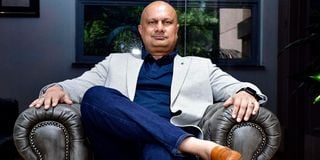
SBM Bank CEO Bhartesh Shah poses for a photo after an interview at the banks offices located along Riverside Drive on November 14, 2025.
Photo credit: Francis Nderitu | Nation Media Group
I would never take out a loan to buy a car if I can't buy it on cash, because it depreciates as soon as it leaves the showroom. But if I was borrowing to invest in something that's going to generate income, I would always do that. So, I would never borrow for consumption, but I would borrow for growth.
What is your life's big question now at 52?
I'm not asking any questions.
None at all?
No question. You know, a lot of people talk about purpose and all of that. Right. But that comes from within you.
Are you at peace?
I am at peace with myself.
What is being at peace with oneself?
Is your mind calm? In the sense that if you can imagine the temperature of your mind—not your brain, but your mind—is it a blue colour? Is it at a cool level? Are you troubled? Are you perturbed? Do you have regrets? I don't. I am at peace. This thing of 'coulda, woulda, shoulda'—it doesn't come into my mind right now.
Is there anything you're struggling with at all right now?
I mean, look, for me, I wouldn't say it's a struggle, but it's always a question of balance. You want your children to be much better than you and more successful than you.
You want to help guide them as well, but at the same time, they have to walk their own journey. So, it's always a question of: are you helping them or guiding them as much as you can, or can you do more?
What's your definition of success?
Peace, travel, happiness and friendship. Peace, which we talked about—it's having a calm mind. Not brain, but mind, you know, the soul, the inner bit of you. Travel, because I love observing people and different cultures. Thankfully, my wife and I have traveled a lot.
I think we counted last week—we've been to about 52 countries, and we love it. Friendship. I have very few people I can call true friends, but they are true friends. I have a lot of acquaintances, but friendship is the ability to have genuine, deep conversations without judgment. That's important for me.