Time flies with great content! Renew in to keep enjoying all our premium content.
Prime
How mascots have become big business in Nairobi
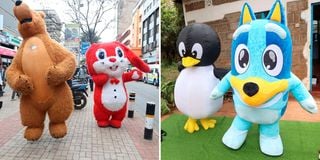
Mascots from Innys Fashion (left) on Tom Mboya Street in Nairobi and from Birdie Mascots in Kikuyu, Kiambu County, pose for a photo on September 23, 2025.
A few years ago, a man dressed as a sad boar and dancing would not have been considered a business that would earn millions of shillings in profit. However, as more Kenyans become entrepreneurial, the mascot craze has swept across towns, with wacky characters being hired to lure visitors and investment.
You have seen them in shopping malls, hotel play areas, or even at a children’s party. The brightly coloured mascots spread joy, but they have also become a source of income for many.
Carol Nyaga, the founder of Birdie Mascots Supplies, is one of the entrepreneurs who has found success in this business.
She started the mascots business in 2013. “I had seen mascots being used abroad, mostly in the US and Europe, and I thought, why don’t we have something like this here?” she says.
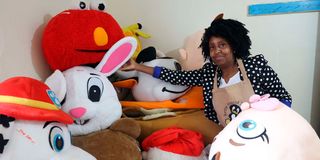
Carol Nyaga, owner and founder of Birdie Mascots and Entertainment, arranges costumes at her business premises in Kikuyu, Kiambu County, on September 23, 2025.
Photo credit: Evans Habil | Nation Media Group
What began as a simple idea soon grew into a thriving business that today serves both families and corporations across the country.
Ms Nyaga’s fascination was not only with entertainment but also with the power of marketing. “I was very interested in B2B (business-to-business),” she explains. “I wanted a product that businesses could use to connect with their customers in a fun and engaging way. A mascot was perfect.”
She reached out to factories in China, not knowing much about how mascots were made or shipped. She designed her first mascot for herself, a cheerful penguin that became the face of her brand, and sent the samples to China for manufacturing. The cost of producing a good-quality mascot, she learned, started from Sh69,000.
“The penguin was my trial-and-error mascot,” she says. “It was how I learned the ropes of customising and shipping.”
Once the penguin mascot landed in Kenya, Ms Nyaga wore it herself to events to see the reaction. “I realised very quickly how much joy mascots bring,” she says. “Children lit up, adults smiled, and people just wanted to take pictures.”
That moment confirmed she was on to something much bigger than just costumes. From there, she expanded Birdie Mascot Supplies and started offering two services.
The clientele
The first is the entertainment side, where she rents out mascots for birthdays, mall events, hospitals, and hotels, often setting up children’s play areas as part of the package.
“I charge Sh5,500 to hire out a mascot. The cost goes up to Sh8,500 if it is outside the city,” she says.
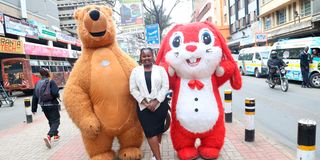
Carol Nyaga, owner and founder of Birdie Mascots and Entertainment, poses next to a performer dressed in a mascot costume at her business premises in Kikuyu, Kiambu County, on September 23, 2025.
Photo credit: Evans Habil | Nation Media Group
Having learnt how to design mascots, she has also found business in customising for companies.
Over the years, she has had clients including Farmer’s Choice, Kenchic, and corporates to schools, malls, and private families. Corporate clients, Ms Nyaga says, remain the backbone of the business. “This is still where the biggest demand comes from,” she says.
From running the business solo, Ms Nyaga now employs 19 casual workers who wear the mascots at events. “Most of them are young, starting from the age of 23. You need to be energetic and vibrant to do this kind of work,” she says. “The costume is heavy and hot, and you can’t talk, so you have to rely on animation and stamina.”
Part of what makes mascots so effective, Ms Nyaga says, is their ability to touch emotions and can outperform traditional flyers or ads because people are naturally drawn to them.
“That’s why even adults smile or take selfies when they see one. A flyer can be ignored, but when you see a mascot, you want to approach it. You want to take a picture. And if it’s branded, that company gets visibility immediately.”
Today, Ms Nyaga not only serves Kenya but also exports to Uganda, Rwanda, Tanzania, DRC, and even as far as Switzerland, thanks to referrals and social media boosting visibility.
Big business pays off
Winnie Jelagat is another entrepreneur in the mascots business. She is the founder of Innys Mascot.
Winnie Jelegat, founder of Innys Fashion, poses at her shop along Tom Mboya Street in Nairobi on September 23, 2025.
Photo credit: Evans Habil | Nation Media Group
Ms Jelagat launched the business mid-2023. “Mascots are becoming part of birthdays, corporate events, and even everyday marketing,” she says.
She began small, with three mascots. Almost immediately, business picked up. “The day my mascot landed in Kenya, it got a client the next day,” she recalls. It was a corporate booking at a club.
Today, she owns more than 10 mascots, with designs ranging from playful characters to larger-than-life costumes. “I imported at Sh60,000 for the big one,” she says.
And the business is paying off. She hires out the mascots for between Sh6,000 and Sh9,000, depending on if it is a half a day or a full day.
Her client base has grown from corporates to schools and families. “Even for a baby’s first birthday, people want mascots,” she says.
From running the business solo, she now has five employees. Social media has been a huge driver of her success. “One funny thing,” Ms Jelagat says, “all my clients are from TikTok and Instagram. All of them. That’s how people discover us.”
Mascots from Innys Fashion (left) on Tom Mboya Street in Nairobi and from Birdie Mascots in Kikuyu, Kiambu County, pose for a photo on September 23, 2025.
Photo credit: Evans Habil | Nation Media Group
Esther Kasoha, a 29-year-old, is also in the mascots business.
“We were inspired by what we saw abroad,” says the field manager at Mascot Kenya. “In other countries, mascots are not just for children’s birthdays. They are part of brand activations, marketing campaigns, and even corporate launches. We wanted to bring that same professional standard to Kenya.”
The business took off quickly, from supermarkets and weddings to school fun days and product launches.
Millicent Cherotich, 30, who runs customer care, says, “Some clients want a mascot just to hype up a supermarket aisle, others need them all day long for weddings or corporate roadshows. We created packages that fit every occasion.”
Sustainable income
Apart from the investors, there are those who have been hired to wear the mascot suits. At 22, Livingstone Okumu is one of the dancers. Every weekend, he slips into oversized heads and furry paws, transforming into beloved characters that make strangers smile.
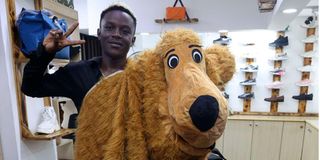
Livingstone Okumu poses with a mascot costume at the Innys Fashion shop along Tom Mboya Street in Nairobi on September 23, 2025.
Photo credit: Evans Habil | Nation Media Group
“It takes a lot of energy,” he admits, sweat and satisfaction in his voice. “Two or three hours inside the costume feels like a workout. You need stamina, confidence, and vibes.”
On long days, he can spend up to eight hours performing, with only short breaks to recharge before stepping back out to spread more happiness.
“This job sustains me,” he says.
Just like him, 22-year-old Eunice Wangare, who graduated with a degree in Journalism, is now a mascot professional dancer. “I thought, why not try. It’s fun, it’s entertaining, and it pays.”