Time flies with great content! Renew in to keep enjoying all our premium content.
Prime
How Makueni textiles maker broke into lucrative Europe, US markets
Tosheka Textiles co-founder and associate director Nyokabi Mwangi during an interview at her home (left), and handwoven shawls and mats by Tosheka Textiles on display in Nairobi on November 4, 2025.
Photo credit: Wilfred Nyangaresi | Nation Media Group
When Tosheka Textiles first set up in 2004, it was not structured as a commercial outfit. At the time, the venture was working as a community-based organisation teaching women in Makueni how to spin yarn from raw cotton grown in the area.
The intention then was to create skills, empower rural households, and demonstrate to the community that even low volumes of cotton could have value once processed.
Over time, they shifted into a fully-fledged textile business, producing premium fabrics and customised fashion pieces.
Today, Tosheka Textiles, co-founded by Nyokabi Mwangi and her aunt Lucy Lau Bigham, has shifted focus to modernising production systems, growing a business-to-business client base, and scaling sustainable fabric production capacity.
“As we progressed, we realised we needed to professionalise the business,” says Ms Nyokabi, who now serves as the production’s Associate Director.
Tosheka Textiles co-founder and associate director Nyokabi Mwangi during an interview at her home in Nairobi on November 4, 2025.
Photo credit: Wilfred Nyangaresi | Nation Media Group
“Back then it was community driven. People brought whatever they could and contributed labour. But for textiles to be viable, you have to standardise. You have to pay for items at production stage. You have to create consistent supply. That transition wasn’t easy, but it was necessary.”
The shift into commercial production fully took shape in 2011. The founders decided that instead of waiting for women to produce fabrics then attempt to market later, Tosheka would buy fibre and pay the women directly for spinning.
This, Ms Nyokabi says, guaranteed income at point of production, raised quality expectations, and set the business onto a more formal contract and delivery footing.
“When we commercialised, we had to define quality and create clear specifications. This was a big lesson. A lot of businesses collapses because the product is not consistent. In this business, what the market pays for is not the story, it’s the quality,” she explains.
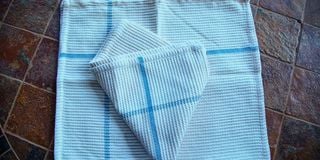
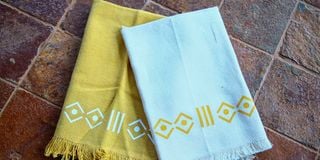
Handwoven kitchen towels by Tosheka Textiles on display in Nairobi on November 4, 2025.
Photo credit: Wilfred Nyangaresi | Nation Media Group
Tosheka produces both fabric by the metre as well as finished premium garments. Clients bring their own designs or choose from Tosheka’s catalogue, with most of the customers being designers, boutique fashion houses, decor and interior players, as well as high-end lodges and hotels.
However, despite Kenya being a cotton-growing country, one of the constraints the business has faced is the scarcity of enough skilled weavers who can produce high standard textile output. Ms Nyokabi says the pool is still very limited, even after years of community skill investment.
“That is still one of our biggest constraints. The artisan base is not yet large enough. We have trained many, but to replace the older, traditionally skilled artisans is a huge challenge,” she says.
“This is a skill that needs protecting. Young people need to see weaving as a dignified career. If we lose the skill pipeline, the industry declines.”
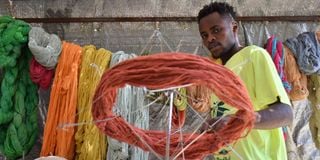
James Wambua winds yarn into a ball at a small textile workshop in Kiatine Village, Makueni County, on November 5, 2025.
Photo credit: File | Nation Media Group
As part of diversifying the production range and elevating the value proposition of their fabric, Tosheka also does silk, a move Ms Nyokabi describes as a breakthrough in their evolution.
“Silk was a turning point. It opened up the ability to serve a different level of product demand; luxury, high-end, premium design work,” she says. “It allowed us to target a stronger market segment that values natural fibre, longevity and unique textures.”
Currently, 70 percent of Tosheka’s clients are local while 30 percent is export. In the next two years, Mr Nyokabi is targeting a 50/50 balance, especially as the business expands capacity to serve more bespoke designers and more specialised interior clients.
In the run to this target, Tosheka is now focused on getting new machinery for increased production.
“We want to modernise while protecting heritage. If we lose the craft, we lose what makes this special. We cannot replace artisanal feel with industrial mass production. People who buy our fabric buy the uniqueness and the texture,” she says.
While the sustainability tag is an advantage, it also raises the cost curve. Tosheka selects premium natural fibre inputs, and Ms Nyokabi says this means the company spends more on raw materials compared to other mass production garment or fast-fashion aligned players.
“Our cost base is high because we invest in quality. It affects our pricing. It affects our margins. But premium textile buyers understand what they are paying for,” she says.
Handwoven table mats by Tosheka Textiles on display in Nairobi on November 4, 2025.
Photo credit: Wilfred Nyangaresi | Nation Media Group
Running the business with a co-founder who also doubles up a family member has also shaped how the two make decisions, pace growth and share operational roles. Ms Nyokabi describes herself and Ms Bigham as extremely complementary in execution style.
“We have different working approaches but we are very aligned in purpose. That balance is what has kept the company stable,” she says.
“Partnership is one of the most important things in business. It has to be built on trust but also on realistic expectations and shared clarity.”