Time flies with great content! Renew in to keep enjoying all our premium content.
Prime
How Kenol, a stopover town, became a magnet for wealthy homebuyers
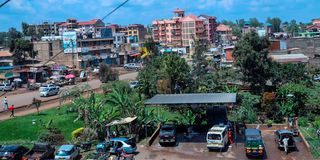
A view of Kenol town in Murang’a county on November 10, 2025. The town continues to grow as improved infrastructure and new businesses attract more residents.
There was a time when Kenol town had just a market and a petrol station. Years later, the once sleepy town has attracted the likes of Carrefour, Quiver and Java.
When Annabelle Njambi Wamunyu and her husband first opened a small convenience shop at a petrol station in Kenol nearly 12 years ago, it was just a quiet roadside rest stop for motorists on their way to Murang’a or Nyeri.
“Kenol was almost empty. At that time, even selling a gas cylinder in a month was impossible. People would come, ask the price, and leave. We didn’t have that kind of clientele back then,” she says.
Their mini mart and a small restaurant, known as Magomano, were part of a simple experiment of combining fuel sales with eatery and a small shop, copying what bigger petrol stations along the highway were doing.
Mrs Wamunyu says business was slow at first; however, as more travellers began stopping at Kenol for meals and short breaks, the couple spotted a bigger opportunity.
“People going for weddings, burials, and other ceremonies would stop at Kenol. Soon, our restaurant became busier. We realised the mini-mart was also picking up, and we needed space.”
They pulled down the service bay, car-wash, and petrol offices to create what is currently County Supermarket, a three-storey retail hub and one of the oldest surviving supermarkets in the area.
“We started with only the ground floor, then two or three years later, we added the other floors as business grew.”
The name change, she adds, was very intentional.
“We wanted a name that could fit anywhere in the country. When counties were being introduced, we said, Let’s call ourselves County Supermarket because it represented our ambition to go beyond Kenol,” she says.
She is among the many people who have reaped the benefits of Kenol’s growth over the past decade.
“Today, Kenol has great potential. We have seen estates coming up and many other businesses setting up. Ten years ago, no big retail chain would have looked at Kenol, but they are all here because of the growth.”
That boom, Mrs Wamunyu says, has translated into a more diverse customer base.
County supermarket Director Annabel Njambi Wamunyu during the interview at her office in Kenol, Murang’a County on November 10, 2025.
Photo credit: Lucy Wanjiru | Nation Media Group
“Before, most of our shoppers were travellers, but now we serve construction workers, and families who have settled here. People who used to pass through now call Kenol home,” she says.
The retail expansion has also pushed up commercial rents, which has been a major sign of business confidence.
“When we started, many buildings couldn’t attract tenants, so rent was low. However, small shops that are not along the highway are going for between Sh30,000 and Sh50,000, depending on the landlord and location. Along the highway, rent is even higher; if you move a bit inside town, it’s cheaper.
“Every week you see someone opening a salon, a hardware store, or a boutique,” she adds.
Beside her supermarket, Mrs Wamunyu owns an acre of land where she operates a car wash. She recalls buying half of the property years ago for about Sh700,000, which, when she decides to sell today, she says it will fetch almost Sh30 million, and the whole acre could go for even Sh100 million.
“Kenol is still a town to watch. There’s land, there’s space, and there’s energy. More people are coming in, and that means more business. If you set up something here today and do it right, you’ll grow with the town just like we did,” Mrs Wamunyu says.
When the BDLife visited, the first impression was of a fast-growing town. Modern shopping centres and well-known eateries stand along the main road, giving it a touch of urban life. However, moving further inside, there is no formal market, no designated stage for matatus, every activity seems to be cramped up.
Just like many unplanned growing towns, Kenol marketplace is stretched along the roadside where grocery vendors sit under their old, faded umbrellas shielding their fruits and vegetables from the sun.
Here, they sell potatoes, tomatoes, bananas, and everything one would expect to find in a market.
In between the commercial stalls, there are small iron sheet shanties with some used as shops, while others are serve as stores.
Matatus have no proper stage either, so they stop anywhere they can find space as they pick and drop passengers.
Consequently, commercial businesses including hardware stores, petrol stations, grocery stalls, and small shops, also sit close to each other, all competing for space and customers. The buildings are packed extremely tightly with commercial and residential units, almost blending into one another.
A view of Kenol town in Murang’a county on November 10, 2025.
Photo credit: Lucy Wanjiru | Nation Media Group
That main road separates Maragwa and Kandara constituencies, and it is filled with trucks and vehicles passing through.
Real estate boom
Unplanned or not, the town that once had a single bank and a few kiosks has turned into a real estate magnet that is drawing developers, homebuyers, and businesses in equal measure.
Anthony Kiragu, the director at Wiklund Property, a real estate firm, says that back then, Kenol was just a rural town. Land was cheap, but investors were few, which made development minimal.
He recalls when a half-acre plot in Kenol, which was a few metres from the tarmac road, could cost around Sh400,000.
“Today, the same half-acre is going for between Sh10 million and Sh15 million, depending on location,” he says. “Even a single plot that we sold in 2010 for about Sh280,000 now costs more than Sh2 million. The prices have gone up, a lot.”
According to Mr Kiragu, Kenol’s transformation is driven by its strategic location and improved infrastructure.
“Kenol is a gateway to the Mount Kenya region. The dual carriageway of the Thika Superhighway and the Kenol–Marua road have opened up the town. They've made movement from here to Nairobi very convenient. You can live in Kenol and still work in Nairobi without much traffic.”
He adds that reliable amenities like water, electricity, and road networks have made the area attractive for both investors and residents. “When accessibility improves, prices follow. That’s exactly what we’ve seen in Kenol,” he says.
To illustrate the pace of growth, Mr Kiragu points to what he calls “visible markers of progress.”
Developers and homebuyers
Kenol’s real estate boom has also drawn a new class of investors. “The buyers cut across,” says Mr Kiragu. “We have companies coming in to set up factories and agro-processing units, we have individuals building residential homes, and even a few speculators, though not as many as before.”
He notes that, unlike a decade ago, most buyers now build immediately after the purchase of land. “People don’t just buy and wait anymore. You’ll find someone buying land and starting construction the next month. Whether it’s a home, a block of apartments, or a factory, they’re building,” he says.
That surge in construction has also had a ripple effect. “Fifteen years ago, you could count the buildings in Kenol; today, you can’t. We have so many contractors, real estate firms, and even valuers. Back then, we had only two valuers; now, there are dozens. The number of transactions happening here every month is unbelievable.”
Additionally, the housing market has mirrored the land price boom. “By then, you could rent a two-bedroom house for Sh7,000 to Sh8,000,” says Mr Kiragu. “Today, modern units go for between Sh25,000 and Sh35,000, depending on the location. Along the highway, prices are higher, but once you move a bit inside, they drop slightly.”
Kenol Muranga Business community Chairman James Githui Gachuru during the interview at his hardware in Kenol, Muranga on November 10, 2025.
Photo credit: Lucy Wanjiru | Nation Media Group
“People are building modern homes, and tenants are willing to pay more for comfort and accessibility,” he adds.
Growth challenges
Still, the growth has not come without challenges. “Regulatory approvals take time, and infrastructure is becoming overstretched. You’ll find delays with power connections or road access because the demand has outpaced capacity. Resources are overwhelmed.”
“Half an acre, about four kilometres from the tarmac, goes for about Sh2 million. A plot along the roadside cut by 40 by 80, although we have 50 by 100, can go from Sh8 million to Sh10 million,” Mr Kiragu adds.
“People saw the potential and moved in.”
James Githui moved to Kenol 34 years ago. He says it was nothing but open land and trees. “ There were no buildings, no businesses, just open land,” he says.
Currently, he serves as chairman of the Kenol Business Community, overseeing a network of traders in what has become Murang’a.
County’s fastest-growing commercial hub. “Kenol’s growth has been very evident. Many people have moved into the area with investment plans because of the proximity to towns like Murang’a and Thika. The junction itself has travellers dispatched to different places, and that impression has brought a lot of people.”
Mr Githui runs a hardware store and several commercial businesses in the town. He remembers when the plots were large and cheap.
“The demarcation then was in half an acre or a quarter acre. Most people were just beginning to buy land, and prices were very low.”
Currently, modern buildings line the highway, alongside supermarkets and bars that have opened, and new companies have created jobs for residents. “There are new companies that have created employment, which adds to the population of the place. And land fraud cases are also minimal,” he notes.