Time flies with great content! Renew in to keep enjoying all our premium content.
Prime
How industry and TVETs are teaming up to bridge skills gap
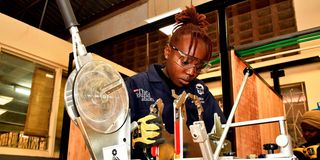
Velma Ondeche, a student studying a plumbing course at Don Bosco Boys Town Technical Institute, operating a butt welding machine at the school located in Karen on September 13, 2023.
Kenya stands at the edge of a new kind of revolution, one powered not by politics or protest, but by skilled hands, sharp minds and a generation determined to build its future.
Across workshops, construction sites and energy labs, a quiet transformation is taking shape. Young people once dismissed as “unemployable” are finding new confidence, new tools and new purpose, thanks to a bold effort to align education with industry.
For years, Kenya’s technical and vocational training system produced thousands of graduates each year. Yet employers complained that most lacked the practical experience needed in the workplace. Projects stalled, costs soared and productivity dipped.
Employers in the construction sector describe the gap as an everyday challenge.
“We spend at least three extra hours daily retraining graduates on basic site work,” says Manesh Shah, Director of Relcon Power Systems. “It costs companies close to Sh20,000 a month per trainee.”
At Realtech Plumbers, Director Nicholas Komu echoes that frustration. “Most new hires take longer to deliver because they’ve never worked under real construction deadlines,” he says.
“The discipline, speed and precision needed on-site can’t be taught in a classroom.”
But even as industries voice concern, a new approach is quietly rewriting the script.
SwissContact’s PropelA Dual Apprenticeship Programme is one of the most promising innovations in Kenya’s technical education.
Instead of sending students into the world after graduation, it places them directly in the workplace as they learn.
Students are jointly interviewed by schools and partner companies, then begin a rotation system, three weeks of practical industry training followed by one week of classroom instruction.
The National Industrial Training Authority (NITA) oversees assessments and certification to ensure graduates meet global standards.
“The aim is to merge theory and practice from day one,”said Sharon Mosin, the Country Director of SwissContact Kenya. “When students learn and work at the same time, they develop confidence, skill and employability in equal measure.”
The results speak volumes: 80 percent of apprentices are retained by their host companies after graduation. This model mirrors Switzerland’s globally admired apprenticeship system, where industry and government share responsibility for training.
In Kenya, the firm partners with Don Bosco Technical College and more than 50 private firms, who pay stipends and school fees for trainees while offering mentorship through certified trainers.
“The future of Kenya’s economy lies in skilled hands,” says Ms Mosin “Our goal is simple, to move from learning to earning, so that every graduate leaves school ready for real work.”
Kenya’s rapid industrialisation has outpaced the capacity of its public Technical and Vocational Education and Training (TVET) institutions. For decades, schools focused more on exams than on experience. The result was a generation trained to memorise not to make.
“Our education system has trained for exams rather than the market,” Ms Mosin explains. “Industry and schools haven’t been speaking to each other. Most TVETs remain theory-heavy, and real work experience is left to chance during short attachments.”
With nearly seven in 10 Kenyans under 35, the stakes could not be higher. A 2020 Ministry of Labour survey found that more than half of firms in the informal sector struggle to find workers with essential technical skills, particularly in plumbing, electrical work and logistics.
The Federation of Kenya Employers’ latest report paints a similar picture: demand for skills in transport, logistics, electrical and construction trades is soaring, yet these remain the hardest positions to fill. In some sectors, up to half of technical vacancies stay open, stalling projects and driving up costs.
Among those benefiting is Dorothy Wando; a professional plumber at Realtech Plumbers Ltd. Her story captures what’s possible when opportunity meets preparation.
“Before my apprenticeship, I had never handled a PPR welding machine,” she says, smiling. “Now I can install systems on my own, understand fittings and even advise clients on the best materials.”
Ms Wando says her journey gave her confidence, skill and pride, three things she never associated with plumbing before.
“I now see my work as a profession, not just a job,” she adds. “It’s changed how I view myself and how others view TVET graduates.”
Her story is one of many reshaping perceptions about technical work. Once dismissed as a fallback option for those who didn’t make it to university, trades like plumbing, electrical work and carpentry are gaining respect as paths to stable, skilled and well-paying careers.
“We’re building a generation that sees technical work not as a last resort, but as the foundation of national development,” says Tobias Olando, chiefr excutive of the Kenya Association of Manufacturers. “These programmes are creating artisans who will power Kenya’s next wave of growth.”
Private sector players are also pushing to make the sector more inclusive. Nearly a third of the programme's trainees are now women, a significant step in industries that were once male-dominated.
“We dropped partnerships with schools that refused to admit female students,” Ms Mosin says. “Now, our female graduates mentor new trainees. It’s about creating role models and proving that skill has no gender.”
As Kenya moves toward renewable energy and digital transformation, the skills gap is shifting too. The programmes FutureFit project trains youth for new opportunities in e-mobility, battery maintenance and smart-energy infrastructure, skills essential for a sustainable economy.
The organisation is collaborating with NITA and the Association of E-Vehicles in Kenya to develop a national curriculum for electric mobility mechanics, covering two-wheelers, four-wheelers and hybrid systems.
“If we don’t prepare technicians for the green economy, we’ll repeat the same mistakes of the past,” Ms Mosin warns. “The time to train for tomorrow is today.”
Private firms are already showing enthusiasm. Some companies have offered to fund entire training workshops within public TVET institutions rather than building their own schools, a model of partnership Ms Mosin believes is key to sustainability.
“TVET and NITA must work under a single vision,” she says. “When that happens, we won’t just produce graduates, we’ll produce problem solvers.”
With Kenya’s youth bulge and accelerating industrial ambitions, the country’s future rests on one question: can it turn its people into its greatest advantage?
The answer, as these stories show, is a growing yes. Every apprentice retained, every workshop upgraded and every stereotype shattered brings Kenya closer to a workforce that can compete and win on the global stage.
“The question isn’t whether Kenya can compete internationally,” Ms Mosin says. “It’s how fast we can prepare our people to lead that competition.”